CONTEST Buddy's Contest

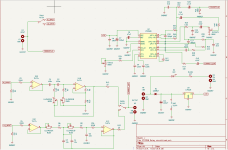
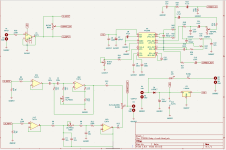
Ok ive updated the Schematic pertaining to the issues above. One question i have is should i make a VREF 4.5V connected to the op amp instead of 9V? Im asking just in case that would be a problem for the PT2399 even though it is connected to the voltage regulator.

PT2399 Delay.png
 
Last edited:
Check out other reverb & echo designs. It is common to drive a PT2399 that runs on 5V from an opamp that runs on 9V.

I have some tips on the design, but I don't want to break any contest rules by offering advice. Sandy, can we get a ruling here?
 
It looks like you're running a delay in parallel with either a hi-pass or low-pass filter, right? You might want to add a blend control for mixing the delay and filter. For that matter, you might want to use a blend control between the two filters instead of a switch.

The delay has a fairly low input impedance. You probably want to buffer the input to the delay.

If you are clever, you can use one buffer to feed both filters and the delay.

You don't need to switch the inputs to the filters. It's ok to feed signal to both filters and only switch the filter outputs.

You can tune a 2nd-order active filter with a single pot, you don't need duals. The Q changes a bit when you sweep, but the Q change can be minimized. LTSpice will show you what you'll get.

 
You can tune a 2nd-order active filter with a single pot, you don't need duals. The Q changes a bit when you sweep, but the Q change can be minimized. LTSpice will show you what you'll get.
Yep, I do that in many of my preamp designs. That Q change can actually be a useful feature rather than a drawback in some cases too, say when you have a typical tone control section before or after the filter and want to leverage the interaction between sections. You can get results kind of along the lines of the Pultec/Equilux thing in some cases, and IME LTSpice or other modeling software is a huge help in getting good results when you start to go off the cookbook page in that way.
 
Last edited:
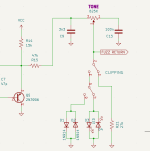
I think I'm going to ditch the Sag knob, and have different clipping options along with no-clipping. I really like the sound of it straight through. I put a resistor there to keep the volume in-line with the diodes because it's several db louder.

Does anyone really use or like Sag? I don't know. I could probably squeeze both on, but there's already a lot going on for my first design.

1675705065978.png
 
Then you might as well save two parts & remove D2 & D4. They will never turn on because the DC current from R14 & R15 keeps D1 & D3 conducting most of the time while D2 & D4 conduct none of the time.

Those tone caps do not compensate for the absence of a DC blocking cap. If it sounds they way you like, that's all that matters. You might want to at least try a DC blocking cap just to hear the difference.
 
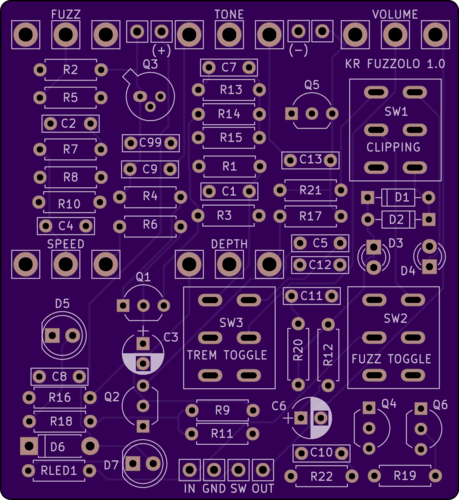
I went ahead and added that as C99 and ordered a few boards from OSHpark. We'll see if it works!

e3c2580151087fb177859340eb4bdb74.png
 
Does anyone really use or like Sag? I don't know. I could probably squeeze both on, but there's already a lot going on for my first design.
I have the SAG pot on my modded BossTone. It varies the harmonic content and will gate at extreme settings. There's a sweet spot; I set it there and leave it.

NB: The SAG pot will behave differently (correctly?) if you add the DC block cap mentioned above.
 
Right on, thanks. Maybe I'll add it back and rearrange the switches on a version 2 or remove the clipping options like I had originally.
 
Back
Top