What’s on *YOUR* workbench?

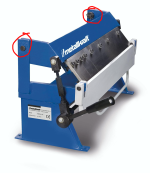
the brake I used had a wheel on the side for adjustment that you could do very easily, if the brakes you guys are using don’t have that I could definitely see that being a pain.
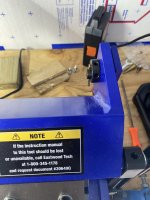
There is a wheel but it has notches in which you need to insert a screwdriver or such to then adjust that wheel but before you do so you need to loosen headless hex screw that keeps that adjustment secure....
IMG_2326.jpeg
 
the brake I used had a wheel on the side for adjustment that you could do very easily, if the brakes you guys are using don’t have that I could definitely see that being a pain.
In order to move the fingers I have to loosen two locking screws and adjust two spoke wheels (one per side, they move independently). And measure finger to table edge distance after every move.

1702659615157.png
 
There is a wheel but it has notches in which you need to insert a screwdriver or such to then adjust that wheel but before you do so you need to loosen headless hex screw that keeps that adjustment secure....
View attachment 63295
Well it’s not as convenient as what I was talking about but at least it has some adjustment, and if you are just after nominal bends with the same thickness material everytime you can just set it and forget it
 
Well it’s not as convenient as what I was talking about but at least it has some adjustment, and if you are just after nominal bends with the same thickness material everytime you can just set it and forget it
The problem with setting and forgetting it is that only works for bends that all have the same angle...once you start adding different angles to the flanges the bend radius adjusts accordingly... so its never just one bend radius :ROFLMAO:

In terms of how my brake works to adjust the bend radius, its definitely my least favorite part of its operation lol
 
Last edited:
my least favorite part of its operation lol
The thickest material I ever work with is 063 aluminum, so I have mine set up so it won't mess that up, and that's where I leave it for everything. I'm gonna see how it likes bending aluminum with a steel finger cover, and I'll open it up a little if it's a problem, but I don't normally see a reason to be chasing it back and forth.
 
The thickest material I ever work with is 063 aluminum, so I have mine set up so it won't mess that up, and that's where I leave it for everything. I'm gonna see how it likes bending aluminum with a steel finger cover, and I'll open it up a little if it's a problem, but I don't normally see a reason to be chasing it back and forth.
So thats exactly the gauge i work with too. The reason i find adjusting the bend radius useful for every bend is because ive noticed that if i didnt follow my bend guides the outer bend radius would not be as sharp as it could have been...of course this is situational depending on the actual bend angle.

Example: If i make a 90 degree bend that same bend radius would not suffice for a bend at lets say 120 degrees. In fact it would have to be much tighter in order to get the same quality bend as the 90 degree angle...Idk if im getting ahead of myself, you know im pretty new to this, Im just trying to convey my experiences in the past with these enclosures!
 
Last edited:
in order to get the same quality bend
I’m sure what you’re doing makes sense, but sometimes I choose to sacrifice quality a little in the interest of consistency. If I never change the setting, that’s one less variable to chase in trying to make something repeatable. Also that adjustment is a pain in the ass.
 
I’m sure what you’re doing makes sense, but sometimes I choose to sacrifice quality a little in the interest of consistency. If I never change the setting, that’s one less variable to chase in trying to make something repeatable. Also that adjustment is a pain in the ass.
This makes a lot of sense, I often spend a lot of time making one bend...
 
Love reading about this. You all should start a dedicated enclosure manufacturing thread. Hopefully all this good info doesn’t get lost in the depths of this thread!
I was thinking about this as I was reading the conversation, but kind of in a broader sense. I'm terrified that the intensification of internet monetization is going to eventually completely smother forums (because I'm a librarian and my anxiety of how modern information systems have a tendency to strangle freely distributed information occupies large portions of my mental space). The information in this thread alone has helped me wrap my head around a bunch of different concepts that I simply wouldn't have the patience to learn about from a technical book or manual (what with the conversational tone, brief descriptions, and clarifying follow-up). I was looking at what's archived in the Wayback Machine, and there's a lot, but it pains me to think about how much knowledge is being lost on the more obscure forums as hosting fees don't get paid and domains get sold off.

A community like this is such a stark contrast to something like Reddit (or even Facebook), where misinformation regularly gets perpetuated by their weird voting system.

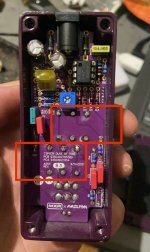
I'm also surprised by how much of that Duke of Tone is through-hole. I'm assuming they're saving money on assembly by not using as much solder...
 
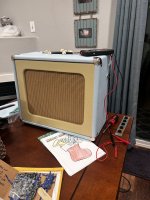
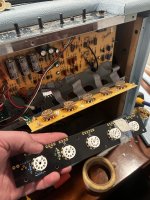
I don’t realize the blues jr had that many tubes. I’ve never actually opened mine up.
I would recommend replacing the tube board if you’ve got a blues jr. If I had one I would. It’s pretty quick and easy. I like this one I bought off eBay from a uk seller has a bias adjustment trim. But I e replaced a fried one before
 
Back
Top