Adventures with the dirty Bassman.

Locrian99

Well-known member
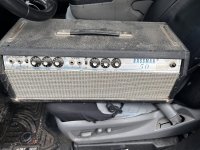
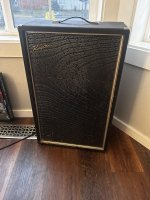
So I posted in the what’s in the the work bench forum about my recent find on Facebook marketplace.

Basically guy posted this for 50$ along with this B28AC632-306E-4A9D-AF8B-F3A40919E54F.jpeg
B6C4D1E2-6F96-4F31-B15B-0BEC42B74EC6.jpeg

I’ve done some limited amp work. Recapped a blues jr, replaced blues jr tube boards. Diagnosed some problems and repaired a jcm 900 etc. figured I’d document my adventure with thing. Any suggestions are highly appreciated. I probably know enough to be dangerous to the amp.

So first I was told it didn’t power on. Found that the fuse was completely roached replaced it and we have power.

Signal through it seems quieter than I would expect.

volume pot has some pops and a scratches as turn it. With some much louder than the signal pops.

Stopped and grabbed some deoxit, and have a new power cord coming today.
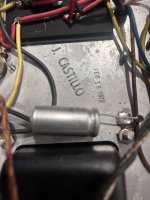
 
Opened it up today to replace the power cord etc.

Was told it was a 76
CE2B3245-5A61-4BF5-98AF-06BD57FF6B31.jpeg 0200F570-8E07-4447-AD7B-349569640FD4.jpeg A28F8E43-7BEA-49FE-ABB2-DB2B5206F4D3.jpeg

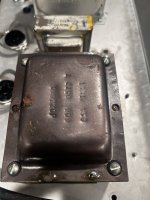
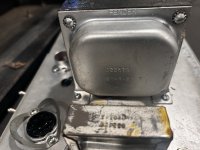
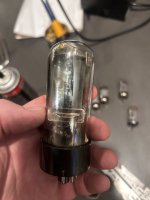
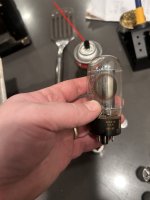
Has an RCA and triad power tubes in it. Both show this not sure if this is normal.


FBB967B0-E95C-4F11-AA40-BD3BBDA622DA.jpeg 96FC3BF8-C287-49CE-98D1-E9046462046D.jpeg

Also I think it has a bad pre amp tube on the bass channel as there is a sort of cascading sound as best I can describe it only on that side.
 
I was told the amp hadn’t been played in 40 years.

Basically went in a closet. Got taken out didn’t work back in the closet.

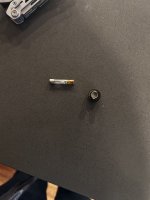
This is what the fuse looked like.
ACC2185B-0216-4546-A5FF-277B89335A16.jpeg
 
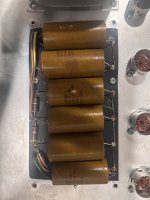
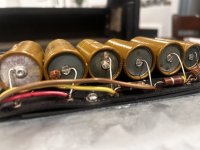
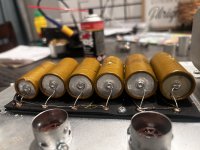
Those filter caps need to be replaced with some shiny new F+Ts. See that brown futz oozing out? Classic sign of being about to blow. Check the value of the dropping resistors between them when you do it - they have some large voltages across them and often drift in value. I would recommend using metal oxide 2W resistors in the doghouse.

The 100K resistors on the board which go to the plates (plate load resistors, dropping resistors, whatever you want to call them) should be checked as again, they have significant voltages across them and will often drift radically. As a matter of course I would strongly recommend changing out all electrolytics - those white Mallorys will probably have to go. And I'm sure you noticed the broken cap in the tonestack of the first channel! If it was my amp I would be very tempted to replace the ugly blue caps with Mallory 150s.

Crackling on a volume pot can be just a dirty pot or it could be DC on the pot from a leaky cap.

You can generally measure most of the resistors while in circuit but the caps need to be disconnected to measure values. Check that every single ground is good!

This sounds like a lot to do but it's not really. As long as the tube sockets still have decent tension there probably isn't too much to do before you have a great amp. Don't be concerned about that blob of silvery stuff on the side of the power tubes. It's just all the stuff taken out of the gas inside by the getter when the tube was manufactured - usually you see it at the top of the tube but sometimes the getter is on the side. It's if that silver stuff goes white you need to pay attention because that means the tube has lost vacuum.

If you can tidy up the wiring and get rid of a lot of excess you will have a lot lower chance of parasitic oscillation and you won't need the little caps that you don't see in earlier versions of the Bassman. I find it quite therapeutic to disconnect the wires from the tube sockets and snip off the excess before reconnection. Just keep grid wires (preamp pins 2+7) away from filament wires and make sure that plate wires (preamp pins 1+6) cross grid wires at 90° if they need to cross.

This should be a fun project and you will likely end up with a great amp.
 
volume pot has some pops and a scratches as turn it. With some much louder than the signal pops.
Pops and scratches in a 50 year old amp are to be expected. The deoxit should help with that.

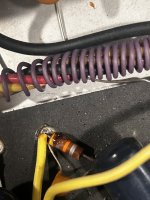
noticed this resistor looks like it’s seen better days.
That definitely looks suspect and should probably be changed.

All in all, the thing cleaned up pretty well. Obviously there is some corrosion from the original soldering flux, but nothing out of the ordinary. The tubes do seem suspect, which is also not unexpected in a 50 year old amp. I don't see any obvious leakage around the caps, but that would not be uncommon either in an amp of that age.
 
Those filter caps need to be replaced with some shiny new F+Ts. See that brown futz oozing out? Classic sign of being about to blow. Check the value of the dropping resistors between them when you do it - they have some large voltages across them and often drift in value. I would recommend using metal oxide 2W resistors in the doghouse.

The 100K resistors on the board which go to the plates (plate load resistors, dropping resistors, whatever you want to call them) should be checked as again, they have significant voltages across them and will often drift radically. As a matter of course I would strongly recommend changing out all electrolytics - those white Mallorys will probably have to go. And I'm sure you noticed the broken cap in the tonestack of the first channel! If it was my amp I would be very tempted to replace the ugly blue caps with Mallory 150s.

Crackling on a volume pot can be just a dirty pot or it could be DC on the pot from a leaky cap.

You can generally measure most of the resistors while in circuit but the caps need to be disconnected to measure values. Check that every single ground is good!

This sounds like a lot to do but it's not really. As long as the tube sockets still have decent tension there probably isn't too much to do before you have a great amp. Don't be concerned about that blob of silvery stuff on the side of the power tubes. It's just all the stuff taken out of the gas inside by the getter when the tube was manufactured - usually you see it at the top of the tube but sometimes the getter is on the side. It's if that silver stuff goes white you need to pay attention because that means the tube has lost vacuum.

If you can tidy up the wiring and get rid of a lot of excess you will have a lot lower chance of parasitic oscillation and you won't need the little caps that you don't see in earlier versions of the Bassman. I find it quite therapeutic to disconnect the wires from the tube sockets and snip off the excess before reconnection. Just keep grid wires (preamp pins 2+7) away from filament wires and make sure that plate wires (preamp pins 1+6) cross grid wires at 90° if they need to cross.

This should be a fun project and you will likely end up with a great amp.
Wow thank you, I really appreciate the advice. Yes I noticed the brown poo and the 20 next to it is hard to see is bulging quite a bit. I intended on replacing all caps with the f&t’s in the dog house. Was just holding off on my order til I determined what else I need to get.

The I believed you call them screen grid resistors on tbe tube sockets the 1w 470s are both reading about 515. Should I replace those ?

Oh snap I now see the disconnected cap you mentioned.

I’ll for sure be printing out your comment to work through.

Much appreciated.

You mentioned the blue guys, thoughts on the ceramics ?
 
Last edited:
Yeah I'd replace the 470s with 2W metal oxides. I guess it depends on whether you want a faithful original style amp or a great working amp, but it's a '72 so I would go with great playing amp. Metal oxides should never need replacement but CC will.

Those ceramics may be fine but they can crack with movement and age. If you replace them (and to be honest I probably would!) go with multi-layer ceramics or good silver mica. As Mr Psionic warns, don't use those silver micas marked SM. I have personally never had a problem with them but he appears to have and he works on a lot more amps than I do. I use the Cornell Dubilier silver micas.

I use carbon film 1W resistors for my builds. They sound great and don't drift or have the noise/hiss of CC resistors. For anything over 1W I use metal oxide. In cathode biased amps I like the Dale wire wound 5-7W resistors as power tube cathode resistors. You don't need those here though!

For the 25µF cathode bypass caps I generally use 25µF/50V Spragues as they are decent quality and a good size. And the F+T equivalents are huge - they make a dual 25/25 but it's too big too fit comfortably. For coupling caps I use Sozo if they fit and Mallory 150s if they don't. I think Mallorys are good for everything really but I like the look of Sozos. :cool:

I'm not sure how different your Bassman is from the AB763 but you should be able to rebuild it at AB763 spec I think as long as your lead dress is better than the stock amp's - and it's not hard to do. An AB763 Bassman is a killer amp.

You should be able to get everything you need from Antique Electronics - tubesandmore.com. Their stock is good and the prices are good too .

Check this out:

 
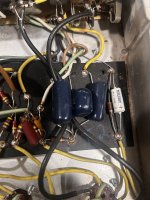
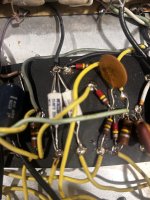
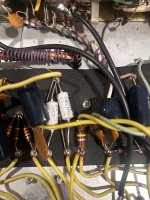
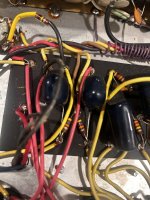
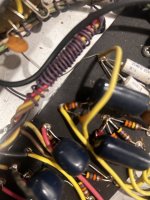
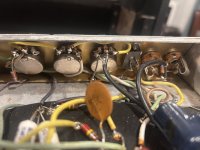
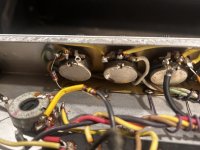
Here are some miscellaneous gut shots. If you notice anything :)

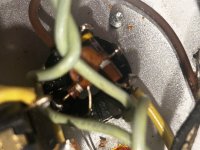
I noticed this resistor looks like it’s seen better days. View attachment 65614

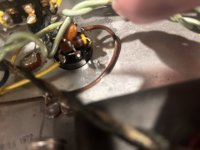
Cap and resistor on power tube socket looked marginal.


View attachment 65615View attachment 65616

View attachment 65617View attachment 65618View attachment 65619View attachment 65620View attachment 65621View attachment 65622
That 47k resistor has a big goober of flux on top of it. When they blow the paint lines change color from the heat and the resistor is charred. Carbon comp also crack, but sometimes it's hard to see.
 
Those filter caps need to be replaced with some shiny new F+Ts. See that brown futz oozing out? Classic sign of being about to blow. Check the value of the dropping resistors between them when you do it - they have some large voltages across them and often drift in value. I would recommend using metal oxide 2W resistors in the doghouse.

The 100K resistors on the board which go to the plates (plate load resistors, dropping resistors, whatever you want to call them) should be checked as again, they have significant voltages across them and will often drift radically. As a matter of course I would strongly recommend changing out all electrolytics - those white Mallorys will probably have to go. And I'm sure you noticed the broken cap in the tonestack of the first channel! If it was my amp I would be very tempted to replace the ugly blue caps with Mallory 150s.

Crackling on a volume pot can be just a dirty pot or it could be DC on the pot from a leaky cap.

You can generally measure most of the resistors while in circuit but the caps need to be disconnected to measure values. Check that every single ground is good!

This sounds like a lot to do but it's not really. As long as the tube sockets still have decent tension there probably isn't too much to do before you have a great amp. Don't be concerned about that blob of silvery stuff on the side of the power tubes. It's just all the stuff taken out of the gas inside by the getter when the tube was manufactured - usually you see it at the top of the tube but sometimes the getter is on the side. It's if that silver stuff goes white you need to pay attention because that means the tube has lost vacuum.

If you can tidy up the wiring and get rid of a lot of excess you will have a lot lower chance of parasitic oscillation and you won't need the little caps that you don't see in earlier versions of the Bassman. I find it quite therapeutic to disconnect the wires from the tube sockets and snip off the excess before reconnection. Just keep grid wires (preamp pins 2+7) away from filament wires and make sure that plate wires (preamp pins 1+6) cross grid wires at 90° if they need to cross.

This should be a fun project and you will likely end up with a great amp.
MOD caps are less expensive and have a higher tempreture rating. They do the same work in a smaller size which indicates more sophisticated production equipment. I've used both, no change in sound at all. You're literally paying for that sexy black and gold paint....
 
Here are some miscellaneous gut shots. If you notice anything :)

I noticed this resistor looks like it’s seen better days. View attachment 65614

Cap and resistor on power tube socket looked marginal.


View attachment 65615View attachment 65616

View attachment 65617View attachment 65618View attachment 65619View attachment 65620View attachment 65621View attachment 65622
I almost said this before, but will say now.
I was hesitant about an amp that sat that long.
I'm all for DIY, but the value you hold in that....
Take it to a good amp shop.
There's a time to diy and there's a time to let pros do it.
You have a real clean vintage piece that's worth investing in. Don't screw it up with stubborn DIY attitude. Find someone who *knows* vintage fenders and can get you back to 100% without a loss in value.
This amp is an investment, not a fling.
My .02
 
MOD caps are less expensive and have a higher tempreture rating. They do the same work in a smaller size which indicates more sophisticated production equipment. I've used both, no change in sound at all. You're literally paying for that sexy black and gold paint....
But I LIKE that sexy black with gold paint! I've had great results with F+T for a fair while now. I'm sure there are others just as good but I will stick to what I know - for now! I haven't heard much about Mod caps. I know their reverb pans are the dogs bollocks (ie good).
 
But I LIKE that sexy black with gold paint! I've had great results with F+T for a fair while now. I'm sure there are others just as good but I will stick to what I know - for now! I haven't heard much about Mod caps. I know their reverb pans are the dogs bollocks (ie good).
Well, I do too. I wish MOD would change their color scheme!!!!!
 
@Locrian99 I tagged you in this post because I don't think you saw it. Very important advice here:

Those tubes look great, the weird shiny spot is called the flashing, perfectly normal.

Whatever you do, DO NOT turn that sucker back on until you replace the power caps! They can explode, taking the transformer and tubes with them. In any case it's a mess, and one reason why they are in their own little enclosure.

On the other electrolytic caps on the circuit board, you can de-solder one side and lift the lead, then you can measure the capacitance and ESR to see if they need to be replaced. Do not shotgun the amp by just replacing them all.

If you flip a bright switch and nothing happens, realize they are only for use at bedroom volume, anything louder than that and they don't do anything. I forget why but I just had my third Bourbon and water. :sneaky:

CHECK THE VOLTAGE DROP ON THE DIODES they should be .5 to .8, unless it's tube rectified. It would be a very good idea to replace them even if they do test good. If they do go bad and you get A/C into the polarized caps then BOOM.

How about posting a gut shot of the entire amp? It's kinda hard to see anything so close up.

Well that's all I can think of now.... shutting off the computer and the TV and whipping out an Axe!!!!!
 
Last edited:
Yeah I'd replace the 470s with 2W metal oxides. I guess it depends on whether you want a faithful original style amp or a great working amp, but it's a '72 so I would go with great playing amp. Metal oxides should never need replacement but CC will.

Those ceramics may be fine but they can crack with movement and age. If you replace them (and to be honest I probably would!) go with multi-layer ceramics or good silver mica. As Mr Psionic warns, don't use those silver micas marked SM. I have personally never had a problem with them but he appears to have and he works on a lot more amps than I do. I use the Cornell Dubilier silver micas.

I use carbon film 1W resistors for my builds. They sound great and don't drift or have the noise/hiss of CC resistors. For anything over 1W I use metal oxide. In cathode biased amps I like the Dale wire wound 5-7W resistors as power tube cathode resistors. You don't need those here though!

For the 25µF cathode bypass caps I generally use 25µF/50V Spragues as they are decent quality and a good size. And the F+T equivalents are huge - they make a dual 25/25 but it's too big too fit comfortably. For coupling caps I use Sozo if they fit and Mallory 150s if they don't. I think Mallorys are good for everything really but I like the look of Sozos. :cool:

I'm not sure how different your Bassman is from the AB763 but you should be able to rebuild it at AB763 spec I think as long as your lead dress is better than the stock amp's - and it's not hard to do. An AB763 Bassman is a killer amp.

You should be able to get everything you need from Antique Electronics - tubesandmore.com. Their stock is good and the prices are good too .

Check this out:

I guess that’s a good place to start, determine what my goal is here. I typically like to keep things original as much as possible but I think metal oxide makes more sense especially as I go through and am going to be pretty much recapping everything.

A solid useful amp is the end goal here and some education in the process of getting there. Going to start
I almost said this before, but will say now.
I was hesitant about an amp that sat that long.
I'm all for DIY, but the value you hold in that....
Take it to a good amp shop.
There's a time to diy and there's a time to let pros do it.
You have a real clean vintage piece that's worth investing in. Don't screw it up with stubborn DIY attitude. Find someone who *knows* vintage fenders and can get you back to 100% without a loss in value.
This amp is an investment, not a fling.
My .02
i appreciate your thoughts and respect them.

I bought this with the idea it would be a project for me. I’ve done some minor amp repairs. Recapped some blues jr’s, replaced tube board etc.

I’m very comfortable with the necessary safety precautions for working on these. And follow steps every time.

I could read until I’m blue in the face on these things and not really take it in well. Just not how my brain works.

If it was a black face amp I would probably rethink it a little. If it was a Princeton Silverface I might rethink it a little. The Bassman 50 head I can buy another for less than the cost of a new blues Jr. It’s not the be all end all, but it is pretty cool. I’m pretty set in going down this path of doing this myself the idea of doing it myself and the knowledge gained is worth more to me.

If I managed to destroy it I’ll be bummed and out 50$, but I’ll have learned something in the process even if it’s what not to do! Gotta start somewhere, and these things are easier to work on than a blues jr from what k can see so far.
 
Back
Top