What if we killed off the 1/4 / 6.35mm jack?

What about ribbon cables that carry power, audio, control voltages (LFOs and such) to/from a cable-less LED-button patching matrix built in to the pedal board?

 
If I could change this timeline, I would also make sure there were a lot more cicuit types being used in the past, so people wouldn't be so hung up on the same fucking sounds for decades to come, but that's an opinion for another place. And one that's not limited to guitar effects, but instruments in general.

Just think where we would be now effects wise if in 1959, they add all of the digital/analog effects we have now..........the innovation and creating of new effects from then until now might have been astounding.

These days, we get very small and mostly unknown pedal builders creating a few creative new effects, while every major company is rebranding the same damn circuit into infinity and beyond.

There is only one company I found that makes a Fade In/Out pedal (Darth Fader) for example. I'm still waiting on someone to make a Sweep Delay pedal...........mostly the reason why I got into pedal building is so I could learn electronics enough to create one myself.........though after 2yrs, I'm still nowhere close to doing anything but assembly "paint by numbers" 😢
 
I think it's mainly the same reason why we use 1/4" jacks and not 6mm...People do not like change.

Pedalboards have always bugged me because of all of the extra cabling and weight. Not to mention the stupid Velcro or whatever silly method people come up with to get the damn things to actually stay on.
 
Hey as long as we're redesigning the wheel, why not just have pedals be wireless networked. No need for patch cords.....

All the latest digital sound equipment is using networking, just not at the wireless stage YET. No more bulky snakes; CAT5 cable.

 
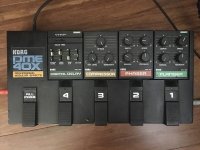
Before tonecore, there was Korg PME
View attachment 81647

Before Tonecore 2004 or so, before Korg PME in 1988... there was ...


ELECTRA MPC!
1976!


MPC-Modules_border_1024x1024.png
 

I remember when this came out, we were all impressed with not only the movie, but some of the songs were pretty good!

I had a really nice wireless, then they took out the 240v lines and put in 5000v lines.

BUUUUUUUUUZZZZZZZZZZZZZZZZZ

Still have it, just can't use it at home....
 
Hey as long as we're redesigning the wheel, why not just have pedals be wireless networked. No need for patch cords.....

All the latest digital sound equipment is using networking, just not at the wireless stage YET. No more bulky snakes; CAT5 cable.

I was "working" at the Tacoma Guitar Show a few years back when Fender was debuting their Bluetooth equipped Rumble Studio 800 amp. Our booth was right across from theirs and I managed to find their password and get someone to hack into the amp. We didn't take it any further than that, but the possibilities were pretty delicious!
 
Switchcraft has entered the chat


Hearing a lot of reasons why this is dumb, which I already admitted from the get go. Not a lot of new ideas though.
I'll add, a 3.5mm has plenty of contact to carry audio and voltage for non-tube pedals. As for solder ability, tons of jacks that are cheap and easy. Here's a familiar looking one. With a right angle connection, you have ~1/4 inch protruding so not easy to shear off.

Here's another idea.
How about a pedal board that directly interfaces with the pedal via a mixed signal dsub. Thinking 9w4 here, like this one.
View attachment 81614
Larger contacts provide audio in and out(including stereo). The other 5 smaller pins are ground, 9v, 12v, 18v and ?¿.
No cables, they directly interface with the pedal via a dsub on the bottom and a movable daubs within the pedalboard.

Let's see some ideas!
Now
View attachment 81615
Nah bruh. Imma stomp this lawn.

The average 3.5mm jack is rated for up to 12 watts (12vdc 1 amp). That's plenty for low plate voltage tube pedal power supplies, and for the (hopefully) non-dc carrying signal cables they're more than adequate. This is why old crybaby wahs used 3.5mm jacks for 9vdc power supply connections: switched 3.5mm jacks were robust and plentiful.

It's worth mentioning that 3.5mm jacks are, mechanically, far weaker than 1/4"s. Your instrument to pedalboard would likely still need to be 1/4". Trying to get away with a 3.5mm here would be inviting random disconnects at the slightest tug and require utilizing a narrower cable assembly that will be *far* more fragile and, likely, prone to handling noise.

There's good reason for using the fact that most guitar cables are around 5mm +/- 1mm or so, even though the signal conductor itself is only between 20-26awg: durability. Thick insulators help prevent the cable from bending too far and putting strain on the central conductor. It provides padding when you accidently step on it. It provides tensile strength when you yank on it.

For pedalboard connnections? Yeah, a 3.5mm plug work just fine. What you gain on enclosure real estate, though, you lose in low-profile connectors. At least, as far as I've seen. Squareplug makes some *awesome* low profile pancake 1/4" connectors, but I'm unfamiliar with similarly low profile 3.5mm connectors. Any integration with pedals that don't have 3.5mm plugs will necessitate adapters amd extra bulk.

Honestly, I'm not saying that it's a terrible idea, and it could make for some very interesting integration with eurorack style modules. But there are trade offs that make going all in on something like this difficult for anything but one-off pedalboards with all custom pedals.

As far as rigid contacts go...well, those have problems for something with a stomp switch attached.

There's plenty of rigid connectors out there, Modular PLC controllers have this style of connection. Board-edge connectors are very common for this purpose. They tend to involve communication and voltage busses built into a proprietary rack. It's not inconcievable to do so, but here's the rub:

These kinds of connections go in industrial control panels, where they don't tend to be exposed to a ton of vibration or angular forces. Like the kind we expose our pedals to when we use them. Contacts will loosen, conductors and boards will break. Flexibility in these connections is very important. Not to mention how difficult it would be to keep dimensions tight enough to be able to even make these sort of connections work on the DIY scale.

I mean, I could do it, but I've got a CNC setup. That's what would be required, and even then the brittleness of these connections would be difficult to deal with.

Having integrated power and signal cables sounds like a great idea. It would also be difficult to pull off consistently without PSU noise seeping into your signal. Electromagnetism: It's a bitch.

That, and something along those lines would require running a bunch of pedals off the same power supply in parallel with each other. The thing is: everything is a circuit, and noise from one pedal can work it's way into another via the first pedal's "feedback" for lack of a better term through the common PSU connections.

Now that I've shit all over the conversation and been a big ol Debbie downer, well...your welcome.

But here's an idea; spring-loaded contacts. Make a pedalboard with modular pedal affixing and positionable spring loaded psu and signal contacts. Drill holes on the bottoms of the baseplates for specifically designed adapter boards that replace or add on to the 1/4" jack. Snap a pedal onto the board in such a way that the spring-loaded contacts make contact with signal and power pads on the adapter boards. Easy peasy. Each pedal can have its own PSU, or daisy-chained PSUs. Cables between pedals could be rigid rails or flexible cables. The spring loaded contacts are very good at maintaining contact when properly secured.

But that has problems, too. The pedalboard design would be complicated. Figuring out ways to prevent shorts on the penetrations through the enclosures would be tricky. Spring loaded contacts can be quite expensive and frustratingly fragile. Oxidation is an enemy. Stock pedals would require possibly permanent alterations, or external adapters that would need to be designed intelligently and offered cheaply enough to be appealing to folks.

Pie in the sky thinking is great, but I live and grew up in the Silicon Valley. I've grown to hate the "Fake it till you make it" "move fast and break things" "I'm a rich entitled asshole that worships Steve Jobs and think that willfully blinding myself to facts is the secret sauce that leads to success."

It's endemic. Especially cause, apparently, that last one is entirely correct. At least on an individual level.

Now I believe I have outdone your get off my lawn, sir. Engarde!

*Edited for clarity. I shouldn't post right before bedtime*
 
Last edited:
So far I think the schmorg is the best alternative. It’s designed just like a modular synthesizer.

The dock isn’t proprietary. It’s just an implementation for mounting, power and signal routing. And you can dock a single module into an enclosure, making it work no different than a regular pedal. Fully backwards compatible.

The tradeoff is you have to mount the circuit to the lid, and have internal connectors on both the circuit and the dummy enclosure.
 
Maybe we should start off with a clear problem definition. My guess is that innovation starts with a problem.
For what problem is ditching the 1/4 a solution?
Are there other solutions? What are their cons?

(Stickman said it pretty much all, besides plastic enclosures)
 
Last edited:
I don't see how 3.5mm plugs are a mechanical problem in pedal-to-pedal connections on a pedalboard. And most of my experience has been fairly chaotic shows with stage diving and IDGAF behavior all round. You need something stronger guitar-to-board, and maybe board-to-amp, for sure.

I'd want to hear a high gain pedal with input & output cables parallel to each other and so close together on a TRRS cable, but it would absolutely be worth the experiment.

Several years ago I decided to make all my DIY pedal jacks LTR. As a lefty, my guitar cable comes from the left, and it's reading order. But there have always been a couple Boss pedals I won't give up, and now my 16yo uses some of those old pedals and it's a shitshow. Inertia is working harder, even though LTR is objectively better, disregarding handedness.
 
Whenever I try out a new pedal, I plug my guitar into the input, and the output into the amp. That would be annoying if I had a different interface to deal with in-between.

When I bought my first pedal, I only needed to get one more cable. Not two little cables, one big cable, in input interface and an output interface.

For what problem is ditching the 1/4 a solution?
Exactly. Too heavy? Too bulky? Too old?

Maybe this thread isn’t for me because I don’t have a problem with 1/4” jacks?
 
Back
Top