@gtfields13 I wanna know about your keyboards. I am the opposite of you- a guitar player that pretends to play keys sometimes
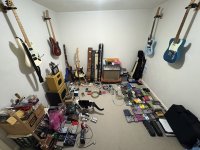
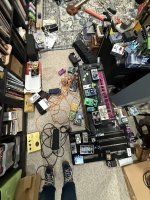
What I use routinely is in my studio pic. More of the story is off-camera, so to speak (i.e. in the closet most of the time, but I have a couple of open audio and MIDI ports free to swap in and out).
The day-to-day stuff is:
Kurzweil PC2x: full-size piano keys (action from Young-Chang piano's I believe). For most of the last 20 years really the only keyboard I used because I am a piano (classical-ish) player first. also last purchase pre-family...
Hydrasynth (upper): first new synth purchase since the Kurzweil, bought because I never had a traditional synth. Technically, I think this is a wavetable, but for me it's a swiss-army knife of a virtual analog plus. Also the reason I am building pedals (below)
Native Instrument's
Kontrol S '61: MIDI controller with tight integration to the NI world of software sythesizers. I picked this up because I am mostly an "in-the-box" keyboard/synth musician and have the full suite of NI software. The integration has reached the point that you don't have to look at the computer anymore to gain access to hundreds of instruments and 10K's of patches. I started on that road 30 years ago, because in the mid 90's there was no Eurorack, old-school modular was a scarce as hen's teeth, and analog synths hadn't staged their comeback.
Beyond this the kit includes my first digital synthesizers and used stuff I pick up when I spot a deal. And, to my wife's chagrin, I never sell anything (because I'll never be able to justify buying it again):
(original kit - my first synth purchases back in 1989)
Kawai K-5: late 80's digital additive synth (way difficult to develop patches) this was my main everything from 1989-2000, because it was multitimbral and a great MIDI controller for the time (with velocity, aftertouch)
Kawai K-1m: related 80's ROM/sample synth: paired with MIDI software, these two were great for orchestrating and playing back pretty much anything (jazz-ish, combo to orchestra) albeit in an 80's sounding way
Boss DR-550: Little bitty drum in a box, better than Kawai's for the drum track's I wanted back when I first got started.
(used recent pickups)
Arturia Microbrute (actually out, but under cover to the left of the main rack) - true analog monosynth, does some great bass sounds
Korg Minilogue XD (haven't spent any time to learn what this can do, but another true analog that has some great sounds)
Roland D-50 (I think): ROMpler MIDI module
Cr8 Audio:
East-Beast semi-modular: another analog bit, developed with Pittsburgh Modular and capable of great weird-stuff
Korg Volca-beat: drum-machine-ish (was thrown in with a couple others in a package deal, haven't figured it out)
Korg NTS-1 (actually a new purchase): a little DIY assembly box that is actually really powerful and popular as an effects unit
this is the full kit. I still work in the box when I am not just noodling, and my primary interface is a new MOTU 828 and Digital Performer for my primary DAW (kind of orthogonal to the mainstream today, but niche specialty for scoring because of it's video integration (which I don't do!) and suits my classical-music style brain.
Way back in the storage room is also a early 80's vintage
Korg LP-10 which I bought as a portable practice piano back when I went off to school. It was a basic transistor organ type with limited sounds. It is partially relevant to this pedal world, because also back in the day, I found Craig Anderton's original comparator distortion circuit (from a 1973 Pop Elec), built that on perfboard from Radio Shack, and even though I had the wrong pots, it could turn the basic square wave organ sound of the LP-10 into a screaming organ a la John Lord's Deep Purple sound.
Today's Pedal Connection: The Hydrasynth (like many digital synthesizers) is accused of being glassy or brittle or whatever you want to call full-spectrum-sound. I think that, with programming care, that's probably not true, but I decided I wanted to take an analog approach to seeing what an external filter and tube amp could do to make the sound more "warm." So I found a PCB for the Korg NuTube fluorescent audio device (it is, to be fair, a real vacuum tube, but looks like a microscope slide and runs at low power. And started hunting up filter ideas. This led to, well, pedalPCB and before you know it I had built a Klon and Big Muff Pi, and I still haven't finished the "Warmerizer" for my Hydrasynth. Which is probably good, because I have learned a whole lot more and when I finally get to building the filter to add onto the NuTube buffer amp, it's going to actually work (at the moment, I am thinking a Baxandall filter).