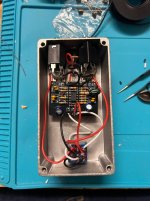
I have watched a ton of videos over the last few weeks and took the dive on my first pedal build, a Mach One OD.
I've got power and bypass works fine, but no sound when the pedal is engaged. I took my multimeter and tried to check every single connection, meticulously scoured this thing for whiskers, even cleaned up a couple solder jobs juuuuuust in case. There are two connections that are not behaving the way I think they should, granted I know one ounce more than nothing.
First, all the lugs on the volume pot (on the right in the attached view) return a value when connected to ground, even the ground leg. Shouldn't the ground to ground beep at me?
Second, the SW spot from the board (the third from left spot bottom-center on the board, red wire going to top-middle switch spot). At either end of that connection to ground, my multimeter beeps and shows 0.0 (though sometimes it briefly shows a number like 15 and then goes to zero and beeps).
Finally, maybe a clue to someone much more knowledgeable than me: When engaged and plugged in, I can run it into a tuner and see there must be some kind of signal coming out because it shows an A#.
I am very new to this and don't have any background in electronics, so I'm sure I'm not using the proper terms. I was just trying to check everything to ground and every component seems to return a value and not cause an issue, at least with the meter, with those two exceptions above. No whiskers, I wicked away as much solder as I could while leaving the wire connected. I took the board out of the case, checked both sides, I can't figure it out. Any thoughts and suggestions appreciated, thanks, and I've already learned a lot from reading these forums, even if troubleshooting is something I tend to learn a lot about by being troubled at first.
I've got power and bypass works fine, but no sound when the pedal is engaged. I took my multimeter and tried to check every single connection, meticulously scoured this thing for whiskers, even cleaned up a couple solder jobs juuuuuust in case. There are two connections that are not behaving the way I think they should, granted I know one ounce more than nothing.
First, all the lugs on the volume pot (on the right in the attached view) return a value when connected to ground, even the ground leg. Shouldn't the ground to ground beep at me?
Second, the SW spot from the board (the third from left spot bottom-center on the board, red wire going to top-middle switch spot). At either end of that connection to ground, my multimeter beeps and shows 0.0 (though sometimes it briefly shows a number like 15 and then goes to zero and beeps).
Finally, maybe a clue to someone much more knowledgeable than me: When engaged and plugged in, I can run it into a tuner and see there must be some kind of signal coming out because it shows an A#.
I am very new to this and don't have any background in electronics, so I'm sure I'm not using the proper terms. I was just trying to check everything to ground and every component seems to return a value and not cause an issue, at least with the meter, with those two exceptions above. No whiskers, I wicked away as much solder as I could while leaving the wire connected. I took the board out of the case, checked both sides, I can't figure it out. Any thoughts and suggestions appreciated, thanks, and I've already learned a lot from reading these forums, even if troubleshooting is something I tend to learn a lot about by being troubled at first.