Deflector Reverb

Erik S

Well-known member
Build Rating
5.00 star(s)
I should start watching demos before I order PCBs :ROFLMAO:

If I had tried this at the music store I would have written it off immediately. The weirdness/ modulation features in this do stuff in a metallic high frequency digital-y zone that bummed me out. It's cooler than some other shimmer/ sparkle magic reverb types, but it also shares some of what I don't like about those.

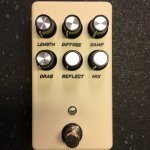
Since I put the time into building this and I do like a pedal that challenges/ confuses me, this has been on my board for a few days anyway. With Damp cranked, Reflect at zero, and Length and Mix set low it's still a huge weird reverb, but I did eventually settle into some ambient nonsense noodling and start having fun. I should also try running some synth noises through it. That's might be a better fit.

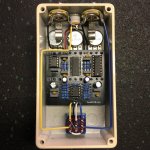
This was the second FV1 I've done with paste and hot air. I've gotten more comfortable doing jfets and opamps with a soldering iron, but I think on these big suckers it's still worth the trouble of getting the paste out. I managed to get my beads of paste just right on this one, and watching all those pins suck down to the board at the same time is really satisfying.

CD8BB35D-1702-459E-B5E0-2DB53981932D.jpeg
D9D19213-6234-450D-8D60-49B8AE3A3C03.jpeg
0592B56E-ACB3-4D94-815F-E28D22546D40.jpeg
 
It’s a fun pedal, but not well suited for traditional use of reverb on guitar. To your point, there can be some good times with gatey/PLL/Synth tones.
 
I like mine, but it's definitely a one trick pony. I had to get a NOS Natl Semiconductor CD4049 from Small Bear for the clock control to work correctly - the TI version introduced too much noise
Interesting... I did notice some weird white noise at one setting - I think with the drag control at zero? It went away as soon as I moved it just off zero, so I wasn't going to worry about it, but I do have a stash of vintage 4049s, maybe I'll try one of those and see if it goes away.
 
The wiring and lettering is so clean! Love your style. I had a similar reaction when I built mine, but I found I got a lot of mileage out of it by dialing back the Mix and Length, upping the Drag (sort of to a long slapback time), keeping Reflect low (I labeled mine as Feedback), and Diffuse and Damp pretty high (this makes it less washy to my ears). I found that setting it this way makes a really nice subtle, echoey cloud that is very usable and very hard to turn off...
 
I found that setting it this way makes a really nice subtle, echoey cloud
Well, that just sent me back to the pedal board for another round. I started with your (good) suggestions, and eventually ended up with mix and length way up where it started self oscillating and really going crazy. That's also a pretty good time.

For a pedal I claim to hate I keep having a weird amount of fun with it. :ROFLMAO:
 
Well, that just sent me back to the pedal board for another round. I started with your (good) suggestions, and eventually ended up with mix and length way up where it started self oscillating and really going crazy. That's also a pretty good time.

For a pedal I claim to hate I keep having a weird amount of fun
Love it! Haha. It definitely took me awhile to get to know, but it was pretty rewarding to experiment with. Surprisingly versatile. Molly Miller's EQD demo video of the Afterneath was what convinced me to build it.
 
I appreciate all this talk of the Deflector not being so great, as I somehow fried the FV-1 in my build and never got it fully working (would work for 10 minutes, then die). Makes me not worry so much about what I'm missing
 
To me, I love all the crazy little artifacts.

Like what happens when you turn the diffuse knob while playing.

I think the key knobs that really affect the pedal's behavior are in ascending order of importance, length (obvs), drag, and reflect. And mix. With mix at less than noon, you can tame the pedal to be an expansive but pretty "normal" reverb.

Length obviously increases the size of the cavern and what goes on.

Drag is the pitch of the reverb, and fully CCW generally introduces granularity and affects the quality of the reflection.

Reflect is the beautiful crazy-making part of the pedal for me. The more CW, the more the signal "bounces" around, eventually ending in some mild but very pretty/haunting self-oscillation. So if that bothers you, keep it CCW.

Most trad reverb setting I've found is Diffuse CCW, Damp wherever (the impact on signal is very minimal to me), Drag full CW, Reflect full CCW, Mix at 10ish, increase to taste.

edit: oh yeah, I found it played better with distortions than the Spatialist
 
Most trad reverb setting I've found is Diffuse CCW, Damp wherever (the impact on signal is very minimal to me), Drag full CW, Reflect full CCW, Mix at 10ish, increase to taste.
That sounds right to me.

I've been thinking of the Damp control as a tone knob for the stuff that happens if you turn up Reflect. With Damp all the way up, the reflections seem to get a little darker which I preferred.
 
Diffuse is definitely a delay governing the gap between the initial signal and the onset of the reverberated signal similar to what goes on in the ghost echo. CCW= virtually no gap, CW = noticeable pause before reverb. And if you turn it and play, it gives a very nice evocative/ ghostly/otherworldly whoosh up (or down).

Damp seems to affect the definition or sharpness of that reverb onset, which is a pretty subtle thing. CCW is most defined, CW is least, and I'm sure it has downstream effects when Reflect is applied.

I'm sure you have noticed all these things, I'm just elaborating for the benefit of future builders.
 
Back
Top