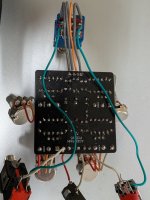
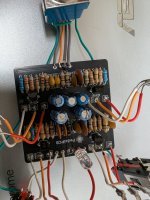
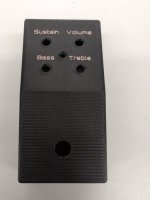
I just finished soldering the acid rain fuzz. 3D printed a cool box for it but it is not working. I have attached some pictures is there something I did wrong? Not sure where to start in the debug, I think everything is in the right place but I am not confident with the input/output nor the power supply. Speaking of which what is the standard power supply for a guitar pedal?

You are using an out of date browser. It may not display this or other websites correctly.
You should upgrade or use an alternative browser.
You should upgrade or use an alternative browser.
First build questions
- Thread starter EugeneAxe
- Start date


Fama
Well-known member
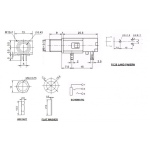
I assume the in/out and power questions were about the jacks? The build docs https://docs.pedalpcb.com/project/AcidRain.pdf show which pad is which at least. I'm not sure about the power jack either, if you have a multimeter available you can check it.Not sure where to start in the debug, I think everything is in the right place but I am not confident with the input/output nor the power supply. Speaking of which what is the standard power supply for a guitar pedal?
A standard guitar pedal power supply is 9 volts, center negative (current is not that important for analog pedals, they're going to be <100mA pretty much always I think, and power supplies are usually something like 200mA at least - digital pedals might need more).
Like I said, the standard is center negative (some very old fuzz pedals might be center positive, but those are always spelled out very clearly). That means it should be negative on the center and positive on the outside. You could check with a multimeter which pin the center goes to, and which pin the outside goes to, inside the power jack, if you're not sure. If there's three pins I think the third pin is a switched positive, to accommodate a battery.
One last note about the enclosure, I don't know how big of a deal it is going to be in practice, but pedal enclosures are generally made from metal (usually aluminum) because it conducts electricity. Thus you can also make a contact with the enclosure from ground, and that protects your circuit from electrical interference. A plastic box does not do that. I've seen some people use aluminum foil or something similar on the inside of a plastic box to do the same thing, but it's hard for me to say if it's absolutely necessary or not.

Alan W
Well-known member
The idea behind shielding is to surround the circuitry. Modern multi layer boards, that can feature full ground planes, can really help with keeping things quiet, as can board mounted pots, etc. Think in terms of off board wires as being potential antennas. That said, it may be fine—when you’ve got it passing a signal, if it’s reasonably quiet, then all is good.Thanks. This is really helpful. I have an aluminum plate base for the box.
Congratulations on your first build! And, welcome to the forum!