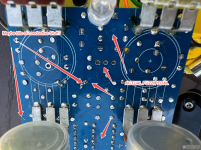
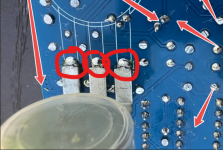
I had an interesting experience this weekend. I went to add my CDB-mod Animals Diamond Peak to my board, and when I plugged in the power adapter, a digital pedal on my board (Boss GT-1000CORE) rebooted. I thought that was weird, and then I went on to notice that the Diamond Peak wouldn't turn on. At first I thought it was the power cable, but that cable worked fine for other pedals. I tried a different 9v source, and it still wouldn't turn on.
First, I've used this particular Diamond Peak pedal quite a bit. It's been in nearly constant use for the better part of a year, across a couple different boards and power supplies. I never had any issue with it.
So I went to debug it. The first thing I noticed was that the 9v PSU I'm using for debugging usually reads around 9.2v when unloaded. When it was connected to this Diamond Peak, it was reading around 8.5v. To see the voltage drop noticeably on a pedal that I would expect to draw single-digit mA suggests a short to me. Additionally, this pedal has a 100-ohm series resistor on the PSU line, right after the 1n5817 reverse-polarity protection diode and just before the bulk filter cap. On the "in" side of this resistor, I was reading around 8.5v, but on the "out" side of this resistor, I was reading less than 1v! If the entire voltage is essentially dropping across that 100R resistor, that's another indicator of a short. (And, furthermore, V=IR, so 8.5=I*100R implies about 85mA of current - this effect should never pull anywhere near that.)
So then I pulled all the active devices I could: Q2 and Q3 are socketed, plus the TL072, CD40106 and CD4053. That left the 2n4393 input JFET and the 2n7000 LED switch mosfet as the only remaining active devices. The voltage readings were unchanged.
I removed power, and started probing devices I thought might potentially short, e.g. bulk electrolytic caps, other power decoupling caps, VREF voltage divider resistors, trimpots, etc. I couldn't find any obvious shorts. Just for kicks, I replaced that series 100R PSU resistor, no change.
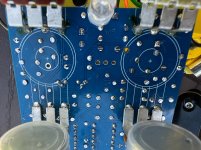
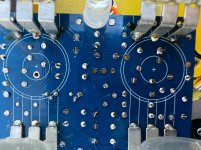
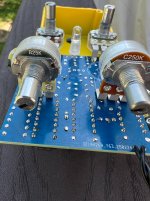
Up until this point, I hadn't bent the two lower pots away from the PCB, so I hadn't probed any of the components that are obstructed by them. So I went ahead and bent them back, and probed a few more components, looking for a short. I still couldn't find any. So then I applied power once again, and now the voltage was back up to ~9.2v! So removed power, put all the active components back, and applied power again: the main voltage is still good (>9v) and now the indicator LED toggles with footswitch presses. I haven't yet put an actual signal through it, but I'd be surprised if it didn't work.
So... what to do now? Besides bending those pots, replacing the 100R resistor, the only other "change" I made was to scrape away the flux residue where I soldered the status LED. All the other flux residue (i.e. on the back of the PCB) I cleaned during initial assembly. The status LED was the last thing I soldered when I did the initial build, and I never cleaned the flux residue. So I suppose there is a chance the flux residue turned conductive and that 2n7000 mosfet was stuck "on" to create a short to ground. But even if that were true, I use a 10k current-limiting resistor for the LED, so that would make the max current at 9v about 1mA, which doesn't add up to what I was seeing. I don't know how the pots could be part of the problem - all the excess component leads have been trimmed, and I use the plastic "pot condoms", so even if they touched the PCB, they are not conductive.
Any thoughts?
Edit - attached pics and schematic.
First, I've used this particular Diamond Peak pedal quite a bit. It's been in nearly constant use for the better part of a year, across a couple different boards and power supplies. I never had any issue with it.
So I went to debug it. The first thing I noticed was that the 9v PSU I'm using for debugging usually reads around 9.2v when unloaded. When it was connected to this Diamond Peak, it was reading around 8.5v. To see the voltage drop noticeably on a pedal that I would expect to draw single-digit mA suggests a short to me. Additionally, this pedal has a 100-ohm series resistor on the PSU line, right after the 1n5817 reverse-polarity protection diode and just before the bulk filter cap. On the "in" side of this resistor, I was reading around 8.5v, but on the "out" side of this resistor, I was reading less than 1v! If the entire voltage is essentially dropping across that 100R resistor, that's another indicator of a short. (And, furthermore, V=IR, so 8.5=I*100R implies about 85mA of current - this effect should never pull anywhere near that.)
So then I pulled all the active devices I could: Q2 and Q3 are socketed, plus the TL072, CD40106 and CD4053. That left the 2n4393 input JFET and the 2n7000 LED switch mosfet as the only remaining active devices. The voltage readings were unchanged.
I removed power, and started probing devices I thought might potentially short, e.g. bulk electrolytic caps, other power decoupling caps, VREF voltage divider resistors, trimpots, etc. I couldn't find any obvious shorts. Just for kicks, I replaced that series 100R PSU resistor, no change.
Up until this point, I hadn't bent the two lower pots away from the PCB, so I hadn't probed any of the components that are obstructed by them. So I went ahead and bent them back, and probed a few more components, looking for a short. I still couldn't find any. So then I applied power once again, and now the voltage was back up to ~9.2v! So removed power, put all the active components back, and applied power again: the main voltage is still good (>9v) and now the indicator LED toggles with footswitch presses. I haven't yet put an actual signal through it, but I'd be surprised if it didn't work.
So... what to do now? Besides bending those pots, replacing the 100R resistor, the only other "change" I made was to scrape away the flux residue where I soldered the status LED. All the other flux residue (i.e. on the back of the PCB) I cleaned during initial assembly. The status LED was the last thing I soldered when I did the initial build, and I never cleaned the flux residue. So I suppose there is a chance the flux residue turned conductive and that 2n7000 mosfet was stuck "on" to create a short to ground. But even if that were true, I use a 10k current-limiting resistor for the LED, so that would make the max current at 9v about 1mA, which doesn't add up to what I was seeing. I don't know how the pots could be part of the problem - all the excess component leads have been trimmed, and I use the plastic "pot condoms", so even if they touched the PCB, they are not conductive.
Any thoughts?
Edit - attached pics and schematic.
Attachments
-
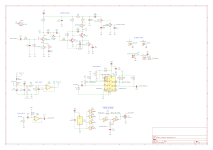 animals_diamond_peak_v1.4.SCHEMATIC.png305.7 KB · Views: 17
 -
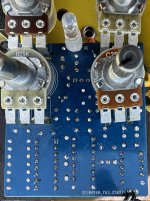 IMG_3061.jpg351.5 KB · Views: 16
 -
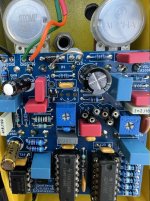 IMG_3062.jpg363.3 KB · Views: 15
 -
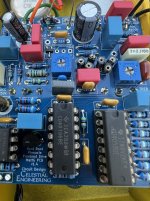 IMG_3063.jpg354.6 KB · Views: 15
 -
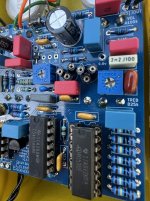 IMG_3064.jpg348.8 KB · Views: 16
 -
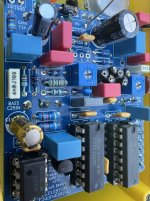 IMG_3065.jpg308.4 KB · Views: 16
 -
 IMG_3066.jpg295.2 KB · Views: 17
 -
 IMG_3067.jpg292.9 KB · Views: 16
 -
 IMG_3068.jpg316.7 KB · Views: 14
Last edited: