thunderaxe
Active member
i'm guessing there isn't an equivalent of a CD40106 with less inverters in it in a smaller package? say, a 3x in a DIP-8 or even a dual in a DIP-6?


Nope. But they can be purchased in an SMD package. So can a 555.i'm guessing there isn't an equivalent of a CD40106 with less inverters in it in a smaller package? say, a 3x in a DIP-8 or even a dual in a DIP-6?
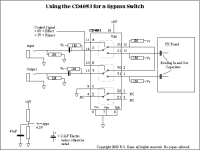
is this not true bypass with a CD4053?Analog switches require more parts than a relay solution because they do not support true bypass.
i remember reading about that on electric druid's page about designing a tubescreamer-style overdrive pedal, but re-reading it now all it really says is that the FET switches need isolating from the outside world. doesn't go into details.In theory, yes. And it might work in some cases. Do you ever wonder why Boss & Ibanez put buffers before and after their FET switches?

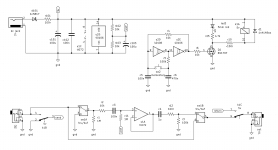
should i have any series resistor for the relay power, or just skip it entirely? and are 100u+100n the right filtering caps for the relay?R101 is too large for the amount of relay current you'll have. I recommend providing a separate filtered power rail for the relay so that changes in relay coil current don't bounce the pedal's Vcc.
correct.i have a couple of basic questions to help me understand the circuit and make sure i've wired it up correctly and not backwards (i.e. LED turns on in bypass mode) -- the datasheets show the positions of the switches in "energized" and "non-energized" states for the coil which is connected to pins 1 (+) and 10 (-). am i correct in assuming that "energized" means there is current flowing through the coil, which in the case of this circuit means that pin 10 is connected to ground, and "non-energized" means there is no current flow because the path to ground is disconnected?
With the power off, C5 & C6 are discharged, i.e. the voltage across each of them is zero. When the power comes on, C5 hold U2-9 is at zero volts. This forces pins 8 & 11 high and therefore pin 10 low. U2-10 low keeps C5 discharged. C6 charges thru R5 and after 50ms or so is ready to toggle the flip-flip to the other state when the stomp switch is pressed. That is how C5 ensures that the circuit always powers-up with the relay in the de-energized state. One could probably put the flip-flop in a random state by rapidly switching the power on and off, but that's not a normal situation.i understand the role of the cd40106 as an electronic latch thanks to r.g. keen's article on CD4053 switching, but that article kind of makes it sound to me like the state of the latch at startup is random. you state on your schematic that your circuit powers up with the relay de-energized, so how is that achieved?
will any N-channel MOSFET work for the ground switch, or are there specific specs i should be looking for?