I checked most that you listed, and Fast Audio Peak Limiter seems to be the one to me that might help in tackling the problem of outstanding peaks in the signal of my guitar. The description mentions certain aspects from that it seems it might work.
But from elsewhere I was suggested to try these:
Really Cheap Compressor (by mictester)
Bearhug FET Compressor
Do you know anything about them? Can they do a better job than the Fast Audio limiter?
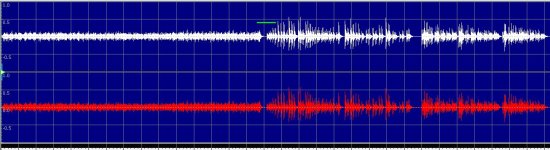
I took a photo of another test and you can see from it about how much cut would be needed to tackle the problem. Above the green line, that part should be cut:
I checked most that you listed, and Fast Audio Peak Limiter seems to be the one to me that might help in tackling the problem of outstanding peaks in the signal of my guitar. The description mentions certain aspects from that it seems it might work.
But from elsewhere I was suggested to try these:
Really Cheap Compressor (by mictester)
Bearhug FET Compressor
Do you know anything about them? Can they do a better job than the Fast Audio limiter?
I took a photo of another test and you can see from it about how much cut would be needed to tackle the problem. Above the green line, that part should be cut:
I know mictester's circuit is well-respected, as is Jon Patton's, but I couldn't tell you whether the Really Cheap Compressor or Bearhug do a better job than the Fast Audio Limiter.
They're small simple circuits, though, so it wouldn't be too much trouble to try all three.
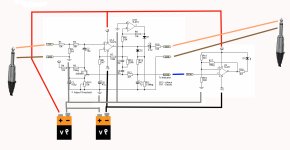
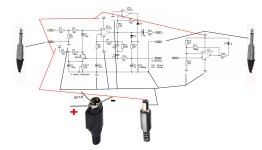
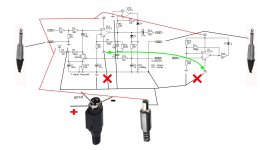
I am looking to build the Fast Audio Limiter. The schematic is below. Do the connections needs to go as indicated by me onn the image, or did I interpret something wrong? Guitar pedals that I disassembled had a metal spring as well that was soldered to the circuit board and was touching the metal box of the pedal. Do I need anything like that here, too, and if yes, where is that point in the schematic that should be connected to the metal spring?
What jimilee means is that the PCB should have ground-pads to connect to, which should be on the PCB itself without having them shown in a schematic, such as the one you've provided. If the PCB doesn't have a ground pad, then it's poorly conceived.
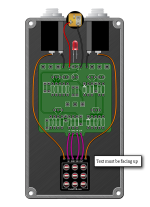
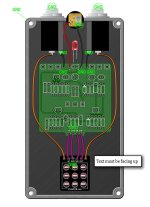
Note in the DIAGRAM Below: you can see the PCB's ground-pad to the right of the LED's pads; grounded from the DC-Jack between the two signal-jacks.
Note as well there are additional ground pads for both jacks as well as ground pads on both the 3PDT daughter-board PCB to the MAIN-PCB. These jacks are NOT isolated, as in they're made of metal that contacts with the metal-alloy-enclosure — so the enclosure is grounded through the jacks (you could have one jack isolated, ie non-conductive plastic, so long as that jack's sleeve-connection is grounded to the board) — so, no need for a metal-spring from the PCB to the enclosure in this particular case.
Note in the DIAGRAM Below: you can see the PCB's ground-pad to the right of the LED's pads; grounded from the DC-Jack between the two signal-jacks.
Note as well there are additional ground pads for both jacks as well as ground pads on both the 3PDT daughter-board PCB to the MAIN-PCB. These jacks are NOT isolated, as in they're made of metal that contacts with the metal-alloy-enclosure — so the enclosure is grounded through the jacks (you could have one jack isolated, ie non-conductive plastic, so long as that jack's sleeve-connection is grounded to the board) — so, no need for a metal-spring from the PCB to the enclosure in this particular case.
Thank you for your description, and sorry, but I don't understand this that you are describing. I understand it only to the end of this sentence "you can see the PCB's ground-pad to the right of the LED's pads; grounded from the DC-Jack between the two signal-jacks."
I am a beginner so I can only understand it if it is drawn on the schematic. Especially because I want to do it on vero board, so there will be no specially designed PCB.
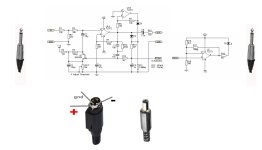
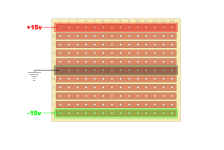
So to avoid going into the forest: If you consider my drawing, what else should it be complemented with? According to what jimilee said, there should be a connection between the grey ground wire and the black -15 wire, right? He mentioned something like that the sleeve and the DC- has to be connected. Or he meant using a 15V DC PSU with a simple barrel plug and connect all GND, GND symbol and -15 together, like on the image below?
Okay, anyway, there was a comment elsewhere to this, and it suggested not to build the Fast Audio Peak Limiter. It says:
"The FET is utilized as a controllable resistor in this limiter, and this way as a resistor between S and D it is not linear. So over 50mV load one can expect nasty distortions from it. Moreover the input splitter reduces the signal to 1/5. Then the regulated signal is raised to 40x. That will introduce noise floor problems.
.... and there are much more advanced solutions for voltage controlled levelling, like this one:
Okay, anyway, there was a comment elsewhere to this, and it suggested not to build the Fast Audio Peak Limiter. It says:
"The FET is utilized as a controllable resistor in this limiter, and this way as a resistor between S and D it is not linear. So over 50mV load one can expect nasty distortions from it. Moreover the input splitter reduces the signal to 1/5. Then the regulated signal is raised to 40x. That will introduce noise floor problems.
.... and there are much more advanced solutions for voltage controlled levelling, like this one:
ESP Project Pages - Fast Audio Peak Limiter. Vastly improved version of a common FET based limiter
sound-au.com
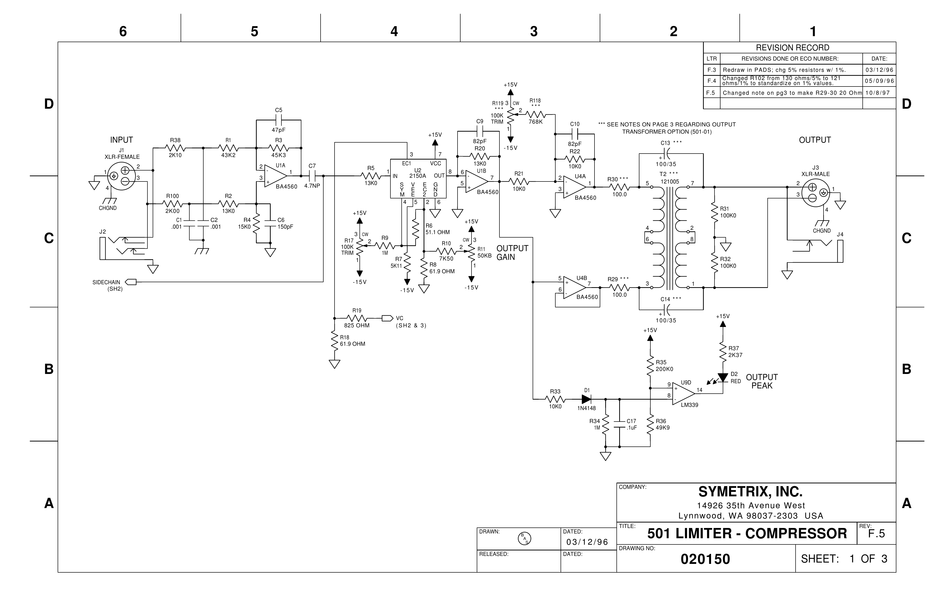
This is what the commentor claims to be an obsolete design, and mentions that the THAT2150A is a more advanced and better quality technology. But gave idea only about the chip but not about the corresponding limiter circuit design.
Edit: sorry I need to correct it, a schematic was linked as an example how to use that chip:
I think you are going to struggle to find a pre-made PCB that does what you want, most guitar comps either compress really heavily, or have a long attack time for more subtly.
I still think your best option might be that compressor I linked to earlier, the Sonicake one, I think you'll struggle to build something for cheaper and it has great features.
No offence meant Geso, but perhaps you're biting off more than you can chew at the moment?
I know I did when I first started building pedals — my very first pedal included drive, boost, EQ and an octave-up circuit. Each was made to work individually, which bolstered my confidence, but when I tried to combine them as intended into one enclosure... I ran into a few problems that I did not have enough experience or understanding to correct my mistakes.
I said the same thing about amps, not interested, too dangerous... then my mentor convinced me to build an amp, and I built a second. Something I previously had no intention of doing at all, I'm going to build more amps, bigger ones with higher voltage — I know I can do it, if I take my time and acquire the knowledge to do so. If anything, you may not be able to build it if the IC is OBSOLETE and no longer available.
THAT Corp suggests either the 2180 or 2181 to replace the 2150A
Keep at it, maybe you'll be designing your own PCB for a limiter circuit instead of vero.
For now, for your limiter circuit, you might need to buy a commercial one and use that 'til you're ready to embark on building one yourself.
Some concepts aren't easily shown via just a schematic, such as what a floating-ground is. I had to check the battery connections in your diagram-cum-schematic in post #23 because I'm not familiar enough myself with using that kind of power configuration — so the battery connections didn't look correct to me, but as unintuitive as they seemed, they were/are in fact correct.
For example, to my understanding you can't really mix your -15v with True-Ground (and if I'm wrong I welcome input from those more knowledgeable).
You want to be shown on the schematic how things connect in the physical world, and yet you see all the grounds, ie:
, on the schematic are NOT shown connected, yet we know the ground is common and will be connected on the vero, perf, PCB, P2P or other method used to build the circuit.
The two points in the schematic that have -15v are not shown to be connected, yet they must be in the circuit itself, just as the +15v points are not connected on the schematic though you drew in lines to show they are connected.
All those points might appear on vero thusly:
Most pedals are powered via the Boss standard of centre-negative for a barrel jack; On your diagram/schematic, you've drawn it up as Centre-Positive. I would recommend sticking with this [BOSS] convention as you'll be able to more easily power your pedal with any of the commercially-made PSUs popular in the market.
Strictly speaking, the vero doesn't reflect what's specifically shown on the schematic, but... if extrapolated, it does.
You said you didn't understand a good portion of my post #26, but maybe look again... I've pointed out all the known ground pads on the PCB; the diagram shows that the jacks are connected to ground on the PCB via small tabs, the collars and threaded bits are connected to those tabs and given the collars/threads are metal contacting the aluminium enclosure, the enclosure is grounded. I don't know how to make it more clear, perhaps read up on Grounding effects via RG KEEN or JACK ORMAN, as they may be able to explain it much better than I can.
You said you didn't understand a good portion of my post #26, but maybe look again... I've pointed out all the known ground pads on the PCB; the diagram shows that the jacks are connected to ground on the PCB via small tabs, the collars and threaded bits are connected to those tabs and given the collars/threads are metal contacting the aluminium enclosure, the enclosure is grounded. I don't know how to make it more clear, perhaps read up on Grounding effects via RG KEEN or JACK ORMAN, as they may be able to explain it much better than I can.
Thanks for the long introduction. Why I did not understand the box grounding stuff is because I absolutely don't know anything about the specific words and expressions related to electronics, but if you write me: if the jack slot is metal on the outside and that metal touches the metal of the enclosure, then you don't need to connect the circuit with the housing, else you need to, then I understand it right away. But when I see there are description of pads, pcb, common ground and other stuff when I won't want to use PCB anyway only vero then that will confuse me, especially when asking these questions "whether the drawing is correct?" and "what about grounding the housing?" I get contradicting answers from different people on different forums. Some replied I need to ground the housing, some said not. Some said the drawing is correct, some not. .I know it was my mistake as well not mentioning I want this on vero, but I just wanted to see the actual connections on the drawing and not on the PCB where most of those connections are ready made.
By now I came to understand all the things related to my questions here about the wiring because meanwhile I found AI can interpret the limiter schematic and I had it verify everything with my first drawing and what happens with grounding the housing. Whether you use batteries or 3 pole connector is not important now I just wanted to see where all incoming and exiting points connect to, to be able to replicate that on the vero board.
What I still don't understand why Jimilee wrote the -15 wiring to the PSU plug (or pad) and the GND wiring to the plug (or pad) needs to be connected together, I still don't undrstand why I needed to do anything like that even now, but that was the thing that confused me initially. I thought he means using a 2 pole barrel plug instead and write the -15 and DNG on the sleeve (or tip) together, that's why I created the second drawing, but that drawing was for asking Jimilee if he meant that kind of connection between the -15 and GND. As he did not clarify this, I still don't know what he meant. Anyhow I will do the first drawing where you can see the batteries, the power source will be decided later how it will be done: batteries, PSU, what PSU, etc.
But again: thanks for your clarification as well.
On the other hand, making a step forwards, so as someone else indicated the limiting technology of the circuit of the Fast Audio Limiter may be problematic. Even the AI wrote while it might have been considered a decent approach around the 2000's, the technology is obsolete indeed, and there are more effective ways to do that kind of limiting now, for example with using the THAT chips.
Me, I don't know. what I do know is that very likely the limiter pedal circuit may not need to be as complicated as the Symetrix, because I do have limiter/compressor pedals that are more simple and have no distortions: the Carl Martin Compressor/Limiter and the Carl Martin Opto Comp. Unlike every other pedal that I purchased through the years no matter premium or low cost pedals, they were the only ones that don't suffer from the intermodulation and the non-linearity causing that. The only problem with the settings available on those pedals is that you cannot set such a delicate peak limiting that you need in my case. The way they designed the function of the knobs doesn't make it possible. And sadly the schematics of those pedals are not available, so no way to correct the knob functions either. The question is whether there are any similar pedal designs where the knobs allow for more delicate settings? Because in that case I wouldn't need to build such a complicated stuff like the Symetrix, I can stay at the pedal version and avoid unwanted distortions. If there is, that would be the ideal choice for me.
I think you are going to struggle to find a pre-made PCB that does what you want, most guitar comps either compress really heavily, or have a long attack time for more subtly.
I still think your best option might be that compressor I linked to earlier, the Sonicake one, I think you'll struggle to build something for cheaper and it has great features.
I did check the Sonicake earlier. Not buying it, but checking reviews, etc. I have that on my list. Why I am not rushing to buy it is because in the past this strategy to tackle the problems I have in my effect chain with buying pedals that were claimed to be top quality transparent pedals did not turn out to bring the solution. So after purchasing many top quality pedals, it turned out I was wasting money and since I turned to tweaking things or building things myself I got much closer to the solution than in case I was buying new and new stuff. So that's why I am not rushing to buy the sonicake. Or explaining it differently: after buying many pedals incl. top quality ones, I noticed pedal makers did not really care about the problems that disturb be in connection with these pedals, and very likely the Sonicake will not be an exception either. Maybe it will, who knows, I just don't want to spend more money on making a 50-50% bet on that. Especially when returning stuff to China for a refund would cost me 2x 3x more than the price of the Sonicake.
And the other problem is when watching videos on Youtube about the Sonicake it did seem to distort at certain settings. I am not sure, but it sounded like that. Maybe it was just the problem with the video or I heard it wrong, but this makes me not rushing to buy it either. But it is on my list anyway in case I would decide buying more pedals in the future.
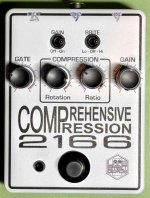
Someone recommended this compressor for me while discussing about distortion in compressors. As it was described to me, it is doing compression in an uncommon way, as I understood it is raising the noise floor or the low volume section instead, or something like that. It seemed to be interesting stuff for me that's worth a try, but when learning in many compressors non-linearity causes intermodulation problems especially in OTA compressors, I couldn't decide whether the AMZ compressor is OTA or not, so it fell out of my focus. Someone wrote it is VCA, I am not sure whether that is better or not in connection with intermodulation, so it is still a project for me in the section: "that I may do in the distant future if I have time".
There are two problems I need to consider:
- 1 is this intermodulation it affects many pedals incl. compressors. The pedals that are not affected by it are the Carl Martin Compressor/Limiter and the Carl Martin Opto Comp. They can receive much higher gain than most of the pedals without issue, and don't have any distortion. So to tackle intermodulation in compressors they seem to be the proper choice. The Opto Comp is slow for limiting in this case, the Compressor/Limiter would be okay. That one is a FET compressor. The only problem is the settings were designed in a way that you cannot set it for delicate limiting. It is capable of acting fast, being noiseless and not distorting, but settingswise the circuit is not properly designed. So I can't use them for the purpose that is the topic of this discussion, but being transparent that FET design seems to be 1 way that already proved to work. That's why I am focusing on FET compressors, trying to find a substitute that is as transparent as the Carl Martin, but allows for more delicate settings. The best option would be to have the schematic of the Carl Martin and correct the problems that the pedal has with the Threshold an Attack/Release knobs, but as I know there have been no successful attempts to trace that pedal. I have it but I don't have the knowledge to trace it. So this is one reason why the AMZ is out of focus for me at the moment, but maybe I am wrong about this.
-2 I found setting most compressors for the purpose I want is not possible. So to act fast, and cut the outstanding peaks in a way that no distortion occurs, leaving anything lower than the tip of those peaks untouched. So when looking for the compressor or limiter at the moment, I am looking for the descriptons that refer to that this might be possible with the compressor that is described. The AMZ did not mention anything about this, the Fast Audio Peak Limiter seems to be capable of this. That's why, again, the AMZ has not been in the focus for me.
But as I mentioned, maybe I am looking at the AMZ the wrong way. It has been my speculation only.
Someone recommended this compressor for me while discussing about distortion in compressors. As it was described to me, it is doing compression in an uncommon way, as I understood it is raising the noise floor or the low volume section instead, or something like that. It seemed to be interesting stuff for me that's worth a try, but when learning in many compressors non-linearity causes intermodulation problems especially in OTA compressors, I couldn't decide whether the AMZ compressor is OTA or not, so it fell out of my focus. Someone wrote it is VCA, I am not sure whether that is better or not in connection with intermodulation, so it is still a project for me in the section: "that I may do in the distant future if I have time".
There are two problems I need to consider:
- 1 is this intermodulation it affects many pedals incl. compressors. The pedals that are not affected by it are the Carl Martin Compressor/Limiter and the Carl Martin Opto Comp. They can receive much higher gain than most of the pedals without issue, and don't have any distortion. So to tackle intermodulation in compressors they seem to be the proper choice. The Opto Comp is slow for limiting in this case, the Compressor/Limiter would be okay. That one is a FET compressor. The only problem is the settings were designed in a way that you cannot set it for delicate limiting. It is capable of acting fast, being noiseless and not distorting, but settingswise the circuit is not properly designed. So I can't use them for the purpose that is the topic of this discussion, but being transparent that FET design seems to be 1 way that already proved to work. That's why I am focusing on FET compressors, trying to find a substitute that is as transparent as the Carl Martin, but allows for more delicate settings. The best option would be to have the schematic of the Carl Martin and correct the problems that the pedal has with the Threshold an Attack/Release knobs, but as I know there have been no successful attempts to trace that pedal. I have it but I don't have the knowledge to trace it. So this is one reason why the AMZ is out of focus for me at the moment, but maybe I am wrong about this.
-2 I found setting most compressors for the purpose I want is not possible. So to act fast, and cut the outstanding peaks in a way that no distortion occurs, leaving anything lower than the tip of those peaks untouched. So when looking for the compressor or limiter at the moment, I am looking for the descriptons that refer to that this might be possible with the compressor that is described. The AMZ did not mention anything about this, the Fast Audio Peak Limiter seems to be capable of this. That's why, again, the AMZ has not been in the focus for me.
But as I mentioned, maybe I am looking at the AMZ the wrong way. It has been my speculation only.
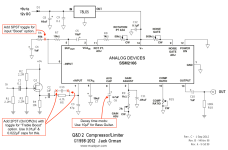
In that case, looking back on my own empirical experiences over time, I had to just build the things that I wanted garner such empirical experiences from. Eventually, I learned how to understand the datasheets by taking the time to scour them, digest what I could and learn how the various circuits performed & sounded in comparison. I suggest taking a shot at the first schematic (Q&D 2 Compressor/Limiter) of the two I posted above. It has some good control over the compression.
In that case, looking back on my own empirical experiences over time, I had to just build the things that I wanted garner such empirical experiences from. Eventually, I learned how to understand the datasheets by taking the time to scour them, digest what I could and learn how the various circuits performed & sounded in comparison. I suggest taking a shot at the first schematic (Q&D 2 Compressor/Limiter) of the two I posted above. It has some good control over the compression.
The AMZ Q&D compressor, based on the SSM2166 vca chip.
www.muzique.com
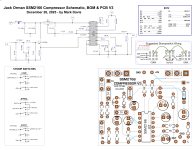
Or the one you presented the schematic for is a different version?
By the way, I was looking for resuorces to get the SSM2166 chip earlier, and found it has different versions: SSM2166A, SSM2166P, SSM2166SZ, etc. Does it matter which one you buy? At Smallbear electronics they are selling the A, but on Aliexpress and many other shop sites they sell the other versions. For example the local shop here is selling the P. Does it matter what letter is at the end of the identifier, or you can just use all for building this compressor?
Another thing: to keep it on the empirical path, do you have this compressor? If yes, in case I send you a sample over, can you run it through the compressor to see if it can compress the signal in the way I want? I can send you a screenshot from the editor where the threshold should be.