Stuff you wanted to know but were afraid to ask

When I started purchasing from sweet water my sales agent kept calling to see how I liked the product(s) I bought. In one of the conversations I put in a request for ONLY "Bit-O-Honey" candies. My next coupla purchases were small but I got only "Bit-O-Honey" candies. So, cool.

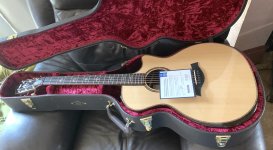
Withdrawing from my retirement account I procured a top of the line Taylor acoustic 914CE Special. In the box was a rather LARGE bag of "Bit-O-Honey" candies. Sweet!
Pics or its a Takamine....
 
@tegendemuur

Ook, cheap plastics and/or rubber can degrade over time just sitting, and break down.

So something like a reel-to-reel might shred the tape if the capstans' rubber breaks apart mid-use.


Ahh Robert and Will beat me to it.
 
Funny, I was going to say tape decks are one example where an unused machine might have some increased value just for the lack of wear on the heads.

Unused certainly doesn't equate to "ready to go" in any old gear.

In general I'm wary of anything that didn't get used. Guitars in particular - an old guitar that never got played seems to me like maybe it wasn't worth playing. People selling guitars often post that pic where they bend the strings to show there's no fret wear, but I'd prefer to see an instrument that looks like someone couldn't put it down.
 
Okay. Another one.

Sometimes you see electronic gear and devices that have been in storage for decades, never used. Not considering marks caused by usage, would you settle for such a device, or one that's been used and known to work perfectly? I am talking about things more complicated than pedals: like tape decks, hifi gear, synths, ets.

Was wondering if it is just electrolytics and crackling pots one has to worry about when things sit still for so long... And if the high prices of long stored products are worth any potential hassle.
I almost think it is like a car, unless it has been stored properly for decades of nonuse, things are going to be an issue. As people have mentioned, rubber and plastic bits caps etc.
 
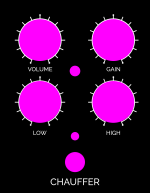
I'm going to order a few UV printed pedals from Tayda for the first time and was hoping I could get a check on my setup. I've read through Steggo's and Tayda's guides so I have a handle on the various layers and concerns with setting the right color codes. For the 125b pedals I was able to find a template to start with, but one of the pedals I want to build is the Chauffer, which uses a 1590BB case. Tayda says my UV printing pdf should be 90mm x115.5mm so I set that up. The problem is in figuring out where the holes should go. I'm using Inkscape for the design before porting to Affinity for the final CMYK and exporting. Inkscape uses an X Y system starting in the top left corner. I did my best to measure from the build docs, but I wanted to verify I actually put things in the right place before I went further. I measured as best I could in inkscape. These are all the center points of my holes, in mm:

Volume: 24-24
Gain: 66-24
Low: 24-61
High: 66-61
High-cut: 45-42.5
LED: 45-81.5
Footswitch: 45-97

I've attached the design draft, the final template won't have the background or magenta hole markers, and the white will be RDG_WHITE in the final.

Also if someone were to have XY mm coordinates for standard two and three knob PedalPCB designs so I can check my work on my other designs that would be swell.
 

Attachments

  • chauffer draft.png
    chauffer draft.png
    245.4 KB · Views: 3
@apierz check the ruller settings in inkscape
You may be able to adjust them where 0,0 is center of the artboard, aligning with taydas drill tool.
It doesn't look like Inkscape supports moving the origin, unfortunately, so I am stuck with recalculating/measuring. Also, I can't find a drill template on the forum for the Chauffeur so I'd have to measure that from the build documentation anyway.
 
Back
Top