
You are using an out of date browser. It may not display this or other websites correctly.
You should upgrade or use an alternative browser.
You should upgrade or use an alternative browser.
Sunnyscopa Film-Free Laser Jet Waterslide Notes for New GW1-PRO Glue
- Thread starter MattG
- Start date
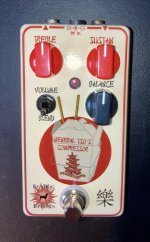
I actually like the Mod Podge Dishwasher safe glue better than the original glue. There's still a learning curve with the whole transfer process, but it seems more forgiving than the original W1+ glue.
Here's the last pedal I built using the Sunnyscopa film-free waterslide decal paper and Mod Podge Dishwasher Safe glue. Awesome pedal by the way.
So I bought this dishwasher save Mod Podge, and tried it with the Sunnyscopa film-free laserjet paper. It didn't really work, I got less than 50% transfer of toner to the enclosure. I was using a bare aluminum enclosure that I'd sanded with 180 grit sandpaper, using an orbital sander. I followed the same application process I described here, using the Mod Podge instead of the Sunnyscopa transfer aid. I did a 15ish minute drying in the toaster oven at 225F.
After that failed, I re-sanded the enclosures and used the GW1-PRO glue, and got a perfect transfer. (The GW1-PRO has generally been pretty good for me on bare aluminum enclosures).
Your pedal looks great, you clearly got 100% transfer. Did your process differ compared to what I described?

T-Go
Member
Thanks! I haven't tried transferring to bare aluminum, only Tayda powder coated enclosures. It's important to first prep the enclosure surface. I do a quick wipe with alcohol soaked paper towel beforehand. The last few times I used the film-free decals, I went to FedEx Office and used their laser printer/copier. I've had to experiment with the paper thickness settings to get the proper amount of ink. There's a Zen to how much Mod Podge to apply; too much, and it's messy and doesn't transfer properly; if you don't use enough, there's nothing in between the enclosure and the transfer sheet to grab onto the ink, plus it's hard to slide the sheet into proper position. Also, I try to leave somewhere between 1/8" to 1/4" of the sheet overhanging towards one end of the enclosure so I can grab it to peel off.So I bought this dishwasher save Mod Podge, and tried it with the Sunnyscopa film-free laserjet paper. It didn't really work, I got less than 50% transfer of toner to the enclosure. I was using a bare aluminum enclosure that I'd sanded with 180 grit sandpaper, using an orbital sander. I followed the same application process I described here, using the Mod Podge instead of the Sunnyscopa transfer aid. I did a 15ish minute drying in the toaster oven at 225F.
After that failed, I re-sanded the enclosures and used the GW1-PRO glue, and got a perfect transfer. (The GW1-PRO has generally been pretty good for me on bare aluminum enclosures).
Your pedal looks great, you clearly got 100% transfer. Did your process differ compared to what I described?
For the transfer process, I hold a hot blow dryer very close and move very slowly for about 7 minutes to transfer the image. The plastic gets kind of melty, but it's okay. I wait about half an hour for the enclosure to cool (very important), then carefully peel back the transfer film. Afterwards, I use alcohol and folded paper towels, sometimes Q-tips, to remove any excess glue. Once you're satisfied with the cleaned up enclosure, it's time for the final setting. Since I've been using Tayda powder coated enclosures, I only heat to about 240 degrees Fahrenheit for 30 minutes in a dedicated toaster oven for the final setting. Any hotter will mess up the powder coating. You can go a little hotter on bare aluminum.
Hmm, that's interesting. It doesn't sound radically different than what I did. You used a hair dryer, where I used a toaster oven, but unless you managed to hit some magic "Goldilocks" temperature, I don't feel that's a major difference. (And as a matter of routine, I always let the enclosures fully cool after any heating/drying step.)
However, that you haven't done bare aluminum may be a clue... Sunnyscopa themselves have different products for smooth (W1+) and porous (W2) surfaces. And in my trials with the new GW1-PRO glue, I've had pretty good luck on bare aluminum but not on coated enclosures. So my working theory is that all these transfer agents, including Mod Podge, have varying amounts of sensitivity to the target surface. I also get the feeling that this Dishwasher Safe Mod Podge is intended for use on things like ceramic mugs - presumably much closer to coated enclosures in terms of smoothness, compared to raw aluminum (raw aluminum that I sanded with fairly coarse sandpaper).
I'll have to try Mod Podge again on a powder-coated enclosure. I hope it works because I'm almost out of the OG W1+ glue, and the GW1-PRO hasn't worked reliably on powder-coated enclosures.
However, that you haven't done bare aluminum may be a clue... Sunnyscopa themselves have different products for smooth (W1+) and porous (W2) surfaces. And in my trials with the new GW1-PRO glue, I've had pretty good luck on bare aluminum but not on coated enclosures. So my working theory is that all these transfer agents, including Mod Podge, have varying amounts of sensitivity to the target surface. I also get the feeling that this Dishwasher Safe Mod Podge is intended for use on things like ceramic mugs - presumably much closer to coated enclosures in terms of smoothness, compared to raw aluminum (raw aluminum that I sanded with fairly coarse sandpaper).
I'll have to try Mod Podge again on a powder-coated enclosure. I hope it works because I'm almost out of the OG W1+ glue, and the GW1-PRO hasn't worked reliably on powder-coated enclosures.

Guardians of the analog
Papi Fuego
T-Go
Member
I do believe there may be something to the hair dryer treatment. The hot air is very direct on the transfer sheet. I can't actually see it happening, but I'm pretty sure the direct heat is releasing the ink onto the enclosure. I've had some failures with the hair dryer method, where I wasn't holding it close enough and/or moving too fast, but after some trial and error, I believe I have a fairly solid methodology to it. I always have some acetone ready for the inevitable screw-ups, but most of the time it turns out decent. You may want to give it a shot.You used a hair dryer, where I used a toaster oven, but unless you managed to hit some magic "Goldilocks" temperature, I don't feel that's a major difference.
I do believe there may be something to the hair dryer treatment. The hot air is very direct on the transfer sheet. I can't actually see it happening, but I'm pretty sure the direct heat is releasing the ink onto the enclosure. I've had some failures with the hair dryer method, where I wasn't holding it close enough and/or moving too fast, but after some trial and error, I believe I have a fairly solid methodology to it. I always have some acetone ready for the inevitable screw-ups, but most of the time it turns out decent. You may want to give it a shot.
I used to use a hair dryer back when I first started doing this (with the W1+ glue). I switched to the toaster oven just because it's easier (literally set it and forget it). What do you think about a heat gun versus the hair dryer?
T-Go
Member
I have a heat gun too and it is way too hot for this. It would melt the plastic transfer sheet and probably damage the powder coating if applicable. You can actually light a cigarette with a heat gun. That's hot!I used to use a hair dryer back when I first started doing this (with the W1+ glue). I switched to the toaster oven just because it's easier (literally set it and forget it). What do you think about a heat gun versus the hair dryer?
I do believe there may be something to the hair dryer treatment. The hot air is very direct on the transfer sheet. I can't actually see it happening, but I'm pretty sure the direct heat is releasing the ink onto the enclosure. I've had some failures with the hair dryer method, where I wasn't holding it close enough and/or moving too fast, but after some trial and error, I believe I have a fairly solid methodology to it. I always have some acetone ready for the inevitable screw-ups, but most of the time it turns out decent. You may want to give it a shot.
I just tried the hair dryer on another sanded bare aluminum enclosure. This wasn't a perfect trial, since my wife's hair dryer literally died after about four or five minutes of use. (Looks like the power cable insulation had worn down enough to expose both conductors - made for a nice display of sparks!) Since I only got about half the time I wanted with the hair dryer, I went ahead and baked it again, this time at 300F for about 15 minutes. Unfortunately, I got very little toner transfer again.
It made me think of a couple more questions for you:
- After you apply the waterslide decal, do you squeegee it to get out all the excess Mod Podge? I habitually squeegee the heck out of the decal with the Sunnyscopa glues. As I was doing that with the Mod Podge, I was thinking, maybe I'm getting rid of too much?
- After the initial drying round with the hairdryer - I know you let it cool down completely. Do you leave it alone just long enough to cool down completely, or do you let it sit even longer? (What made me think of that: the directions say two hours between coats and to let it cure completely for 28 days before putting in the dishwasher.)
T-Go
Member
1. I do squeegee the decal quite a bit, but I try not to overdo it. I repeatedly dip the squeegee in water to help with the flow. Also, I use distilled water, which is supposedly important for proper adhesion.I just tried the hair dryer on another sanded bare aluminum enclosure. This wasn't a perfect trial, since my wife's hair dryer literally died after about four or five minutes of use. (Looks like the power cable insulation had worn down enough to expose both conductors - made for a nice display of sparks!) Since I only got about half the time I wanted with the hair dryer, I went ahead and baked it again, this time at 300F for about 15 minutes. Unfortunately, I got very little toner transfer again.
It made me think of a couple more questions for you:
- After you apply the waterslide decal, do you squeegee it to get out all the excess Mod Podge? I habitually squeegee the heck out of the decal with the Sunnyscopa glues. As I was doing that with the Mod Podge, I was thinking, maybe I'm getting rid of too much?
- After the initial drying round with the hairdryer - I know you let it cool down completely. Do you leave it alone just long enough to cool down completely, or do you let it sit even longer? (What made me think of that: the directions say two hours between coats and to let it cure completely for 28 days before putting in the dishwasher.)
2. I typically wait just a half hour, but I've left it longer if I had other stuff going on.
Since I'm not dealing with bare enclosures, I'm not really accustomed to how they would turn out. Also, for the hair dryer treatment, 7 minutes is probably the minimum, and I go by how hot the enclosure is getting. Basically, too hot to handle with bare hands. In the past, I did 10 minutes but found the plastic started to melt and was hard to peel off.
One more thing to consider, I'm not sure what kind of ink you are using. Apparently, some laser printers aren't appropriate for printing the transfer sheets.
Hmmm, I’m about to order some cheap powder coated enclosures to try on, since the bare aluminum is starting to look increasingly suspicious. IME the W1-PRO glue doesn’t work well on powder coated surfaces, but is pretty good on raw aluminum. So there’s definitely a surface-glue compatibility dimension to this.
In the meantime, I’m making one more bare aluminum attempt. After reading some random stuff about Mod Podge curing, I decided to try a longer bake at a lower temperature. I did a full hour at 175F. And I’m also going to let it cure at room temp for at least 24 hours before I peel off the film.
I wish I’d taken pictures of my botched attempts, but I’m pretty sure this most recent attempt was noticeably worse. I remember feeling like I had 50ish% transfer on the first attempt, and maybe 10% most recently. My thinking is, more heat seemed to be worse, so I’m going in the opposite direction this time around.
Printer toner I suppose could be at play, but I’d assume that since my toner works with the Sunnyscopa glues that it should be ok.
In the meantime, I’m making one more bare aluminum attempt. After reading some random stuff about Mod Podge curing, I decided to try a longer bake at a lower temperature. I did a full hour at 175F. And I’m also going to let it cure at room temp for at least 24 hours before I peel off the film.
I wish I’d taken pictures of my botched attempts, but I’m pretty sure this most recent attempt was noticeably worse. I remember feeling like I had 50ish% transfer on the first attempt, and maybe 10% most recently. My thinking is, more heat seemed to be worse, so I’m going in the opposite direction this time around.
Printer toner I suppose could be at play, but I’d assume that since my toner works with the Sunnyscopa glues that it should be ok.
Guardians of the analog
Papi Fuego
I have had this issue with the w1+ glue on various powder coated finishes. Some finishes are so slick I have had adhesion issues where the glue won't spread evenly and this caused issues with toner sticking. The raw finish seems to soak into the enclosure and I've not had a single adhesion issue with these.IME the W1-PRO glue doesn’t work well on powder coated surfaces, but is pretty good on raw aluminum. So there’s definitely a surface-glue compatibility dimension to this.
I have no experience with this at all, only transfers for etching, with mixed results. But laser printer powder("ink") melts around 230-250F, depending on manufacturer and color. I am guessing you need to hit that temp to get it to release from the transfer paper, adhering only to the glue. Just a guess.
In the meantime, I’m making one more bare aluminum attempt. After reading some random stuff about Mod Podge curing, I decided to try a longer bake at a lower temperature. I did a full hour at 175F. And I’m also going to let it cure at room temp for at least 24 hours before I peel off the film.
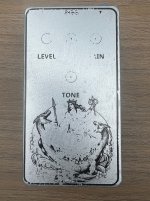
Unfortunately this didn't fare too well. An hour bake at 175F, followed by air drying/curing at room temperature for 48 hours. I took a picture this time, see below. I'm recycling the graphic I used for this build, so you can see what's missing. (And, perhaps ironically, I didn't get perfect transfer when I did that pedal either!)
What I don't understand is why some parts of the graphic transfer really well. Like the lower-right part of the graphic got nearly perfect transfer, and the border isn't too bad. So the potential is definitely there, I feel like I'm missing an ingredient or two.
Attachments
Last edited:
The Dishwasher Safe Mod Podge trial and error continues. I have one (mostly) success and one utter failure.
First, the failure. Thinking the raw aluminum was the culprit, I tried on a powder coated enclosure, specifically a "Brunken Blue" from StompBoxParts. I did not use a hair dryer, but baked at 175F for a little over an hour, then let it air dry/cure at room temperature overnight (roughly 12 hours). The result was basically only some border transferred, pretty much everything else remained on the decal paper. This is the same image I used for this build. Here's a photo of the enclosure and the decal paper after the oven bake and 12-hour cure time:

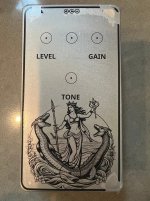
Next up is the semi-success. This is the same unfinished enclosure from the previous post. I sanded off the botched transfer with 180 grit sandpaper using an orbital sander. Then I used 320 grit paper with the orbital sander to smooth it even more. Then I applied four coats of Dishwasher Safe Mod Podge, waiting two hours between coats. I baked it for an hour at 175F, and let it sit over night (roughly 12 hours). I then hand-sanded it lightly with 1200 grit sandpaper. My intent was to smooth the Mod Podge down a bit, but it actually started to come off and expose the bare aluminum in a few places.
I applied the decal, then baked for about an hour at 200F. I let it cool down fully and sit for a couple hours. Here I got a nearly perfect transfer! The only places where the decal didn't transfer is where I had sanded away the base Mod Podge layer, which is the top two corners and the lower-right corner. So I suspect that had I not sanded down to the bare aluminum, I would have had a complete, perfect transfer:

Next up, I'm applying base coats of the Dishwasher Safe Mod Podge to the blue enclosure, just like I did with the bare aluminum.
I still need to try the hair dryer and/or hotter initial drying with a powder coated enclosure (i.e. to match @T-Go). My new hypothesis is that this Dishwasher Safe Mod Podge just doesn't adhere to the bare aluminum too well. Even if the base coats help the decal transfer, how durable the final coating is remains to be seen. That it sanded off so easily with very light 1200 grit sandpaper is not encouraging.
Anyway, I still need to try the hair dryer and/or hotter initial drying with a powder coated enclosure (i.e. to match @T-Go exactly). I've got some cheaper powder coated enclosures on order from Tayda. (I didn't want to risk my nice StompBoxParts Bruken Blue enclosure with higher temps.)
First, the failure. Thinking the raw aluminum was the culprit, I tried on a powder coated enclosure, specifically a "Brunken Blue" from StompBoxParts. I did not use a hair dryer, but baked at 175F for a little over an hour, then let it air dry/cure at room temperature overnight (roughly 12 hours). The result was basically only some border transferred, pretty much everything else remained on the decal paper. This is the same image I used for this build. Here's a photo of the enclosure and the decal paper after the oven bake and 12-hour cure time:
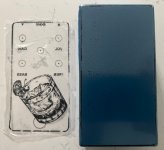
Next up is the semi-success. This is the same unfinished enclosure from the previous post. I sanded off the botched transfer with 180 grit sandpaper using an orbital sander. Then I used 320 grit paper with the orbital sander to smooth it even more. Then I applied four coats of Dishwasher Safe Mod Podge, waiting two hours between coats. I baked it for an hour at 175F, and let it sit over night (roughly 12 hours). I then hand-sanded it lightly with 1200 grit sandpaper. My intent was to smooth the Mod Podge down a bit, but it actually started to come off and expose the bare aluminum in a few places.
I applied the decal, then baked for about an hour at 200F. I let it cool down fully and sit for a couple hours. Here I got a nearly perfect transfer! The only places where the decal didn't transfer is where I had sanded away the base Mod Podge layer, which is the top two corners and the lower-right corner. So I suspect that had I not sanded down to the bare aluminum, I would have had a complete, perfect transfer:
Next up, I'm applying base coats of the Dishwasher Safe Mod Podge to the blue enclosure, just like I did with the bare aluminum.
I still need to try the hair dryer and/or hotter initial drying with a powder coated enclosure (i.e. to match @T-Go). My new hypothesis is that this Dishwasher Safe Mod Podge just doesn't adhere to the bare aluminum too well. Even if the base coats help the decal transfer, how durable the final coating is remains to be seen. That it sanded off so easily with very light 1200 grit sandpaper is not encouraging.
Anyway, I still need to try the hair dryer and/or hotter initial drying with a powder coated enclosure (i.e. to match @T-Go exactly). I've got some cheaper powder coated enclosures on order from Tayda. (I didn't want to risk my nice StompBoxParts Bruken Blue enclosure with higher temps.)
T-Go
Member
Cool artwork! The graphics transfer part of the pedal building process is definitely the most frustrating part for me. Lots of trial and error involved. I actually bought a cheap blow dryer just so I wouldn't kill my wife's blow dryer, and then she would kill me. I really do think there's something to the direct heat from a blow dryer vs an oven. When I was a kid, we had these transfer sheets for model cars and whatever, where you would take a tongue depressor and rub the back of the sheet to transfer the decal. I believe the direct heat from the blow dryer has a similar releasing effect. Nevertheless, I've still had failures with the blow dryer method, but again, it's all trail and error with regard to all the different elements involved. Best of luck to you!
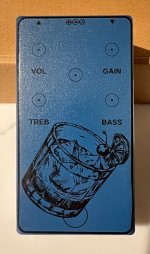
I really do think there's something to the direct heat from a blow dryer vs an oven. When I was a kid, we had these transfer sheets for model cars and whatever, where you would take a tongue depressor and rub the back of the sheet to transfer the decal. I believe the direct heat from the blow dryer has a similar releasing effect. Nevertheless, I've still had failures with the blow dryer method, but again, it's all trail and error with regard to all the different elements involved. Best of luck to you!I keep meaning to post pics, but: I've since done two more enclosures where, before applying the actual decal, I first applied about three coats of Dishwasher Safe Mod Podge (DSMP), waiting two hours between applications, and then baking for an hour at 200F. The difference between these and Andromeda above is that I didn't sand before applying the decal. I then baked with the decal film for another hour at 200F. The two enclosures where I used this process have come out perfect, 100% image transfer. After it's cooled completely, I then apply another three coats of DSMP (two hours between coats), and yet another hour bake at 200F. So the total process looks like this:
The only thing that remains to be seen is how durable/long-lived the DSMP is. That it sanded off so easily does give me pause. But, this DSMP is cheap, readily available, non-toxic, and water-based/easy cleanup. So if it holds up, it's a pretty compelling alternative to the Sunnyscopa glue.
Edit: I just posted my Delegate Boneyard Edition build report, where I used a DWMP-finished enclosure. You can see in the pics in that build report, it has developed tiny cracks that source from a couple of the holes that I drilled for the pots. I'm pretty sure these showed up sometime after I drilled, and not during the drilling. As I said in the build report, it's a Tayda Chrome finish, which are sort of infamous for their fragility, so not sure if it's the DSMP or just the powder coat itself. Anyway, I attached another enclosure (Brunken Blue from StompBoxParts) that I finished with DSMP, but I haven't drilled it yet.
- Clean enclosure thoroughly, wipe down with rubbing alcohol
- Apply three coats of DSMP, letting air-dry at least two hours between coats
- Bake for one hour at 200F, let fully cool
- Apply film-free decal using DSMP (same process as if using the Sunnyscopa transfer agents)
- Bake again for one hour at 200F, let fully cool
- Carefully, slowly remove decal film
- Apply three coats of DSMP, letting air-dry at least two hours between coats
- Do a final hour bake at 200F
The only thing that remains to be seen is how durable/long-lived the DSMP is. That it sanded off so easily does give me pause. But, this DSMP is cheap, readily available, non-toxic, and water-based/easy cleanup. So if it holds up, it's a pretty compelling alternative to the Sunnyscopa glue.
Edit: I just posted my Delegate Boneyard Edition build report, where I used a DWMP-finished enclosure. You can see in the pics in that build report, it has developed tiny cracks that source from a couple of the holes that I drilled for the pots. I'm pretty sure these showed up sometime after I drilled, and not during the drilling. As I said in the build report, it's a Tayda Chrome finish, which are sort of infamous for their fragility, so not sure if it's the DSMP or just the powder coat itself. Anyway, I attached another enclosure (Brunken Blue from StompBoxParts) that I finished with DSMP, but I haven't drilled it yet.
Attachments
Last edited:

analog_bham
Well-known member
i tried the GW-1 Pro on a powder coated enclosure from LMS. applied glue directly to the decal rather than the surface of the enclosure, baked at 225F for 10 minutes, cooled completely and transfer was perfect.Hmmm, I’m about to order some cheap powder coated enclosures to try on, since the bare aluminum is starting to look increasingly suspicious. IME the W1-PRO glue doesn’t work well on powder coated surfaces, but is pretty good on raw aluminum. So there’s definitely a surface-glue compatibility dimension to this.
In the meantime, I’m making one more bare aluminum attempt. After reading some random stuff about Mod Podge curing, I decided to try a longer bake at a lower temperature. I did a full hour at 175F. And I’m also going to let it cure at room temp for at least 24 hours before I peel off the film.
I wish I’d taken pictures of my botched attempts, but I’m pretty sure this most recent attempt was noticeably worse. I remember feeling like I had 50ish% transfer on the first attempt, and maybe 10% most recently. My thinking is, more heat seemed to be worse, so I’m going in the opposite direction this time around.
Printer toner I suppose could be at play, but I’d assume that since my toner works with the Sunnyscopa glues that it should be ok.
i have since done three additional bare aluminum enclosures with perfect transfers. i think that the key might be the direct application of the glue to the decal itself rather than the enclosure. that's really the only variable for me between these recent successes and the prior failures.
i do like the idea of the DSMP as it's readily available. i'm barely dented this bottle of GW-1 Pro though so that might be a battle i save for another day.
T-Go
Member
Glad to hear that worked for you. I know that going to FedEx Office and getting the printer settings straight to achieve optimum results is a bit of a struggle too. It seems that more ink printed to the transfer sheet produces better results.i tried the GW-1 Pro on a powder coated enclosure from LMS. applied glue directly to the decal rather than the surface of the enclosure, baked at 225F for 10 minutes, cooled completely and transfer was perfect.
i have since done three additional bare aluminum enclosures with perfect transfers. i think that the key might be the direct application of the glue to the decal itself rather than the enclosure. that's really the only variable for me between these recent successes and the prior failures.
i do like the idea of the DSMP as it's readily available. i'm barely dented this bottle of GW-1 Pro though so that might be a battle i save for another day.