3PDT switch pop

Rpschultz13

Well-known member
Hi,

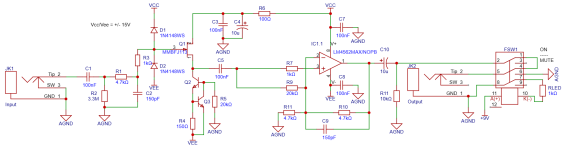
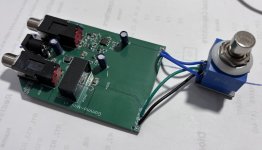
I have a circuit I've been working on. Newest iteration has switch pop that I didn't have before - this is usually considered DC offset across the switch hitting the audio path. I've simplified the circuit to just the below, a JFET and buffer. The switch is simply wired as a test case, to pass signal or mute. I've tried different values of R11. Initially had nothing, then 1M, lastly 10k. The 10k worked for a few seconds but eventually the charge built up and wouldn't go away.

In a previous iteration, JK1 went directly to the switch, and then the JFET, buffer and rest of circuit. But to cut down on noise pickup I wanted the JFET as close to the jack as possible so I rearranged the routing as such. I'm not sure if that's related to the switch pop or not. But the previous version doesn't have switch pop.

Any ideas?

1780777296169.png
IMG_8182.jpeg
 
Last edited:
It looks like the jack side of C1 doesn't have anywhere to discharywhen the effect is bypassed. You could add a pull-down resistor, or modify the switching so that the effect input is grounded in bypass. Either approach should get rid of any popping coming from C1.
 
It looks like the jack side of C1 doesn't have anywhere to discharywhen the effect is bypassed. You could add a pull-down resistor, or modify the switching so that the effect input is grounded in bypass. Either approach should get rid of any popping coming from C1.

Please elaborate. Wouldn't R2 serve as a PDR for C1? It would be easy to add a 1M across the tip and ground of the jack. Should R2 go BEFORE C1? I guess I don't understand the difference for a non-polarized cap.
 
You should be shunting the input to ground, not the output.

You're probably hearing that big 10uF charge/discharge with each switch cycle.

EDIT: Nevermind, I see now that the bypass switching isn't actually part of your circuit and you've just drawn the 3PDT switching (I think?)...
 
Generally, unconnected capacitor legs pop when you reconnect them. R2 giving C1 a way to drain makes sense, but it's hard to know exactly what's happening at the other side of the cap. Adding a resistor to ground on that side means you have a well-defined path to equalize potential. it will also reduce your input impedance: an AC signal will see the PDR in parallel with R2. That's why I favor grounding input caps.

All that said, it may be the popping is happening somewhere else. I'd slap a 1M resistor to ground from the input and see what happens.
 
Last edited:
Well, that worked! 2.2u and 10k to ground.
Interesting, if I click it a few times in a row I hear a thin click. But give it 5s and there's no click. So that means it's bleeding off but not fast enough if I click a few times in a row?
That's a cutoff of 7 Hz. I could lower the 10k down to 2k without it getting into the guitar realm. Would that help?
 
Here's chatgpt's answer:


⚡
Why electrolytics pop more than film caps
1. Electrolytic leakage current is orders of magnitude higher
A typical small electrolytic (like your 10 µF):
• Leakage: 1–10 µA is normal
• That leakage charges the node feeding the 3PDT
• When you stomp → the charged node dumps → pop
A 2.2 µF film cap:
• Leakage: picoamps to low nanoamps
• Essentially zero DC buildup
• Nothing to discharge → no pop
This is the main reason.
---
2. Electrolytics have dielectric absorption
Electrolytics “soak up” charge and then release it slowly.
So even if you think the node is at 0 V, the cap can rebound a few tens of millivolts.
Film caps have extremely low DA, so they don’t “remember” charge.
---
3. Electrolytics have polarity and bias quirks
If the DC bias across the cap is near zero (common in audio coupling):
• Electrolytics behave poorly
• Leakage increases
• Capacitance shifts
• The node becomes more unstable
Film caps don’t care about polarity or bias.
---
4. Electrolytics have higher ESR and ESL
This doesn’t directly cause pop, but it does make the transient sharper because the cap can’t dump charge smoothly.
Film caps have low ESR → smoother behavior.
 
Back
Top