
Fama
Well-known member
I've been wondering about a way to test and/or measure what different diodes sound like, and more accurately if they indeed sound different when used for clipping.
To elaborate, I know the biggest difference between different diodes we use for clipping is the forward voltage. To simplify things, lower value means more clipping at a similar signal level. However, that doesn't technically make them sound different, right? If you manipulate the signal level so that the clipping happens at a similar level in proportion to the actual waveform, it should sound the same, just quieter/louder. But that model for how a diode works isn't quite how it works in real life.
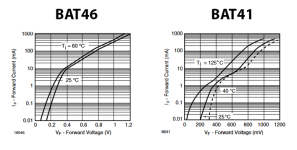
Looking at actual measurements of diodes (thanks to the excellent database by thomasbe86 here https://thomasbe86.github.io/plotly-plot/Diodes_Avg_Plotly.html), it looks like the "no conducting until forward voltage is hit, then dumping everything straight to ground" for hard clipping is not quite accurate. But rather there is a gradual increase before it starts flowing freely - this is the part I'm less sure about, so please correct me if I got something wrong here!
As far as I understand the full view is somewhat misleading in that usually the current is much lower in guitar pedals than what the measurement was done at, but you can zoom in - the results might be inaccurate though, since it's not what the tool was intended to measure.
However, all that matters is that it's not quite as simple as "no conducting and then fully conducting". The important question is, does that make an actual difference in the sound of a pedal that a human can hear?
The naive answer would be "just try out different diodes, they obviously sound different", but that ignores the forward voltage difference which absolutely makes a difference. So my question is, how would you measure and/or test it so you can account for the forward voltage difference? And secondarily, is it worthwhile to even test it, or is it just irrelevant nitpicking? You can often read advice like "it doesn't really matter what kind of diode it is", but then you often run into "my five dollar germanium diodes sound warmer/creamy/whatever" or "LED's sound more open". A lot of that is due to the different VF I believe, but is it all that?
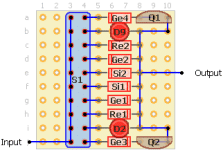
The first idea I had is using an interface to feed a signal to a circuit which only has clipping diodes going to ground and nothing else, and then returning back to the interface. Then you could digitally match the level of the signal going to the circuit so that the resulting signal is at a similar enough level to account for the VF difference. But I'm not sure if that would really tell you anything.
There's also leakage in germanium diodes, and I don't know how that affects things - does it effectively just lower the whole signal by leaking a certain amount to ground all of the time, or is it also more complicated? And if it is, does that make a perceivable difference or not?
Tl;dr: How would you test how different diodes sound when used for clipping outside of VF difference?
To elaborate, I know the biggest difference between different diodes we use for clipping is the forward voltage. To simplify things, lower value means more clipping at a similar signal level. However, that doesn't technically make them sound different, right? If you manipulate the signal level so that the clipping happens at a similar level in proportion to the actual waveform, it should sound the same, just quieter/louder. But that model for how a diode works isn't quite how it works in real life.
Looking at actual measurements of diodes (thanks to the excellent database by thomasbe86 here https://thomasbe86.github.io/plotly-plot/Diodes_Avg_Plotly.html), it looks like the "no conducting until forward voltage is hit, then dumping everything straight to ground" for hard clipping is not quite accurate. But rather there is a gradual increase before it starts flowing freely - this is the part I'm less sure about, so please correct me if I got something wrong here!
As far as I understand the full view is somewhat misleading in that usually the current is much lower in guitar pedals than what the measurement was done at, but you can zoom in - the results might be inaccurate though, since it's not what the tool was intended to measure.
However, all that matters is that it's not quite as simple as "no conducting and then fully conducting". The important question is, does that make an actual difference in the sound of a pedal that a human can hear?
The naive answer would be "just try out different diodes, they obviously sound different", but that ignores the forward voltage difference which absolutely makes a difference. So my question is, how would you measure and/or test it so you can account for the forward voltage difference? And secondarily, is it worthwhile to even test it, or is it just irrelevant nitpicking? You can often read advice like "it doesn't really matter what kind of diode it is", but then you often run into "my five dollar germanium diodes sound warmer/creamy/whatever" or "LED's sound more open". A lot of that is due to the different VF I believe, but is it all that?
The first idea I had is using an interface to feed a signal to a circuit which only has clipping diodes going to ground and nothing else, and then returning back to the interface. Then you could digitally match the level of the signal going to the circuit so that the resulting signal is at a similar enough level to account for the VF difference. But I'm not sure if that would really tell you anything.
There's also leakage in germanium diodes, and I don't know how that affects things - does it effectively just lower the whole signal by leaking a certain amount to ground all of the time, or is it also more complicated? And if it is, does that make a perceivable difference or not?
Tl;dr: How would you test how different diodes sound when used for clipping outside of VF difference?