El Sol - Gating Issue

ckendall924

New member
I know this has been posted previously and resolved, but I'm having this same issue and cannot resolve it using any of the suggestions on the previous post.

I get clean bypass. LED turns on, great big Acapulco Gold sound when I dig in. But the sustain dies abruptly with a fuzzy gated sound. The signal even dies completely and back on in a sort of swelling sound as a chord is allowed to ring out. (It's kinda cool, but also not the intended sound with this circuit.)

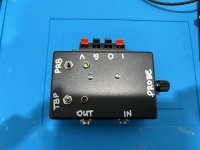
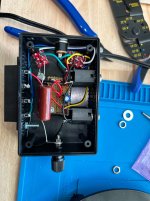
I've posted some pics below. (Just one thing to note, the pic of the back of my pcb should've been updated. I reflowed all of my solder joints as a good measure. Also, I have 2 sets of the JRC386 chips. I swapped out the IC's to see if that would do the trick. No success.)

Any ideas would be helpful.
 

Attachments

  • tempImagenrVXbJ.png
    tempImagenrVXbJ.png
    4.3 MB · Views: 48
  • tempImageb1jX9f.png
    tempImageb1jX9f.png
    4.2 MB · Views: 46
  • tempImagenzZFov.png
    tempImagenzZFov.png
    4 MB · Views: 45
I know this has been posted previously and resolved, but I'm having this same issue and cannot resolve it using any of the suggestions on the previous post.

I get clean bypass. LED turns on, great big Acapulco Gold sound when I dig in. But the sustain dies abruptly with a fuzzy gated sound. The signal even dies completely and back on in a sort of swelling sound as a chord is allowed to ring out. (It's kinda cool, but also not the intended sound with this circuit.)

I've posted some pics below. (Just one thing to note, the pic of the back of my pcb should've been updated. I reflowed all of my solder joints as a good measure. Also, I have 2 sets of the JRC386 chips. I swapped out the IC's to see if that would do the trick. No success.)

Any ideas would be helpful.
Hey im having this exact same problem, did you find a solution/identify the issue?
 
Hey im having this exact same problem, did you find a solution/identify the issue?
100% for the OP and yourself... The short answer is check your component values.. verify any cold joints, solder bridges... and make yourself a circuit tracer to hook up and trace the circuit per the schematic.... it will point you to the exact spot the issue starts..
 
Last edited:
... and make yourself a circuit tracer to hook up and trace the circuit...

Isn't that why we have Robert?


Lots of info out there, folks; try searching "audio-probe", "circuit-probe", and "Debugging tools"

It's a cap, a jack/plug and some wire.
audio_probe DIY plug, cap, wires....gif
Slightly better idea, use a jack and a regular lead...
audio_probe_socket1 BETTER AUDIO PROBE Female.gif

Vids on yootoob to show you how to use it.

If you've got a Protoboard Micro (or big protoboard), it's very easy to chuck a cap on it and add a jumper to start probing.

An audio-tracer /probe or whatever you want to call it is easy enough to make a standalone unit, but I use my Protoboard Micro all the time and then don't have to make/loose/find/not-find/make-again the stand-alone audio-probe.
 
Last edited:
Isn't that why we have Robert?


Lots of info out there, folks; try searching "audio-probe", "circuit-probe", and "Debugging tools"

It's a cap, a jack/plug and some wire.
View attachment 119699
Slightly better idea, use a jack and a regular lead...
View attachment 119700

Vids on yootoob to show you how to use it.

If you've got a Protoboard Micro (or big protoboard), it's very easy to chuck a cap on it and add a jumper to start probing.

An audio-tracer /probe or whatever you want to call it is easy enough to make a standalone unit, but I use my Protoboard Micro all the time and then don't have to make/loose/find/not-find/make-again the stand-alone audio-probe.
yah.... I've finally learned this is the way to do it and it's usually one of the first things I do now when something doesn't fire right up... You guys have taught me a ton.
 
Back
Top