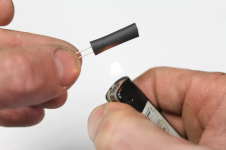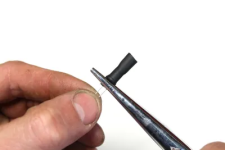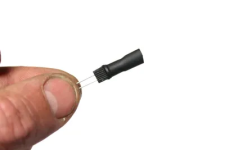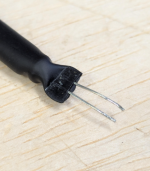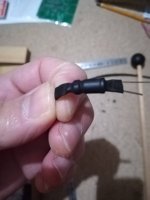
I am testing/rebuilding and copying an existing optocoupler from one of my pedals. The one in the particular pedal was assembled in a way that a LED and LDR is turned towards each other, and they are inserted in this manner into a heatshrink tube, that was shrinked onto them to make a firm grip. Both ends of the tube was sealed by melting the ends. I guess the ends were pressed together with some hot pliers.
The problem is that I cannot replicate this sealing method. I have pliers that have a shape that makes them ideal for this purpose. I put the tip of the pliers into candle flame, but when they are hot enough and I clamp them onto the ends of the tube, the material of the tube melts together between the protruding leads of the components, but over the leads, the tube material either flows away or sticks onto the pliers. And this way, a little hole will remain around the leads.
The only way I managed to seal the ends successfully is to keep the end of the tubes (with the component inside the tube) into candle flame for a second, and then press down on the ends with a small piece of rectangular wood. Then a uniform firm seal will be created. But why I worry about using this method is that this way, the LDR itself will be very close to the portion of the tube that I put into the candle flame.I worry about that that momentary heat stress will melt the epoxy on the LDR and the cadmium will be released.
Do I need to worry about this indeed, or the LDR epoxy is much more durable than that? Can you recommend any safer solution that can make sealing the tube more secure and successful? I also thought about sealing the ends with cyanoacrylate glue, but I am not sure what happens if some excess glue flows into the tube and reaches the epoxy of the LDR. I have experienced in the past that certain glues react heavily with plastic, and some can dissolve them.