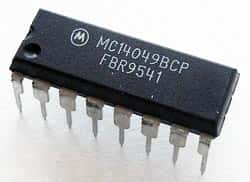
I'm not so sure about that. Just because ON Semiconductor calls them a "buffer," which is a pretty generic term in the industry, doesn't mean that they are buffered internally. FYI, when a CMOS device (usually an inverter) is labeled "buffered," it means there are cascaded stages. The CD4050 will always be "buffered" because it takes an even number of stages to make a non-inverting gate.
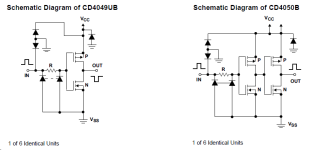
Some manufacturers show us a schematic of what's inside; ON Semi does not. I'd have to test one to be sure one way or the other. Here's what's inside the TI devices. Each complementary pair of P & N devices inverts the signal.
View attachment 15727
The reason it's important to use an unbuffered device in an analog application is that only unbuffered devices can be biased into linear operation. The CD4050 is NOT interchangeable with a CD4049 no matter who makes it or what suffix is tacked onto the part number because the CD4049 inverts and the CD4050 does not.
Yes, you are correct about the CD4050 and its diagram. The "buffered" version of the 4049 has one more pair of P & N devices so it "inverts" like the unbuffered 4049. So one pair for the unbuffered 4049, 2 pair for the 4050 and 3 pair for the buffered 4049.
Again, they stopped making the buffered 4049 in the 1990s, probably because of redundancy. What got me on to this search in the first place was that I read somewhere that "buffered" cmos ICs will provide a better square wave than unbuffered Cmos, so I had to try myself. This is where I hunted down the 4049BE or buffered version of the 4049. First I tried it out in my Red Llama and the sound was atrocious, all spitty and choppy sounding. This is because the extra pairs couldn't be biased correctly, like you stated. Then I tried that same IC as a clock buffer in a flanger project that I had. I ran the clock at the specified 1.3mHz and the square wave wasn't any better than with the 4049UBE. So, basically, my hunt was a waste of time but I did learn something.
I think the confusion sets in because these ICs are called hex inverters or "hex buffers" even though the 4049 is an unbuffered hex buffer, er, I mean hex inverter... See what I mean? Now, is everyone confused???
One more thing I'd like to add: The CD4050 works fine as a clock buffer in place of the CD4049. Or at least in the pedal projects I've made, like flangers, delays, etc.
One more thing I'll add too:
I have bought 4049BE from fleabay which ended up being unbuffered 4049 ICs, so the UBE and BE suffixes aren't in strict adherence. My best test to determine whether the 4049 is buffered or unbuffered is to pop one in a Red Llama. If it sounds nice, it's unbuffered. If it sounds like $hit, it's buffered. BTW, a buffered 4049 will sound similar to a 4050 in a Red Llama.