
You are using an out of date browser. It may not display this or other websites correctly.
You should upgrade or use an alternative browser.
You should upgrade or use an alternative browser.
Calamity Fuzz jfet bias.
- Thread starter kizzer
- Start date

Chuck D. Bones
Circuit Wizard
I just fixed a Calamity for a friend. Once I got the right J201s in there, Q1's Vd was about 4V, Q2's Vd was 0.5V. Not every J201 will work unless you feel like mucking about with the drain resistors. That circuit is very picky about JFETs. You need ones with a very low Vp, like -0.2V or so. Fairfield must have to hand-pick the ones they put in their production pedals.

SYLV9ST9R
Well-known member
Yes, they do (from what I remember my friend who works there telling me about the Barbershop, that's why I replaced the 2 bias resistors with trimpot on my Chop Shop build).I just fixed a Calamity for a friend. Once I got the right J201s in there, Q1's Vd was about 4V, Q2's Vd was 0.5V. Not every J201 will work unless you feel like mucking about with the drain resistors. That circuit is very picky about JFETs. You need ones with a very low Vp, like -0.2V or so. Fairfield must have to hand-pick the ones they put in their production pedals.

Dali
Well-known member
I have a Calamity Fuzz waiting to be build. I also have about 20 PedalPCB MMBFJ201 arriving this week but I don't know how to test drain voltage on these at all.
I'm a total ignorant in electronics (even after more than 15 PedalPCB built, kudo to our leader for that!). Just check my signature.
I have this multimeter but never use one:

Any tip, trick, link? I tried YouTube without success (got cars battery checks mainly...)
Thanks i advance.
I'm a total ignorant in electronics (even after more than 15 PedalPCB built, kudo to our leader for that!). Just check my signature.
I have this multimeter but never use one:
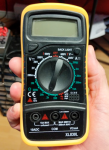
Any tip, trick, link? I tried YouTube without success (got cars battery checks mainly...)
Thanks i advance.
Hi there
You'll be testing a 9V circuit, so set the Multimeter to the nearest higher value, which looks to be 20V on your Multimeter.
I used the SMD J201's on my build, had to solder them to the adaptors myself, bit of a pain!!! First of all I would suggest (if you don't already) using SIPP sockets, so you can change transistors if need be. And along the same lines socket the R4 resistor, this is the 16K resistor and this is on the drain of Q1.
With the circuit together measure the input voltage to the circuit with your multimeter. Touch a Ground Pad or Grounded point with the Black probe and touch the V+ pad of the circuit with the Red Probe. In my case I had 9.27V. I always start unless specified otherwise to bias the drain at half the input voltage, which for me was around 4.6V.
The J201 adaptor is marked DSG for Drain,Gate and Source. So with your Black probe touching Ground, touch D (Drain) with your Red probe to give you your reading. In my case it was at 3.62V with the 16k resistor, so I needed to lower the resistor value. 13K got me 4.65V, which sounds great.
You'll be testing a 9V circuit, so set the Multimeter to the nearest higher value, which looks to be 20V on your Multimeter.
I used the SMD J201's on my build, had to solder them to the adaptors myself, bit of a pain!!! First of all I would suggest (if you don't already) using SIPP sockets, so you can change transistors if need be. And along the same lines socket the R4 resistor, this is the 16K resistor and this is on the drain of Q1.
With the circuit together measure the input voltage to the circuit with your multimeter. Touch a Ground Pad or Grounded point with the Black probe and touch the V+ pad of the circuit with the Red Probe. In my case I had 9.27V. I always start unless specified otherwise to bias the drain at half the input voltage, which for me was around 4.6V.
The J201 adaptor is marked DSG for Drain,Gate and Source. So with your Black probe touching Ground, touch D (Drain) with your Red probe to give you your reading. In my case it was at 3.62V with the 16k resistor, so I needed to lower the resistor value. 13K got me 4.65V, which sounds great.
Chuck D. Bones
Circuit Wizard
Did it not sound great with the 16K drain resistor?I ended up biasing Q1 drain to 4.6V by swapping the 16k resistor for a 13k. This pedal sounds great!

Did it not sound great with the 16K drain resistor?
Sounded markedly better biased to 4.65V than at 3.6V.
thelaconic
New member
I've tried J201s from three different sources, some through-hole and some SMD, and I can't find any with Vp that low. The best I can find are around -0.7V. Is this just a non-starter and I need to keep looking, or is there something else I can do?I just fixed a Calamity for a friend. Once I got the right J201s in there, Q1's Vd was about 4V, Q2's Vd was 0.5V. Not every J201 will work unless you feel like mucking about with the drain resistors. That circuit is very picky about JFETs. You need ones with a very low Vp, like -0.2V or so. Fairfield must have to hand-pick the ones they put in their production pedals.
Chuck D. Bones
Circuit Wizard
Unfortunately, there is nothing else you can do short of changing resistor values. If you do that, then it won't sound like a Calamity any more.
If you are set on building an authentic Calamity, then you'll have to keep buying and testing J201s. The good news that any legit J201s you buy are not scrap, they can be used in other pedals.
If you are set on building an authentic Calamity, then you'll have to keep buying and testing J201s. The good news that any legit J201s you buy are not scrap, they can be used in other pedals.
thelaconic
New member
Thanks. I'll keep looking.Unfortunately, there is nothing else you can do short of changing resistor values. If you do that, then it won't sound like a Calamity any more.
If you are set on building an authentic Calamity, then you'll have to keep buying and testing J201s. The good news that any legit J201s you buy are not scrap, they can be used in other pedals.
bilisnegra13
Member
I just finish one unit, and didn't read this until now so i wish i could test their Vp before soldering them in the pcb. I used SMD J201's and trimpots instead of Drain resistors, funnywise i could get the bias values you mentioned here Q1=4.5V , Q2=0.5V, maybe i got lucky, pedal sound nice but i haven't compared to the originalI just fixed a Calamity for a friend. Once I got the right J201s in there, Q1's Vd was about 4V, Q2's Vd was 0.5V. Not every J201 will work unless you feel like mucking about with the drain resistors. That circuit is very picky about JFETs. You need ones with a very low Vp, like -0.2V or so. Fairfield must have to hand-pick the ones they put in their production pedals.
My question is, if i could bias my j201's to those "correct" Voltages, im good to go? or still would be better to check their Vp to make sure everything is as it should be?
Chuck D. Bones
Circuit Wizard
You probably got lucky. You can measure Vp in-circuit if you lift one lead on R5 & one lead on R7. Power up and connect you DMM from Q1-S to GND. The voltage you read is essentially Vp. Then measure from Q2-S to GND.
bilisnegra13
Member
i tried now ,lift the leads conected to Source of Q1 and Q2 from R5 and R7 and measured Voltage with red probe to S and black probe to GND in my DMMYou probably got lucky. You can measure Vp in-circuit if you lift one lead on R5 & one lead on R7. Power up and connect you DMM from Q1-S to GND. The voltage you read is essentially Vp. Then measure from Q2-S to GND.
Q1 read 0.95V and Q2 was 0.75V but now, for some weird reason, i cant find the thread about the good specs for the J201 in this circuit
Chuck D. Bones
Circuit Wizard
Look at post #2. We're looking for Vp close to -0.2V. Your J201s are compliant with the J201 spec, but they are not suitable for this circuit.
bilisnegra13
Member
cool thanksLook at post #2. We're looking for Vp close to -0.2V. Your J201s are compliant with the J201 spec, but they are not suitable for this circuit.
( im found this from another post you made troubleshooting Glory Hole)
Measuring JFETs:
Vp
Connect drain to +9V.
Connect gate to GND.
Connect DMM between gate & source, + end at gate, measure voltage.
The voltage reading will be negative
i believe if i test them this way, its much better than test them in circuit as i did, with full 9V going to Drain instead of whatever was coming after the drain resistors (R4-R6) and did i got no negative V because i measure Source to GND in circuit, instead of Gate to Source for that method above?
Chuck D. Bones
Circuit Wizard
Testing that way is equivalent to the in-circuit test I described above. The only difference is meter polarity. If you want the true polarity, then connect the DMM + lead to GND (gate) and - lead to source. The drain and gate resistors don't impact the measurement because the the test currents are under 1μA.
Similar threads

- Replies
- 13
- Views
- 1K


- Replies
- 1
- Views
- 395
