when to use mlcc capacitors

BouncyBear

New member
hi
i am pretty new to pedal making and i was wondering why people uses mlcc caps and what benifits do they have and how can i tell when to use them when making a pedal thank you so much for your help

from sam
 
people use them because they are small.

otherwise wherever possible, it's best to use film caps.

but sometimes large values like 1uF (or larger) are too big (PCB footprint, overall size) in a film cap format, so either MLCC or electrolytic alternative may be used.
 
They’re mainly a higher quality replacement for ceramic disc caps. Usually used for very low capacitance values that film caps aren’t available in.

Is the quality difference between ceramic disc and MLCC discernible in most pedal circuits?
🤷‍♀️ Maybe not, but MLCCs are pretty cheap these days, so why not use them. That’s my logic anyway.
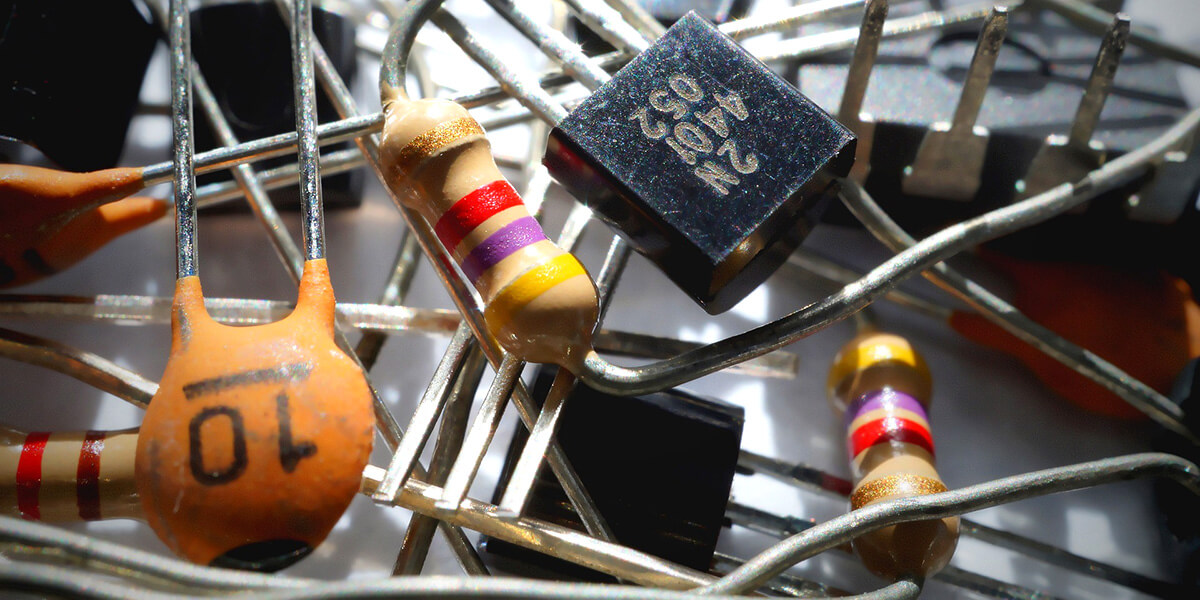
There’s a little more info here about which specific types to look for and why:
 
Last edited:
I've seen this movie before
Yes, but the reason it keeps getting asked is because there doesn't seem to be any straight answers. It's always, "i use this and it's works fine" or "try it and see". There is nothing wrong with experimentation but, I think the question that is being asked is more like.... what are the definitive sources for guidance on this so I don't have to waste my time with trial and error that's been done again and again.
 
Yes, but the reason it keeps getting asked is because there doesn't seem to be any straight answers. It's always, "i use this and it's works fine" or "try it and see". There is nothing wrong with experimentation but, I think the question that is being asked is more like.... what are the definitive sources for guidance on this so I don't have to waste my time with trial and error that's been done again and again.
MLCC are noisy, derate at higher voltage/capacitance changes with voltage change. If you must use them in the audio path it's advisable to use c0g, not x5r or x7r. NP0 are also an option, but seem rarer. MLCC can also be microphonic.
Some people don't care/can't hear a difference/etc
Best practice vs in practice for low voltage mostly low fidelity circuits.
If you want to go to the extreme, silver mica are an option. Quite, stable, but expensive.
How's that?
 
I use MLCC when the only alternative is a ceramic cap, or if there isn't space on the board for a film, or if for some reason the build doc calls for it. For instance, I'm building an Aion Xenotron, which needs 100nF MLCC's for the power supply and BBD filtering sections.

Typical values for an MLCC would be like 470pF, 27pF, 100pF, etc. Stuff that's too small to be a film.

I'll also use it in a 1uF value etc if there isn't space on the board for a film capacitor.
Yes, but the reason it keeps getting asked is because there doesn't seem to be any straight answers. It's always, "i use this and it's works fine" or "try it and see". There is nothing wrong with experimentation but, I think the question that is being asked is more like.... what are the definitive sources for guidance on this so I don't have to waste my time with trial and error that's been done again and again.
I googled "when should i use mlcc in a pedal" and this is what I found

If you want a more thorough answer, invest some time going down the rabbit hole of various electronic engineering type youtube videos. But the short and sweet answer that satisfies most peoples' patience is always going to be anecdotal
 
Would it be fair to say that.... Ideally film would be preferred in 99% of the use cases we care about in the pedal building world but realistically can't affordably be made for higher and lower capacities, so therefore we use mlcc for lower and electrolytic for higher value?
 
Would it be fair to say that.... Ideally film would be preferred in 99% of the use cases we care about in the pedal building world but realistically can't affordably be made for higher and lower capacities, so therefore we use mlcc for lower and electrolytic for higher value?

I’d say that’s a reasonable rule of thumb.

When going mlcc, you’ll note there are different chemistries. NP0/C0G should be your first choice with mlcc, but you’ll find those are only available in very small capacitance values. X7R is usually the next choice, mostly because that’s what’s readily available.
 
Anyone ever breadboard a circuit and audition these various capacitors types?

I use crummy mlccs with wild abandon.

Are we talking about human-discernible audible differences here?
It's very possible that the noise picked up from the pickups and amp self noise is 10 fold higher than mlcc. I've yet to see any experiments pertaining directly to guitar pedals.
A no knob(hardwired wide open) could be a good candidate, since the pots would have the largest variation among components.
 
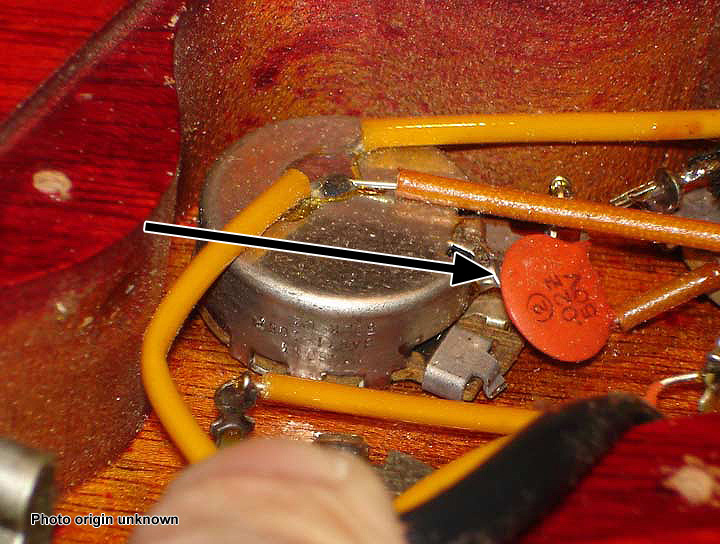
I love seeing old Fender and Gibson guitars that have a big ceramic capacitor for the tone control. I think of this kind of discussion every time.

ceramic_disc_cap_wm.jpg


NOS High Voltage Ceramic... "excellent sounding"

It may be that the limitations of the ceramic cap (noisy, etc) are mostly found in higher frequency applications and don't have as much, if any, effect at the lower freqs our circuits deal with.
 
MLCCs (with an X5R/X7R dielectric) are fine in the audio path (certainly as far as pedals go, at least) as long as any voltage across them is far less than their rated voltage. This avoids voltage-dependent loss of capacitance and distortion. I use 10% tolerance X7R rated at 50V (or more) and they're perfectly adequate in most places in 9V guitar circuits. When used as input/output coupling caps in particular, there's almost no AC across them at the frequencies of interest (they're almost as good as a short) so they won't affect the signal. In filters, I prefer to use C0G dielectric for values below 47nF or so. They're available in better tolerances such as 5% or less (this can be important in filters) and are inexpensive enough at low values.
 
Back
Top