Help with LFO ticking (Karaoke Chorus)

sumo

New member
Hi, first of all I am not sure if discussing other boards here is allowed so if it isn't feel free to remove this question.

I built a lectric-fx Karaoke Chorus (CE-1 "clone") and I have some ticking/thumping from the LFO. The weird thing is, the thump goes away if you turn the Depth knob down below around 80% (its gradual as you turn it down). If its turned up more than that, the thump gets longer and louder. It also follows the rate knob. This happens in all the effect modes (chorus, vibrato, wet) and it is not present when the effect is bypassed, so I don't think it is from bad wire routing. With depth dialled back, the effect is quiet and it works as expected so I think the fundamentals of the circuit are working.

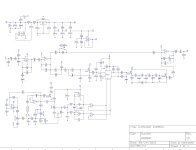
LectricFXKaraokeChorus.jpg

I usually test in chorus mode since it is less obnoxious but poking around with an oscilloscope, I can see the 15V output from the 78L15 also shows the thump as a definite sag of around 200mV. The sag corresponds to the rate/thump. VR on the schematic however is clean.
The triangle wave from pin 7 of the LM358 shows a clean triangular waveform but probing after R6, I get a triangle wave where the lower point becomes distorted. Rolling off the depth while probing this point shows it cleaning up and once it gets to a clean triangle wave again, the thumping disappears.
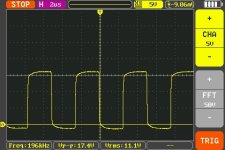
The square wave from pin 1 is a bit ragged on the corners and the thump seems to correspond to when the falling signal overshoots (?) on the way down and possibly going negative or getting clamped? There is no thump on the way up even though there is some overshoot.

Things I've tried:
  1. Remove the rate LED to take it out of the equation (no change)
  2. Try 3 other MN3007s (all from different sources and all behave in the same fashion in the circuit so MN3007 should be good)
  3. Remove the MN3007 altogether (thump still present but overall volume is reduced)
The below was then tried one at a time with the LED and MN3007 removed.
  1. Add 10pF cap across pins 2 and 7 of the LT1054 (there were some reports that newer LT1054s can cause heterodyning... this made no difference)
  2. Do the "soft square" mod mentioned elsewhere (Moosapotamus pdf. I lifted Pin 2 of LM358, inserted 75k resistor from pin to board, then added 0.047uF cap across pins 1 and 2. Values I used were a bit off since I just used what I had around, but the idea should be the same. No change.)
  3. To brute force it a bit, I placed a 100uF (yes, micro farad) cap across pins 1 and 2 of the LM358 and that smoothed the square and gave a prolonged distorted noise instead of a thump. Feeling adventurous I tried a 220uF and thump disappeared but the square wave was destroyed haha.
  4. I thought maybe increasing the square wave bias would help keep it off the 0 volt rail so I added a 150K resistor in parallel with R8 (no change)
  5. VR was a clean voltage so I tried lifting pin 2 of LM358 and jumpered to pin 5 (no change... although it was interesting to note that with pin 2 lifted and left floating, the thump was still there)
One thing I don't really understand is how the depth knob works. Twiddling it up and down while watching the output at pin 7 doesn't really show much change although the effect definitely does change. Is it just a really subtle change to the waveform? I would have expected the amplitude of something somewhere to change. Maybe I'm poking around the wrong spot? I would have thought the input clock of the MN3007 is just a clock so amplitude shouldn't be a factor?

So, I am at a bit of a loss as to where to look next. I have a (basic) oscilloscope although I am not well versed in its usage, but any pointers would be really welcome. I can also post some shots from my oscilloscope but I'll have to figure out how to get them off of there first...
Thank in advance!
 
Thanks guys for the tips!

@anevilspar7an I actually have some TL022s on order already. They'll probably be a while until they arrive. I wasn't sure they had appreciably lower power draw compared to the 358 and they also seem to have a faster slew rate but I'm basically up for trying anything. Thanks for a vote of confidence in them though!

@Scruffie I believe you are one of (or maybe the sole?) designer of the board so first, thanks so much for it. It sounds great when the thump isn't there which is why I am pretty determined to make it work.
I have looked over all the components in the power and LFO sections and all component values and polarities are correct. I guess the only deviation from the BOM is I use a TC4011BP in place of the CD4011BE but I believe they are equivalent. I didn't put that IC in a socket (didn't have any 14pin DIPs at the time) but I can unsolder that for testing is you think that would be worthwhile.

A couple of things popped into mind as I was checking:
  • Is the C8 tantalum cap super important? I believe it was the clock filter? I initially had a salvaged 1uF tantal (from an old Yamaha amp) in there and after seeing your post elsewhere about how the Tayda caps were not good, I bought a new tantal (Kemet T350) to put in there. It didn't change anything but I was just wondering if it had to be tantalum and what a bigger value would do...
  • I've run off of both an isolated DC supply and 9V battery. However both gave around 13.5V at the 15V test point (which also showed the thumping ripple incidentally). The DC power out actually read 8.6V or so unloaded, and the battery was 8.35V iirc. I have yet to try a fresh alkaline 9V battery since I can't find one in any stores nearby but will try that once I can get one. I might pick two up so I can try bypassing the LT1054 altogether and running 18V into the 15V regulator.
I'll poke around with the scope a little later and check the depth pot output and clock frequency. I'll also try and get some data off the scope to post here and take a shot of the build in case that helps.
 
OK, so I found out that all the 9V outs on my power supply are like 8.6V with no load but the adjustable sag simulating output when set to 9V actually outputs 9.3V or so so I plugged that in and the 15V TP is now 15.1V however the thump is still there.

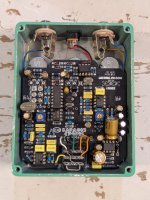
Here is the component side of the build:
KaraokeChorus.jpg
I don't think there is much out of the ordinary except a few series resistors here and there to make up for some of the values I didn't have. A couple of the big electrolytics wouldn't fit in the footprint so I had to get creative. I also put the MN3007 back since that didn't seem to make much difference. Rate LED still has one leg unsoldered. I also don't have any pot covers but I am pretty sure nothing is shorted there. Audio jacks are both grounded on chassis as well. DC Jack is not.

I managed to get some shots from the scope so here they are (all taken with probe grounded to output jack ground):

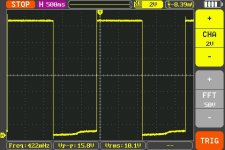
This is the trace from LM358 Pin 1. Top of the square looks OK, but the bottom is kinda ragged.
LM358_pin1.jpg

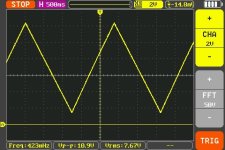
This is the LM358 Pin 7 output. Its a clean triangle wave.
LM358_pin7.jpg

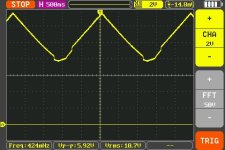
This is after R6 (before the depth pot). The bottom is distorted and I guess that is the source of the thump. Not really sure why its squashed up compared to the Pin 7 output... that's above my pay grade :LOL:
after_R6.jpg

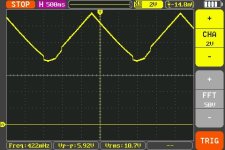
This is Pin 2 of the Depth pot at max setting. As expected its the same as above.
depthP2_MAX.jpg

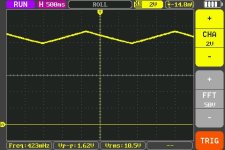
This is depth pot 2 set at a middle of the road depth.
depthP2_MID.jpg

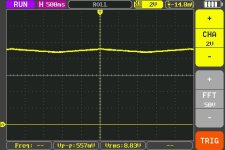
And this is the depth pot set at minimum.
depthP2_MIN.jpg

This is depth pot pin 2 with depth set just so the thump just disappears.
depthP2_nothump.jpg

This is Pin 11 of the 4011 when depth is set at max, but the sweep is in a non-thump region. Looks normal? One thing to note is that the min V here is about -1.2 or so volts. Is it supposed to go minus?
4011Pin11_normal.jpg

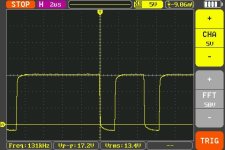
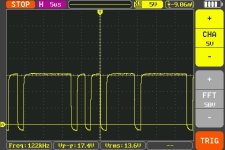
This is at pin 11 again but when the thump hits. You can see the clock goes a bit wonky.
4011Pin11_thump.jpg

Here is another shot of the clock during thump.
4011Pin11_thump2.jpg


Sorry for all the pictures.

@Scruffie So for your question about the clock frequency, I measured it with chorus rate at min and the depth set just as thump disappeared and it seemed to swing from about 160kHz to about 500kHz. I tried with depth max as well but it seemed to stay about the same except for the thump where it went a bit crazy due to the distortion. As I understand, the depth shouldn't affect the clock frequency.
Compared to the stock CE-1 frequency (66kHz~200kHz), this seems around the correct ballpark (since the clock for the Karaoke needs to be doubled for the MN3007)?
 
So the thump is probably less LFO tick and more the BBD thumping when the clock goes wonky.

Quickly try tacking some small caps in parallel with C1 & 2 (22pF or something) to see if getting the max clock frequency down will stop it overshooting, it is a little high, may be down to the chip brand.

Failing that, parallel a 100k resistor with R5 and see if that helps.

The LFO triangle has a distorted bottom by design, D3 is clipping off the triangle a little for a slight siney-triangle effect.

The square wave on the LFO is like that because it's smashing in to the ground rail but the LM358 isn't too fussed.
 
@Scruffie Hi, so I rummaged around the parts bin and found a couple of 27pf caps and a 75k resistor. Parallel-ing C1 and C2 with the 27pfs still left a thump, but it was more of a scratch now instead of a sharper thump. I then stuck the 75k across R5 and most of the thump has gone. I would imagine reducing the 75k a bit more (or just replacing R5 with a 7k resistor or so) and maybe upping C1 and C2 would get rid of the residual thump?

I also tried in Vibrato mode and the thump is still pretty loud. It was always louder than in Chorus mode and required more toning down on the depth knob to get rid of the thump. Is there a separate place to tame the clock for the vibrato circuit? Or is it just a matter of increasing C1 and 2 and lowering R5 until everything is quiet?

Frequencies for the clock after the mod are around 110kHz-350kHz in chorus mode and about 160kHz-430kHz in Vib mode.

I might also try and source a CD4011BE too to give that a whirl. Might take a while though.
 
Do you have a TL072 to try instead of the TL022? That might be an upgrade over the 358 in there.

Some other random advice:

Are your input or output wires close to the LFO at all? Those are big antennas that can pick up the quick voltage changes.

You could try beefing up the capacitance on GND<->VB, maybe even try getting a 100uF electrolytic near the LFO op-amp
to try to prevent the voltage sags. The fact that you're seeing the drops on your regulator makes me think something is
hitting it pretty hard.
 
@z2amiller Hi, thanks for the suggestions. Currently I don't have any TL072s around. I might be able to salvage one from one of my other pedals though.

As for input/output wires, they are as far away from the LFO as possible as is. I don't think they are a problem though as poking them around doesn't change the thump and there is no noise in bypass.

I've actually tried sticking a 220uF cap across the 15v rail with not much effect. Previously, I found I wasn't getting a full 9v out of my power sources so that could be the cause of the sag. Now, I have a solid 15v though after getting a proper 9v source. Still have thumping. Currently we're suspecting the clock frequency might be causing an issue for my Toshiba version of the 4011.
 
The LFO won't work with a TL072.

I really don't think the problem is LFO tick, it's more a VCO tick... obviously the LFO's swing does impact the amount of control voltage though and the swing does differ between chorus & vibrato mode.

Notice how your vibrato mode clock is higher than chorus now and that's now causing more thump so I'd say the problem is definitely occurring at the higher clock speeds.

However... the vibrato's sine wave should have a much smaller voltage swing than the triangle chorus and sit somewhere vaguely in the middle of the choruses range so I can't work out why you've got that disparity in clock frequencies.

You definitely have 1N4148 in D1-5?

What does your scope show (taken @ the R6/R5 junction) for both chorus and vibrato mode?

The TC4011 does have very mildly different specs to the CD4011, certainly worth seeing if the chip change helps anything... we know plenty of people have built this without issue so if there's definitely no value differences on your board or any salvaged caps that might be iffy, there's something afoot that's making your build different.

Reducing R5 with parallel resistors is shifting the control voltage a bit higher and slightly reducing the depth...
 
@Scruffie So I checked the Vibrato and Chorus clock frequencies and they aren't wildly off from each other.
Chorus = 100~400kHz
Vibrato = 130kHz~500kHz
Its hard to get exact numbers since it is always changing but that seems to the rough range.

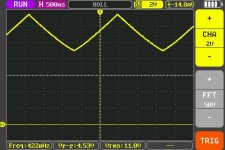
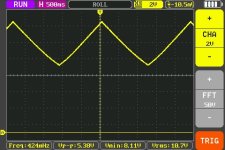
Here is the Chorus at R5/R6 junction, with the extra caps and resistor, and depth at max:
Cho.jpg

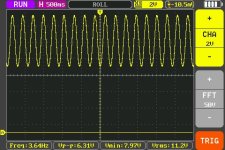
And this is the Vibrato, same conditions:
Vib.jpg

Amplitude of the vibrato sin wave seems to be around 1V larger than the triangle (I don't imagine frequency matters here).
It sounds like that shouldn't be the case :unsure:
Looking at it from a layman's perspective, it would be good to get the sin wave amplitude down a bit?

Tayda seem to have some CD4011BEs so I'll put an order in with them soon and try switching out the 4011.

As for the other parts of the build, I was using a few salvaged caps but after hearing the thump I replaced all of them. As it is now, everything was ordered in new for the build (bar the MN3007 which was pulled from working equipment).
The diodes *should* be 1N4148s and I was smart enough to orient them so the markings are visible... but only half way through installing so D1, D4 and D5 are definitely 1N4148s. I can't see D2 and D3's markings so can't confirm 100% but they were ordered at the same time and came in the same bag so... they probably are. I don't know if they are all good though. I'll need to pull them to test that. Maybe once I get the 4011 in I'll take things apart to double check values and component integrity around the LFO/Clock section.
 
@Scruffie OK, so I checked D4 and D5 and they had good connections, no shorts etc and they were connected to the surrounding components as per the schematic. I also removed them and they are marked 4148 and both tested good on my meter's diode mode (0.6V one way and open the other).
Just for laughs, I plugged it in without the diodes and scoped the R5/R6 junction and I still got a sin wave with not much change in amplitude compared to the trace above. Is that normal?
I don't have any spare 1N4148s so I'll have to pick some up.
Any other components I can mess around with there? It seems the sin generation chunk is possibly broken in one way or another.
If I was to rebuild it, it would be:
R22, R23, R24
C6, C7
D4, D5?
Are R4 and D3 part of the sin circuit?
Also, should I check VR for a specific voltage?
 
Back
Top