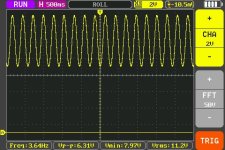
Hi, first of all I am not sure if discussing other boards here is allowed so if it isn't feel free to remove this question.
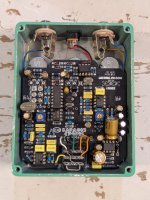
I built a lectric-fx Karaoke Chorus (CE-1 "clone") and I have some ticking/thumping from the LFO. The weird thing is, the thump goes away if you turn the Depth knob down below around 80% (its gradual as you turn it down). If its turned up more than that, the thump gets longer and louder. It also follows the rate knob. This happens in all the effect modes (chorus, vibrato, wet) and it is not present when the effect is bypassed, so I don't think it is from bad wire routing. With depth dialled back, the effect is quiet and it works as expected so I think the fundamentals of the circuit are working.

I usually test in chorus mode since it is less obnoxious but poking around with an oscilloscope, I can see the 15V output from the 78L15 also shows the thump as a definite sag of around 200mV. The sag corresponds to the rate/thump. VR on the schematic however is clean.
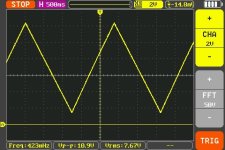
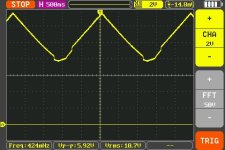
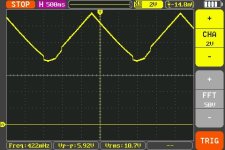
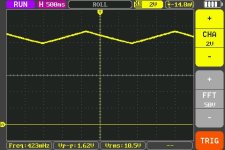
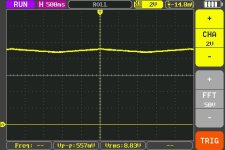
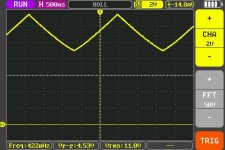
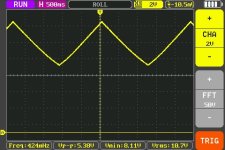
The triangle wave from pin 7 of the LM358 shows a clean triangular waveform but probing after R6, I get a triangle wave where the lower point becomes distorted. Rolling off the depth while probing this point shows it cleaning up and once it gets to a clean triangle wave again, the thumping disappears.
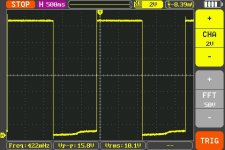
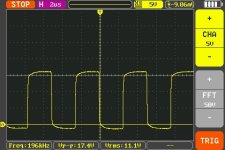
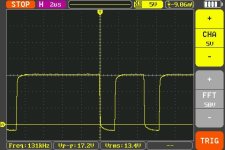
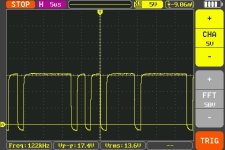
The square wave from pin 1 is a bit ragged on the corners and the thump seems to correspond to when the falling signal overshoots (?) on the way down and possibly going negative or getting clamped? There is no thump on the way up even though there is some overshoot.
Things I've tried:
So, I am at a bit of a loss as to where to look next. I have a (basic) oscilloscope although I am not well versed in its usage, but any pointers would be really welcome. I can also post some shots from my oscilloscope but I'll have to figure out how to get them off of there first...
Thank in advance!
I built a lectric-fx Karaoke Chorus (CE-1 "clone") and I have some ticking/thumping from the LFO. The weird thing is, the thump goes away if you turn the Depth knob down below around 80% (its gradual as you turn it down). If its turned up more than that, the thump gets longer and louder. It also follows the rate knob. This happens in all the effect modes (chorus, vibrato, wet) and it is not present when the effect is bypassed, so I don't think it is from bad wire routing. With depth dialled back, the effect is quiet and it works as expected so I think the fundamentals of the circuit are working.
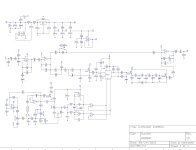
I usually test in chorus mode since it is less obnoxious but poking around with an oscilloscope, I can see the 15V output from the 78L15 also shows the thump as a definite sag of around 200mV. The sag corresponds to the rate/thump. VR on the schematic however is clean.
The triangle wave from pin 7 of the LM358 shows a clean triangular waveform but probing after R6, I get a triangle wave where the lower point becomes distorted. Rolling off the depth while probing this point shows it cleaning up and once it gets to a clean triangle wave again, the thumping disappears.
The square wave from pin 1 is a bit ragged on the corners and the thump seems to correspond to when the falling signal overshoots (?) on the way down and possibly going negative or getting clamped? There is no thump on the way up even though there is some overshoot.
Things I've tried:
- Remove the rate LED to take it out of the equation (no change)
- Try 3 other MN3007s (all from different sources and all behave in the same fashion in the circuit so MN3007 should be good)
- Remove the MN3007 altogether (thump still present but overall volume is reduced)
- Add 10pF cap across pins 2 and 7 of the LT1054 (there were some reports that newer LT1054s can cause heterodyning... this made no difference)
- Do the "soft square" mod mentioned elsewhere (Moosapotamus pdf. I lifted Pin 2 of LM358, inserted 75k resistor from pin to board, then added 0.047uF cap across pins 1 and 2. Values I used were a bit off since I just used what I had around, but the idea should be the same. No change.)
- To brute force it a bit, I placed a 100uF (yes, micro farad) cap across pins 1 and 2 of the LM358 and that smoothed the square and gave a prolonged distorted noise instead of a thump. Feeling adventurous I tried a 220uF and thump disappeared but the square wave was destroyed haha.
- I thought maybe increasing the square wave bias would help keep it off the 0 volt rail so I added a 150K resistor in parallel with R8 (no change)
- VR was a clean voltage so I tried lifting pin 2 of LM358 and jumpered to pin 5 (no change... although it was interesting to note that with pin 2 lifted and left floating, the thump was still there)
So, I am at a bit of a loss as to where to look next. I have a (basic) oscilloscope although I am not well versed in its usage, but any pointers would be really welcome. I can also post some shots from my oscilloscope but I'll have to figure out how to get them off of there first...
Thank in advance!