8" vs 4" Speakers for practice amp

phi1

Well-known member
I have some questions about speaker size kicking around and haven't found many satisfactory answers online. I thought I'd open it up here. Lots of generalizations for the sake of discussion.

Small practice amps often have 8" speakers. I've read people say that when they plug into a 12" cab, even cheap solid state amps such as Fender Frontman sound much better.

Question 1: Is the sound difference between a 12" and an 8" most importantly a difference in frequency response? As in, 12" cuts off around 3~5khz, to make the classic electric guitar sound we're all used to. Whereas, the 8" can produce more highs, so it sounds thin and harsh, somewhere in between a 12" amp and DI? Also 12" tends to have more lows.

Question 2: Has anyone tried running a cab sim pedal into an 8" speaker to approximate the 12" speaker sound? Assuming that an 8" will cut highs compared to a FRFR/PA, maybe a cab sim into an 8" would be too muffled. Maybe a customized IR or EQ curve that is less aggressive would help.

Question 3: Desktop amps like the Spark or Yamaha THR use small speakers (3" or 4") that apparently have decently good response over the whole frequency range. They use cab sim IR to match the sound of a guitar speaker (12" or whatever they're trying to mimic), but they can also stream Bluetooth audio and play it across the whole frequency range, so that sounds better than a 12" guitar amp speaker would. Has anyone experienced being happier with the sound of a desktop amp than an 8" practice amp?

So it seems like:
12" (or some prefer 10") = the sound that most guitarist like with the 3~5khz cutoff.
8" (with no cab sim) = Not full range, but more highs than 12". Kinda seems like the worst of both worlds...
3-4" (desktop amp or many studio monitors) = full frequency with cab-sim modelling.


Question 4: Are there 12" speakers than can perform the full range, or is it a physical limitation with that size of cone? It seems like FRFR/PA rely on tweeters to cover the high frequencies, so it seems like a universal physical limitation of 10-12".

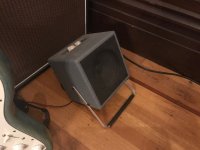
I did find one 4x4" speaker cab, which looks cool. More of the form factor of an 8" practice amp, compared to the desktop styles. I assume it performs similar to an FRFR, and you benefit from cab-sim to sound more like a 12".
 
An overgeneralization, but the larger the speaker, the more low end and more volume can go through. More speakers do not necessarily mean more volume. In other words, going from a 2x12 to a 4x12 doesn't mean your cab it 4x louder.
 
You might be overthinking it--what do you need from a practicing amp? My main practice/home playing amp is Vox Rhythm Mini 5, which has a 6.5". It's fine. I also sometimes play my 12" amp combo at home (which is too loud but I just turn it down) and it's fine.

A lot of people use Princeton's (10") or Champs (8"), and they're fine too.

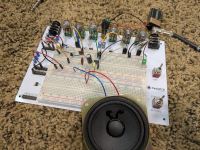
I'm building a ruby amp in a cigar box using a 3.5" speaker, and guess what, it's fine too--Right now I've only got it breadboarded, and I haven't even got the speaker in it's cigar box enclosure and already I can tell it's good enough for practice.


1773253700844.png
 
Overthinking for sure. The Ruby build looks cool. I'd be curious to hear the difference between:
Ruby -> 3.5"
Ruby -> 12"
Cab Sim (or EQ) -> Ruby -> 3.5"

Not that you have to report back, just thinking. I wonder if the cab sim would help the 3.5" sound more guitar-like, especially with distortion, though of course not providing the low end of a 12".
 
Don't have a cabsim yet--been meaning to build one though, that'll be for a future project. I was thinking of doing the cabsim for use with the headphone amp (which I also have on my wish list).
 
The pedalpcb headphone amp is really handy, especially with the phase switch to spread the sound and feel more immersive. But I definitely don't like the sound without any cab-sim. Clean sounds thin and distortion sounds quite harsh. (Although the 424 -> DI thing has some popularity at the moment). It's one of the things that has gotten me thinking about the importance of Speakers (or speaker sim) in the signal chain.

There's some debate if analog EQ cab sim circuits can match the quality of digital IR, and I've read a lot of people that prefer digital. I did build the Unicab, and I prefer the Iridium I have (expensive though). Could just be personal preference, and there's other digital options out there.
 
Small practice amps often have 8" speakers. I've read people say that when they plug into a 12" cab, even cheap solid state amps such as Fender Frontman sound much better.

The problem with this statement is two variable are changing at the same time. The size of the speaker, and the quality of speaker and cab. I suspect the increase in quality is a much larger factor here.
 
I just went thru this last year - I have a THR10 but while it's good I never really bonded with the sound. I found an old PEAVEY Blazer (Rage with a small reverb) that had an 8" speaker and it is AWESOME for low volume practice. Something about the low vol and the 8" is really nice. NOT as much bass of course, but for low volume practice too much bass can be a problem

Then I went down the rabbit hole! I tried different speakers, Jensens, etc and even 10" size speakers. As said above - the QUALITY of the speaker makes a HUGE difference. And the cab - but open back less so. That said, I really like the SMALLER amps for lower vol practice. I have a Deluxe Reverb and Deluxe with 12" speakers and while some say they sound "great" at low volume I dont think so. Maybe what they think is low is a lot higher than what I run.

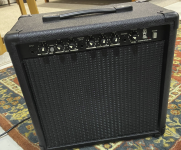
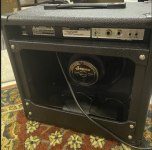
What did I wind up with? I still use the PEAVEY with the lower feedback(gain) mod to clean it up a bit and lower the overall power. What I wound up with though is below. It's a PEAVEY Blazer in a custom cabinet (pretty much the same size a bit thicker) and a JENSEN FALCON 10" with a MOD reverb tank replacing the crappy tiny unit. To me it sounds awesome for my low volume practicing. So yeaah, I went down a rabbit hole....

amp front.png back.png
 
That IR link is cool.

I did a quick test with a 3.5" driver from an old, keyboard. I drove it with the L channel of the headphone jack of the pedalpcb headphone amp (LM386 like the ruby). The speaker is not good and cannot get very loud without distorting. However, I was still able to confirm that running the Iridium in front of it was a significant improvement, more electric-guitar like tone.

Maybe even a simple 2-pole lowpass filter would get in the ballpark, such as the TOP control portion from the UNICAB circuit. I'll try to build that on breadboard or perf just to experiment with. It might be worth considering for the Ruby build, on a switch, unless you're counting on the low-parts count for space.
 
Smaller speakers tend to have extended highs and maintain treble off-axis compared to larger diameter speakers.

Bigger speakers tend to be louder per Watt input than smaller ones.

These are not hard rules. Speaker design is a game of compromises and speakers can be made to have lots of bass at the expense loudness. These tradeoffs can be made at any diameter.

Those smaller Yamaha speakers are near certainly making the tradeoff I listed above.

I suspect the guitar speaker sound from 10s and 12s relates to low end but also the quality of construction as bigger diameters tend towards higher price point and thus better assembly.

Note that guitar speakers are highly nonlinear and that introduces a ton of unknowns.
Cheaper drivers may not be designed to distort musically.
Those small Yamaha FR drivers are definitely closer to monitor and PA drivers in nature, allowing the distortion to come from modelling.

The achilles heel of many analog cabsims is insufficient sloped roll-off in the highs. Real speakers tend to be 4th (24db/Oct) order or higher roll off above breakup peaks (5kish). Many earlier analog sims are 2nd order. You see the issue.

Most Jensen speakers have a mid notch at ~400 as well.

The other consideration is that guitar cabs also lose a lot of low end, especially open back cabs. You add that low end roll off of the speaker plus transformer high passing plus cabinet high passing (if closed back).

Look up the celestion copper back to see how far this goes.
 
It’s complicated! A bunch of years ago I built a small battery powered 1/2 watt amp, and used a 6 inch MOD speaker in it as a compromise in size. I always felt guitar sounded a bit emasculated through it, but discovered that my 5 string fretless bass sounds great (albeit at fairly low volumes…).

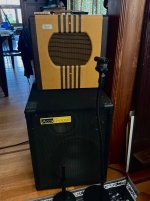
I’ve been using a full range Accu-groove bass cabinet (12 inch woofer, 5 inch midrange, and a horn tweeter, the latter two with level controls, 400 watt rated) with a little 12 watt single ended old style amp—with the mid/tweeter levels up all the way. I was really surprised that the extra top end extension still sounded so good—I’ve been really enjoying this set up… I had never tried this cabinet on guitars before, always reading that guitars sounded wrong through FRFF speakers. Maybe if I played with distortion. (On the other hand, that little amp does distort quite a bit!)

Where it gets complicated is that speakers have a lot of variables. Typically we’re concerned with the diameter of both the cone (bass response) and the voice coil (power handling). But, especially with small speakers and bass response, cone throw is a major factor. As is the type of surround, and what type of damping is used. Also the cone material and shape (ribbed, straight, seamed, etc.). I haven’t looked specifically at them, but those MarkBass cabinets loaded with 4 inch drivers are, I’m pretty sure, very long throw. IMG_0952.jpeg IMG_0012.jpeg
 
Cone throw is the main enemy of low end reproduction. Required excursion quadruples per octave down.

The larger diameter drivers displace more air per excursion and so get more bass for their throw. They also have on average higher cone mass so lower resonant frequency.

The larger diameter also means breakup modes start at a lower frequency. Thus they beam and lose treble and upper mids volume as you step out of the line of sight.
 
Back
Top