Adding a LPF to a rangemaster circuit

zakco

Member
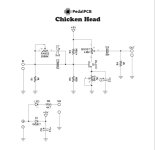
I'm experimenting with the Chickenhead (modified NPN rangmeaster) circuit on a breadboard by adding the passive LPF from this thread:

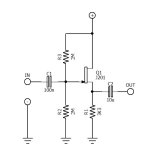
It works great but there is a small drop in level even when the filter is at it's minimum setting. Chuck suggested adding a buffer before and after the tone stack, so I started by adding PPCB's "simple jfet buffer" circuit to the output of the chickenhead (without the tone control) and I was expecting unity gain, but the output is less than unity gain and to my ears thre is a slight LF loss.

I would like to understand why the buffer doesn't maintain unity gain and how I could manage the impedance issues between the chickenhead and the tonestack without losing the original circuit's mojo. Any suggestions?

Screenshot 2026-03-18 at 9.25.34 PM Medium.jpeg
Screenshot 2026-03-18 at 9.24.33 PM Medium.jpeg
 
I def don’t know even a 1000th of what Chuck does ab circuits, but I know that any tone tone stack has the potential to lose volume and I would presume that if you are losing volume there then the buffer isn’t going to actually bring it back up, it’s just going to buffer what is going into it. If you want to regain volume on the output after a tone stack you may need to add another gain stage like in a muff. Just my 2 cents.
 
I def don’t know even a 1000th of what Chuck does ab circuits, but I know that any tone tone stack has the potential to lose volume and I would presume that if you are losing volume there then the buffer isn’t going to actually bring it back up, it’s just going to buffer what is going into it. If you want to regain volume on the output after a tone stack you may need to add another gain stage like in a muff. Just my 2 cents.
Yeah, that makes sense. I wasn't expecting the buffer to compensate for the lossy tone stack, but I did expect it to be unity gain in itself at the output of the rangemaster, but it's not. I should probably clarify...I added the buffer WITHOUT the tone stack first and it puts out less than unity without the filter in the circuit.

My understanding of Chuck's suggestion was that the buffer would help compensate for the Rangemaster's high impedance to smooth out the interaction with the filter. I'm probably misunderstanding this. So much to learn!
 
Rangemasters have a high impedance output (and thus usually interact or loads with whatever comes next) so you might just be losing a bit of oomph by going into the buffer. You might also be clipping the buffer, especially if it's not biased evenly, causing more perceived volume loss.
Are you using a j201--if so try an 2n5457.
 
Rangemasters have a high impedance output (and thus usually interact or loads with whatever comes next) so you might just be losing a bit of oomph by going into the buffer. You might also be clipping the buffer, especially if it's not biased evenly, causing more perceived volume loss.
Are you using a j201--if so try an 2n5457.
yes, I'm using a j201. I'm not sure how to bias a jfet, but I'll see if I can find a tutorial. I also have a 2n5457. Do they have more headroom?
 
Source followers are theoretically unity gain, but in reality lose a dB or two. You could wire up a common source buffer (like a Tillman) and gain a few dB back. You could also experiment with the source follower and see if you get any change biasing the input to ground rather than mid-rail.
 
Source followers are theoretically unity gain, but in reality lose a dB or two. You could wire up a common source buffer (like a Tillman) and gain a few dB back. You could also experiment with the source follower and see if you get any change biasing the input to ground rather than mid-rail.
Is this the Tillman circuit you're talking about?


I've built this on it's own on a separate breadboard for testing and for some reason I can't get it to pass signal. Using a probe, I have signal at the source but not at the drain. MM shows 8.4v at the drain and 0.34v at the source. Any idea what I might be doing wrong?
 
Is this the Tillman circuit you're talking about?


I've built this on it's own on a separate breadboard for testing and for some reason I can't get it to pass signal. Using a probe, I have signal at the source but not at the drain. MM shows 8.4v at the drain and 0.34v at the source. Any idea what I might be doing wrong?
Directly from the article:

The upshot is that while this preamp circuit is designed to work with typical J201 FETs, it will not work with all of them and it would be a good idea to try a handful of FETs and throw out any that don't bias correctly. An easy test is to measure the voltage at the drain of Q1 and if it's between 5.0 and 7.0 volts things are fine.
 
Is this the Tillman circuit you're talking about?


I've built this on it's own on a separate breadboard for testing and for some reason I can't get it to pass signal. Using a probe, I have signal at the source but not at the drain. MM shows 8.4v at the drain and 0.34v at the source. Any idea what I might be doing wrong?
Yes that’s the one. If you have other jfets I’d try them out - even other j201s. Otherwise check connections and fiddle with the source resistor.

I like 2sk208-y jfet, if only because it’s part-to-part variation is a lot lower. If one gets out of spec, then tag it with a different suffix. You could also try biasing the input to mid rail and see if that changes anything. You’ll use a lot less power biased to ground though. Not much issue in a pedal (we’re talking a few ma). I’m using dual mini buffers onboard my bass biased midrail but I may change that to conserve battery.
 
Yes that’s the one. If you have other jfets I’d try them out - even other j201s. Otherwise check connections and fiddle with the source resistor.

I like 2sk208-y jfet, if only because it’s part-to-part variation is a lot lower. If one gets out of spec, then tag it with a different suffix. You could also try biasing the input to mid rail and see if that changes anything. You’ll use a lot less power biased to ground though. Not much issue in a pedal (we’re talking a few ma). I’m using dual mini buffers onboard my bass biased midrail but I may change that to conserve battery.
I've tried 3 J201s in this circuit. All 3 show 8.4v at the drain and fail to pass any audio at the drain using a probe. All 3 also work perfectly in the PPCB simple jfet buffer https://forum.pedalpcb.com/attachments/screenshot-2026-03-18-at-9-24-33 pm-medium-jpeg.113723/

Is there an explanation why all 3 work in the PPCB circuit yet don't pass audio to the drain in the Tillman?
I've triple checked the layout and all component values. I've breadboarded much more complicated circuits than this, there must be some simple mistake I'm making!
 
Last edited:
Maybe it’s just a typo but the gate is the input so it should be passing audio from the gate to the output.

Might be interesting to see if you get a signal on the source side. Maybe there’s a bad capacitor somewhere.
 
If I'm reading that Tillman schematic correctly, normally you'd set the R3 value so your drain voltage is 1/2 your power supply.
 
Maybe it’s just a typo but the gate is the input so it should be passing audio from the gate to the output.

Might be interesting to see if you get a signal on the source side. Maybe there’s a bad capacitor somewhere.
Yes, typo. Fixed that, sorry.
Input is gate - It passes signal at the source but nothing at all comes out of the Drain
 
Any chance you connected the lines where they cross (but don’t connect) on Tillman’s schematic? I could see myself doing that :)

Weird that you’d get a signal at the source side but not the drain. So I’m grasping at straws.
 
Back
Top