Adding a LPF to a rangemaster circuit

zakco

Member
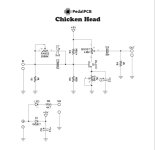
I'm experimenting with the Chickenhead (modified NPN rangmeaster) circuit on a breadboard by adding the passive LPF from this thread:

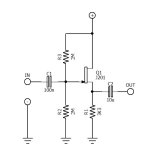
It works great but there is a small drop in level even when the filter is at it's minimum setting. Chuck suggested adding a buffer before and after the tone stack, so I started by adding PPCB's "simple jfet buffer" circuit to the output of the chickenhead (without the tone control) and I was expecting unity gain, but the output is less than unity gain and to my ears thre is a slight LF loss.

I would like to understand why the buffer doesn't maintain unity gain and how I could manage the impedance issues between the chickenhead and the tonestack without losing the original circuit's mojo. Any suggestions?

Screenshot 2026-03-18 at 9.25.34 PM Medium.jpeg
Screenshot 2026-03-18 at 9.24.33 PM Medium.jpeg
 
I def don’t know even a 1000th of what Chuck does ab circuits, but I know that any tone tone stack has the potential to lose volume and I would presume that if you are losing volume there then the buffer isn’t going to actually bring it back up, it’s just going to buffer what is going into it. If you want to regain volume on the output after a tone stack you may need to add another gain stage like in a muff. Just my 2 cents.
 
I def don’t know even a 1000th of what Chuck does ab circuits, but I know that any tone tone stack has the potential to lose volume and I would presume that if you are losing volume there then the buffer isn’t going to actually bring it back up, it’s just going to buffer what is going into it. If you want to regain volume on the output after a tone stack you may need to add another gain stage like in a muff. Just my 2 cents.
Yeah, that makes sense. I wasn't expecting the buffer to compensate for the lossy tone stack, but I did expect it to be unity gain in itself at the output of the rangemaster, but it's not. I should probably clarify...I added the buffer WITHOUT the tone stack first and it puts out less than unity without the filter in the circuit.

My understanding of Chuck's suggestion was that the buffer would help compensate for the Rangemaster's high impedance to smooth out the interaction with the filter. I'm probably misunderstanding this. So much to learn!
 
Rangemasters have a high impedance output (and thus usually interact or loads with whatever comes next) so you might just be losing a bit of oomph by going into the buffer. You might also be clipping the buffer, especially if it's not biased evenly, causing more perceived volume loss.
Are you using a j201--if so try an 2n5457.
 
Rangemasters have a high impedance output (and thus usually interact or loads with whatever comes next) so you might just be losing a bit of oomph by going into the buffer. You might also be clipping the buffer, especially if it's not biased evenly, causing more perceived volume loss.
Are you using a j201--if so try an 2n5457.
yes, I'm using a j201. I'm not sure how to bias a jfet, but I'll see if I can find a tutorial. I also have a 2n5457. Do they have more headroom?
 
Source followers are theoretically unity gain, but in reality lose a dB or two. You could wire up a common source buffer (like a Tillman) and gain a few dB back. You could also experiment with the source follower and see if you get any change biasing the input to ground rather than mid-rail.
 
Source followers are theoretically unity gain, but in reality lose a dB or two. You could wire up a common source buffer (like a Tillman) and gain a few dB back. You could also experiment with the source follower and see if you get any change biasing the input to ground rather than mid-rail.
Is this the Tillman circuit you're talking about?


I've built this on it's own on a separate breadboard for testing and for some reason I can't get it to pass signal. Using a probe, I have signal at the source but not at the drain. MM shows 8.4v at the drain and 0.34v at the source. Any idea what I might be doing wrong?
 
Is this the Tillman circuit you're talking about?


I've built this on it's own on a separate breadboard for testing and for some reason I can't get it to pass signal. Using a probe, I have signal at the source but not at the drain. MM shows 8.4v at the drain and 0.34v at the source. Any idea what I might be doing wrong?
Directly from the article:

The upshot is that while this preamp circuit is designed to work with typical J201 FETs, it will not work with all of them and it would be a good idea to try a handful of FETs and throw out any that don't bias correctly. An easy test is to measure the voltage at the drain of Q1 and if it's between 5.0 and 7.0 volts things are fine.
 
Is this the Tillman circuit you're talking about?


I've built this on it's own on a separate breadboard for testing and for some reason I can't get it to pass signal. Using a probe, I have signal at the source but not at the drain. MM shows 8.4v at the drain and 0.34v at the source. Any idea what I might be doing wrong?
Yes that’s the one. If you have other jfets I’d try them out - even other j201s. Otherwise check connections and fiddle with the source resistor.

I like 2sk208-y jfet, if only because it’s part-to-part variation is a lot lower. If one gets out of spec, then tag it with a different suffix. You could also try biasing the input to mid rail and see if that changes anything. You’ll use a lot less power biased to ground though. Not much issue in a pedal (we’re talking a few ma). I’m using dual mini buffers onboard my bass biased midrail but I may change that to conserve battery.
 
Yes that’s the one. If you have other jfets I’d try them out - even other j201s. Otherwise check connections and fiddle with the source resistor.

I like 2sk208-y jfet, if only because it’s part-to-part variation is a lot lower. If one gets out of spec, then tag it with a different suffix. You could also try biasing the input to mid rail and see if that changes anything. You’ll use a lot less power biased to ground though. Not much issue in a pedal (we’re talking a few ma). I’m using dual mini buffers onboard my bass biased midrail but I may change that to conserve battery.
I've tried 3 J201s in this circuit. All 3 show 8.4v at the drain and fail to pass any audio at the drain using a probe. All 3 also work perfectly in the PPCB simple jfet buffer https://forum.pedalpcb.com/attachments/screenshot-2026-03-18-at-9-24-33 pm-medium-jpeg.113723/

Is there an explanation why all 3 work in the PPCB circuit yet don't pass audio to the drain in the Tillman?
I've triple checked the layout and all component values. I've breadboarded much more complicated circuits than this, there must be some simple mistake I'm making!
 
Last edited:
Maybe it’s just a typo but the gate is the input so it should be passing audio from the gate to the output.

Might be interesting to see if you get a signal on the source side. Maybe there’s a bad capacitor somewhere.
 
If I'm reading that Tillman schematic correctly, normally you'd set the R3 value so your drain voltage is 1/2 your power supply.
 
Maybe it’s just a typo but the gate is the input so it should be passing audio from the gate to the output.

Might be interesting to see if you get a signal on the source side. Maybe there’s a bad capacitor somewhere.
Yes, typo. Fixed that, sorry.
Input is gate - It passes signal at the source but nothing at all comes out of the Drain
 
Any chance you connected the lines where they cross (but don’t connect) on Tillman’s schematic? I could see myself doing that :)

Weird that you’d get a signal at the source side but not the drain. So I’m grasping at straws.
 
Any chance you connected the lines where they cross (but don’t connect) on Tillman’s schematic? I could see myself doing that :)

Weird that you’d get a signal at the source side but not the drain. So I’m grasping at straws.
Oh man...I could have saved myself a couple of hours of confusion if I'd just zoomed in on the schematic a bit. Sheesh, what a dummy I am. I thought it was pretty odd to connect the output to both +9 and ground, but unfortunately I don't have enough experience to question things sometimes. Oof. You were spot on...thank you!

If I'm reading that Tillman schematic correctly, normally you'd set the R3 value so your drain voltage is 1/2 your power supply.
If I'm reading the notes correctly, it's calling for 6v at the drain, so more like 2/3 the supply. Am I misunderstanding?

The J201 passes signal now as expected, though I needed to change R3 to 22k to get it to bias 6v at the drain. If I'm reading the article right, a good J201 should measure between 5v and 7v at the drain with the 6.8k resistor, so does that mean that all 3 of my J201s are garbage? Or is it normal to need to adjust R3 to the extent that I did?

Now that it's working(ish) I'd like to try adding the Tillman into the Rangmaster/LPF combo, but I have a couple of questions about the implementation.

1. Is C2 (10uF) from the Tillman redundant because of C6 (47uF) in the Chickenhead Power section?

2. Should R4 (1Mohm) from the Chickenhead be moved now that there is a tone stack and a buffer between it and the output? If so, how exactly should it be placed?
 
Yes I think c2 is redundant now.
I don’t think it hurts anything to keep r4. But I’m no expert. I’ve just had a little experience using the ppcb mini buffer onboard and went on a deep dive of jfets, so I feel like I’ve got a little knowledge there but woefully less on other active components.

In fact I think I can build an onboard buffer with only a single jfet, a single resistor, and a single capacitor, but that’s taking advantage of the fact that a passive guitar pickup will ground itself through its own windings and never have DC bias.

But in a pedal it’s safest to use a few more - take a look as the Submersible schematic. It uses a common source jfet gain stage at the input, and another at the output, presumably to buffer and recover gain lost in the tone stack, with a big muff-style tilt tone stack in the middle (which is same as the PPCB muffin crumb tone). In fact that’s kinda all it does, but should give you an idea of how they connect it all together. I’ve not built mine yet but I have most of the parts here and have studied the schematic so it comes to mind. Theres probably a lot of circuits that share these characteristics but the submersible is simple enough that it won’t confuse us with a lot of other stages.

I don’t think your j201s are junk but maybe at one end of the spec range, so you have to go through your bias exercise to get maximum headroom, which may not even be necessary. I like the j201 where power consumption is a concern (you can get them down to .1-.2 ma) but I prefer the 2n5457 if I have to solder the thing because of the thru hole package or the 2sk208 series because of super low noise and tighter specs. I doubt I could hear any audible difference, particularly in low gain circuits I’m doing (mainly a bass player)
 
Well, this has been an interesting experiment for me. I tried the Tillman (biased to 6v) both in front of the tone stack and after it and in both cases it actually adds too much gain. The Rangemaster already has so much level that the extra 3db from the Tillman (it actually sounds like a lot more than that to me), just hits the front end of the amp in a not so nice way. So far with the J201, the PPCB's simple Jfet buffer was too lossy and the Tillman is too much.

Thanks for suggesting the the Submersible circuit. I actually have some 2n5457s here, so I'll experiment with that and see if it's a good fit with the Rangemaster. It's entirely possible I'm chasing something futile here, but it's been a great learning process so far. Thanks for your help!
 
I mean, you are adding a LPF to a treble booster. 🤣
Haha. Yeah.
But in all seriousness, with the variable input filter, it’s not really a treble booster any more, it’s completely full range. And what started me on this path is the extreme differences in the top end from pickup to pickup - even when used full range. This circuit would be way more useful with a way to shape the HF response. It sounds glorious with filtertrons but not so nice with a telecaster. Rolling back the guitar’s tone control is fine until you turn the pedal off and then it’s instant mud. I can’t be the first fool to chase this 😆
 
Well, this has been an interesting experiment for me. I tried the Tillman (biased to 6v) both in front of the tone stack and after it and in both cases it actually adds too much gain. The Rangemaster already has so much level that the extra 3db from the Tillman (it actually sounds like a lot more than that to me), just hits the front end of the amp in a not so nice way. So far with the J201, the PPCB's simple Jfet buffer was too lossy and the Tillman is too much.

Thanks for suggesting the the Submersible circuit. I actually have some 2n5457s here, so I'll experiment with that and see if it's a good fit with the Rangemaster. It's entirely possible I'm chasing something futile here, but it's been a great learning process so far. Thanks for your help!
You can tweak the gain of a common source amplifier (I.e. Tillman) by fiddling with the source and drain resistors. I forget the exact relationship but I think if you tweaked values from Tillmans you may have changed the gain. There’s also some magic to be had by bypassing the source resistor with a capacitor, and by playing with the capacitor value you can make the gain frequency-dependent. You could look at really any schematic using jfets as gain stages and see what they do with the volume/gain controls to get an idea.

In any event, too much gain can always be tamed with a voltage divider on the output.
 
Back
Top