Adventures with the dirty Bassman.

92410903-8B98-4831-9F0F-B67E69FE992A.jpeg

Got the input jacks out since I was going to start measuring resistors and checking grounds. But it’s nearly midnight and I gotta work in the morning. Got the power cable replaced schemes printed and going through the layout a bit just to familiarize myself with what’s going where etc.
 
Cool find! I also have a dusty '72 Bassman that's never been recapped. I played it a lot years ago with seemingly no problems, but it's been in storage for 5 years. I was going to use it again but now wondering how much of a MUST all this is this is before I fire it up again.
 
@RetiredUnit1 @HamishR

Hope you two don’t mind me picking your brains just want to make sure I got the right stuff here. I’m going to start with replacing all electrolytics the white Mallory’s, the doghouse and the one in the bias circuit and coming off the solid state rectifier. The the final two are where I’ve got a question.

I decided f&t for the Dog house. They do not offer a 70u but do an 80u at 500 vs the 70 @ 350. Should be within original tolerance. Thought I’d be good there. Mod does offer the 70@350 any real reason to go that way ?

However on the bias/rectifier seen here.

EB93357A-1057-40EE-87CD-E7EA1E650692.png

I cannot find an 80 u 75v cap (or near that voltage rating). Everything is 450 and huge. So im thinking I can probably just do a more common value like 100u/100v there without any change in tone.
 
@RetiredUnit1 @HamishR

Hope you two don’t mind me picking your brains just want to make sure I got the right stuff here. I’m going to start with replacing all electrolytics the white Mallory’s, the doghouse and the one in the bias circuit and coming off the solid state rectifier. The the final two are where I’ve got a question.

I decided f&t for the Dog house. They do not offer a 70u but do an 80u at 500 vs the 70 @ 350. Should be within original tolerance. Thought I’d be good there. Mod does offer the 70@350 any real reason to go that way ?

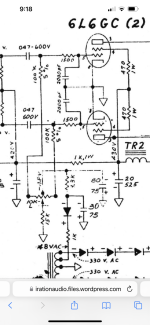
However on the bias/rectifier seen here.

View attachment 65662

I cannot find an 80 u 75v cap (or near that voltage rating). Everything is 450 and huge. So im thinking I can probably just do a more common value like 100u/100v there without any change in tone.
Yeah a 100uf works just fine, a lot of people upgrade to that.

You really should be checking the original caps in the signal path before replacing tho. Replacing everything is called shotgunning the amp and greatly devalues the vintage value of the amp.

Those cathode bias caps in the preamp *rarely* go bad. You just desolder and lift one side to remove it from the circuit before testing for capacitance. If it's bad, you're half way there to replacing it, if not you just put it back down.
 
Yeah a 100uf works just fine, a lot of people upgrade to that.

You really should be checking the original caps in the signal path before replacing tho. Replacing everything is called shotgunning the amp and greatly devalues the vintage value of the amp.

Those cathode bias caps in the preamp *rarely* go bad. You just desolder and lift one side to remove it from the circuit before testing for capacitance. If it's bad, you're half way there to replacing it, if not you just put it back down.
I’ll measure them before replacing, just getting everything ordered. Just ordering electros today. Cost is small enough where I’d just as soon order them and have them if I need them.
 
Yeah a 100uf works just fine, a lot of people upgrade to that.

You really should be checking the original caps in the signal path before replacing tho. Replacing everything is called shotgunning the amp and greatly devalues the vintage value of the amp.

Those cathode bias caps in the preamp *rarely* go bad. You just desolder and lift one side to remove it from the circuit before testing for capacitance. If it's bad, you're half way there to replacing it, if not you just put it back down.
Oh yes I did measure the diodes. All are measuring right around 6.
 
Todays activity on the dirty girl.

Attempted to try some armor all on the tolex. Meh. I think I’m going to have to go at it with a tooth brush. So much dirt in that texture but we’ll get to that along with try to get some of the rust off metal bits (debating how much I want to worry about thag or just leave it as is).

Today I orders all new electros for the dog house and all new electros for the electros in the amp. Figure worse case if they measured well o can toss em in the parts stash. Also ordered the 2 watt metal oxide resistors for the dog house and the 100k carbon films @HamishR had mentioned.

After bed time for the kiddos I started lifting electro legs and testing results were as follows (I attempted to measure leakage by reading the resistance with positive probe to positive and negative to negative then let it sit there for a bit.

1. 1uf - Tested at 1.74 uf, resistance was around 17M

2. 5uf- tested at 7.5uf resistance was 5-6M but I don’t think I let climb as high as it would have.

3. 25uf- 37u resistance was 10M and climbing

4 25uf- 36.1u resistance was 27M I let this one go the longest for sure.

5 25uf- 44.7u resistance was 10m +

6 70 u (bias cap)- 58.4u resistance was 10M+. We’re just barely within the 20%. My replacement coming for this is 100u as the only. 70us available were z huge z350v+ same with the 80’s.

7 70u - 64.85. 17m this one is in the rectifier.

interesting that the electros handling any sort of power the bias and rectified were the only two lower than the value. Both in spec but I’m wondering if I shouldn’t replace the bias cap with it being what 16-17% low.

Not sure how much concern the way over caps are as well. The one at 80% over spec comes off pin 8 of v3.

Also am I looking at this right half of v3 is t being use for anything ? Seems wasteful.

Anyways.

Priority mail is saying Tuesday for Phoenix to pdx hoping it’s wrong but we got snow and ice forecast for this weekend so it probably isn’t….

 
Couple of other things of note. 1w 100k resistors a bit all over the place. I’ve got readings of

104.9
108
91.59
87k
86k

I’m thinking I should probably replace anything over 5% there?

Also there’s two 220k’s are way off

48D7A037-EA2B-402C-9044-DE612A1A66C6.jpeg

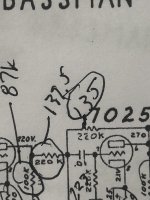
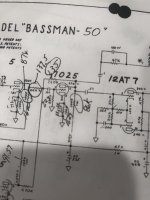
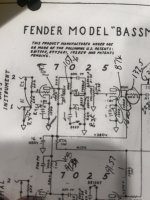
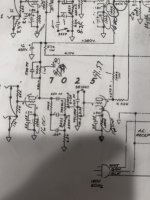
Some of my other Schematic notes if anyone cares and can read my hand writing

7274E7D8-CB88-4549-BD27-236B4F7B1220.jpeg 5E28A979-039C-430A-AC3E-3CB0CED6A110.jpeg C070A679-6E24-4829-80C1-45321FFAC613.jpeg

Tomorrow nights goal is to finish the resistor testing on the eyelet board. And get the film caps measured on the eyelet boards get see if I need to
Order anything else though resistors I’ll probably pick up at a local shop . That point I should basically just be waiting for parts. Waiting to test all the grounds until I have all my new parts in seems silly to do that then replace a bunch of things.

I really wish they numbered the parts ok tbe Schematic. I half debated trying to redraw this thing with parts numbered.
 
You're well on your way! You have to start somewhere and I think that this amp you have in front of you now is a great opportunity. In my view it's not immensely valuable from a collector's point of view but is capable of becoming a great amp to use. I'm sure others will disagree but it's your amp so that's for you to decide.

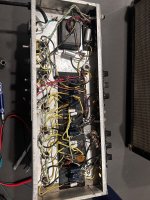
All the key parts are good quality. The transformers, layout and circuit are sound. All you need to do really is replace parts which are out of spec or worn out and improve the lead dress. Lead dress is part art and mostly common sense. Wires should be as short as possible but not tight. There should be no stress placed on the joins. Grid wires in particular should be as short as practical and kept away from the filament wiring as much as possible. If they need to cross a filament wire then try to make it at 90°. Plate wires can be longer than grid wires if needed to avoid the interfering with each other - ideally the 90° rule to grid wires should apply where necessary. Most wiring can be kept low and against the chassis. In this style of amp the filaments are usually raised directly above the tubes and wound tightly around each other. Twisting the pairs of wires helps to keep the hum down. Filaments are AC current while the rest of the amp runs on DC, and getting the filaments too close to the signal wiring can induce AC hum.

Looking at the interior pic above one thing I would change would be how the AC cord's ground is connected to the chassis. The ground should have it's own chassis connection, not using a PT bolt to connect it. Over time the PT bolts can loosen and the AC ground connection is one of the most important in the amp. The wire inside the amp for the ground should also be longer than the hot or neutral, so that if the cord is pulled out the ground is the last one to remain connected. This ground is extremely important. The connection should be clean and very tight.

When replacing parts clean the eyelet completely using a solder sucker. It doesn't take long. New solder is best. Being very anal I would be tempted to tidy up the filament wires. I don't think they need to be disconnected but I'd straighten them up and try to get them as neat as possible and keep them away from other pins on the sockets. Tidiness can help with noise but also help you keep track of what goes where.
 
You're well on your way! You have to start somewhere and I think that this amp you have in front of you now is a great opportunity. In my view it's not immensely valuable from a collector's point of view but is capable of becoming a great amp to use. I'm sure others will disagree but it's your amp so that's for you to decide.
Some what my thoughts exactly. If this was a blackface I'd probably be a bit more leaning towards having it looked at by a pro, or even a princeton reverb silverface etc. These while not "cheap" go for less than the cost of a new hot rod or blues jr. Theres one that is in pretty good looking cosmetic shape on reverb right now for I think 699. Cost of getting into amp building is a bit prohibitive and it's a lot to invest for something that could possibly not work when you're done without a lot of recourse than dumping more money into it. So this seemed like a great intro for me. Fairly small investment to get my feet wet poking around inside in a layout that would be very similar eyelet board etc to what I will want to build in the future as well. After I'm done if I don't butcher it I can always sell this to help fund that deluxe reverb I'd like to build down the line etc.

I replaced the cord, but did leave it set up the same way which did seem a bit odd to me, the bias capacitor is grounded in a similar fashion as well.

I do have some desire to leave it some what original but still functional and was debating a bit on the replacement of the bias cap for instance which is running pretty much at tolerance below spec, im guessing that it likely will continue to drop overtime. But I would be replacing it with 100u instead of 70u just based on whats available in a similar physical size. And the ones that are so high above spec specifically bypass cap running at 1.74 u that should be 1, and a bypass cap at 44u that should be 25.

I'm having a bit of an internal argument how much I want to just replace vs. keep original and how far out of spec it needs to be for me to make that change. Load resistor being 15% low I'm thinking I need to but 7-8%? Anyways I guess those are things I need to decide how much value I put in vintage parts vs not. Funny because I got a big chuckle out of the 1987 rat my buddy just sold for 300$, could build one that sounds better for 25 :) Although the master volume mod piqued my interest, also seems like if I wanted to eliminate one of the channels wouldn't be too hard to add a tube driven effects loop the jacks are there, could possibly even fiddle around with the tone stack a bit anyways . But these are all things to think about later on I suppose.
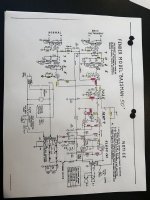
I was planning on doing some more measuring tonight, but I realized I was having a hard time referring to what these different parts were and were doing. So I decided to hop on Robrobinettes page and am doing some reading while I wait for caps etc. to arrive. Which should probably help me in making some of the above decision I am debating on.

When I was doing the measuring for caps I was completely removing everything from the eyelet, then sucking out all the solder then resoldering. I have noticed the PVC on these wires is quick to burn. Made me tempted to to go through with silicone and replace it all, but thats probably more effort than its worth...

Thank you @HamishR

Anyways back to reading for me :)
 
All resistors measured. Most of the caps are done but not done yet

Realized the 220ks that were way off were interacting with others. When one leg was lifted measured much better.

Pink is out of tolerance
Yellow is between 5-10% but within listed 10% tolerance (thinking I will replace these)
Circled are within 5% of spec

5D86F272-000B-4BAF-B148-03B3FCB8E61B.jpeg
 
All film and ceramic capacitors are testing good. Most are within 5% none are more than 10 and they are 20%. So guess I’m waiting on the post office at this point.

Edit: and a trip to the hardware store to build my lightbulb limiter...
 
Last edited:
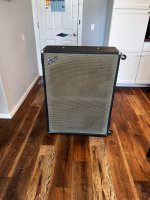
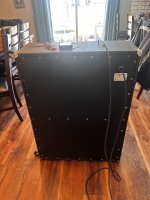
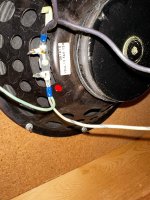
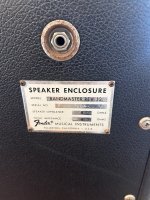
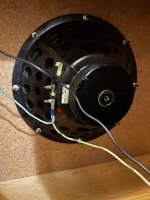
Well no updates on amp work. But I found a cab for it.

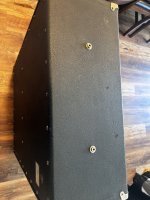
Was talking to guy about a guitar trade and we got on the subject. He mentioned he had a bandmaster cab and from the Oxford speaker date codes assuming a 71. Has the piggy back hardware like head. I haven’t undone the 34 screws yet to take a look but have the pics he provided. Managed to trade some pedals I made for it.

Grill cloth could use a good cleaning g. 699DA3BE-F953-4A23-9B60-5E78D40903E7.jpeg 8783D33B-105C-420F-A21F-437D4832D6D2.jpeg F8496E21-B125-4287-B38B-1814243E3B77.jpeg AD3FED10-EBBC-4792-83A8-06DDD9A48A6F.jpeg 8407C69D-1161-4C27-AE50-A8D1836DDB5C.jpeg 6A013349-6FFA-4A30-B18A-9090BDAFC13D.jpeg
 
Back
Top