My band is covering "Shakedown Street" by the Grateful Dead. When we decided to add it to our set list, I bought an EHX Q-Tron Nano to get that distinctive "quacking" sound. The Q-Tron Nano works great---but it's not DIY. Before I bought it, I actually did a cursory search for a DIY envelope filter, but somehow I overlooked the Aion Lumitron Resonant Filter. Ultimately I did find it though, and finally finished it today.
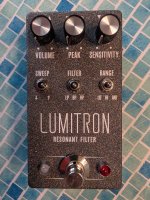
This build gave me some grief. The enclosure is the Tayda "Chromium". The labels and graphic are from a Sunyscopa film-free waterslide decal. As a final step, I always do a heat treatment of the waterslide decal in an old toaster oven (that we no longer use for food). I always do an hour at 300F. It's never been a problem until now. As you can see from the pictures, the sides of the enclosure got "crinkled". The front face isn't too bad, except in the corners, where you can see a bit of wrinkling in the factory finish. It's almost like the factory finish is itself some kind of adhesive film, as opposed to a pigment that's truly bonded to the aluminum. Fortunately, that's just cosmetic, and I can't see the sides when it's on my board anyway.
This is one of my better drilling jobs: I have a drill press and a step bit, but I've always been too lazy to drill a pilot hole before using the stepper bit. And, more often than I'd like to admit, the stepper bit would move a bit when I started to drill, resulting in holes that were off just enough to be annoying. It only took me 50 or so builds to realize this is the ghetto way to drill an enclosure! So starting with this enclosure, I now use a regular bit to drill pilot holes. And boy does it make a difference!
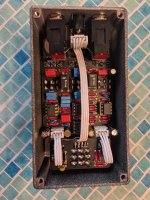
Now to the inside... if you look closely at the smaller footswitch PCB, in the middle, on the top edge, there's a cutout intended for wire strain relief. These holes also exist on the right and left sides, but the middle cutout is special in that it actually protrudes from the top of the board, and adds a few millimeters to the height of the board. It just so happens, it made that board too tall to fit in the enclosure with the effect PCB. So, without bothering to check for traces, I just assumed there wouldn't be a trace routed along that protrusion, and I snipped it off to make the board fit.
As I'm sure many of you do, when I power up a build for the first time, I hit the bypass switch to see if the status LED comes on or not. And mine did not. My heart sank. But I went ahead and picked up the guitar, and lo and behold, everything actually worked (except the power-on LED). So I made yet another foolish assumption, that I installed the LED backwards. So I soldered in a new LED in the opposite orientation. But it still didn't come on. So I got out the DMM to see if either terminal of the LED had any voltage, and neither did.
So then I finally did what I should have done in the first place, which is to actually look at the traces to see how they route to the LED. Sure enough, the positive voltage trace for the status LED runs through the part of the board that I cut off! My solution was to use a 1R resistor to re-create the trace that I foolishly destroyed. I then covered the resistor in self-amalgamating tape to prevent it from causing a short.
Now everything works properly. There's actually a second LED that shows you the envelope in action. From Aion's documentation: "The footswitch PCB includes a second LED that shows the envelope. This correlates closely to the optocoupler LEDs that drive the filter, so it’s a good way of seeing the action directly." It's kind of fun to watch it pulse and fade with my playing.
Anyway, I only dabbled with it long enough to see if I could dial in a sound similar to how I had the Q-Tron set, and I was able to get quite close. I haven't even messed with the trimmer pot at all yet. It seems to me this Lumitron actually has a wider range of sounds available (it's not a Q-Tron clone, it's based on the Mu-Tron III; and I think the Q-Tron is not so much a Mu-Tron clone, but a derivation/cousin/inspired-by kind of thing).
This build gave me some grief. The enclosure is the Tayda "Chromium". The labels and graphic are from a Sunyscopa film-free waterslide decal. As a final step, I always do a heat treatment of the waterslide decal in an old toaster oven (that we no longer use for food). I always do an hour at 300F. It's never been a problem until now. As you can see from the pictures, the sides of the enclosure got "crinkled". The front face isn't too bad, except in the corners, where you can see a bit of wrinkling in the factory finish. It's almost like the factory finish is itself some kind of adhesive film, as opposed to a pigment that's truly bonded to the aluminum. Fortunately, that's just cosmetic, and I can't see the sides when it's on my board anyway.
This is one of my better drilling jobs: I have a drill press and a step bit, but I've always been too lazy to drill a pilot hole before using the stepper bit. And, more often than I'd like to admit, the stepper bit would move a bit when I started to drill, resulting in holes that were off just enough to be annoying. It only took me 50 or so builds to realize this is the ghetto way to drill an enclosure! So starting with this enclosure, I now use a regular bit to drill pilot holes. And boy does it make a difference!
Now to the inside... if you look closely at the smaller footswitch PCB, in the middle, on the top edge, there's a cutout intended for wire strain relief. These holes also exist on the right and left sides, but the middle cutout is special in that it actually protrudes from the top of the board, and adds a few millimeters to the height of the board. It just so happens, it made that board too tall to fit in the enclosure with the effect PCB. So, without bothering to check for traces, I just assumed there wouldn't be a trace routed along that protrusion, and I snipped it off to make the board fit.
As I'm sure many of you do, when I power up a build for the first time, I hit the bypass switch to see if the status LED comes on or not. And mine did not. My heart sank. But I went ahead and picked up the guitar, and lo and behold, everything actually worked (except the power-on LED). So I made yet another foolish assumption, that I installed the LED backwards. So I soldered in a new LED in the opposite orientation. But it still didn't come on. So I got out the DMM to see if either terminal of the LED had any voltage, and neither did.
So then I finally did what I should have done in the first place, which is to actually look at the traces to see how they route to the LED. Sure enough, the positive voltage trace for the status LED runs through the part of the board that I cut off! My solution was to use a 1R resistor to re-create the trace that I foolishly destroyed. I then covered the resistor in self-amalgamating tape to prevent it from causing a short.
Now everything works properly. There's actually a second LED that shows you the envelope in action. From Aion's documentation: "The footswitch PCB includes a second LED that shows the envelope. This correlates closely to the optocoupler LEDs that drive the filter, so it’s a good way of seeing the action directly." It's kind of fun to watch it pulse and fade with my playing.
Anyway, I only dabbled with it long enough to see if I could dial in a sound similar to how I had the Q-Tron set, and I was able to get quite close. I haven't even messed with the trimmer pot at all yet. It seems to me this Lumitron actually has a wider range of sounds available (it's not a Q-Tron clone, it's based on the Mu-Tron III; and I think the Q-Tron is not so much a Mu-Tron clone, but a derivation/cousin/inspired-by kind of thing).