Awful Waffle

someone recently commissioned a hotcake from me, and since it was on vero there was a little more wiggle room for mods.

i tried 071 vs 741 and found 071 to be shrill and horrid. i added a switch for a slight variation on the madbean mod- less bass, less gain. it's a nice addition, but doesn't fix the issue. both XLF and BB mods were installed. they helped a little, but that crackle was just driving me nuts.

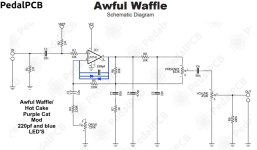
my solution, hereby known as the Purple Cat Mod, is a 220pf and blue LED's in the feedback loop. it doesn't remove ALL the crackle, but it seems to help. until the gain is dimed those LED's barely light up. it's the most subtle bit of soft clipping that made it a little more modern and usable
 
someone recently commissioned a hotcake from me, and since it was on vero there was a little more wiggle room for mods.

i tried 071 vs 741 and found 071 to be shrill and horrid. i added a switch for a slight variation on the madbean mod- less bass, less gain. it's a nice addition, but doesn't fix the issue. both XLF and BB mods were installed. they helped a little, but that crackle was just driving me nuts.

my solution, hereby known as the Purple Cat Mod, is a 220pf and blue LED's in the feedback loop. it doesn't remove ALL the crackle, but it seems to help. until the gain is dimed those LED's barely light up. it's the most subtle bit of soft clipping that made it a little more modern and usable

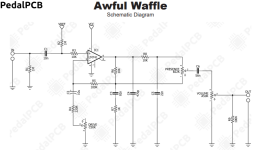
Just in case anyone reads this later who ..ahem.. isn't as smart as you and me, could you be a little more specific about how one might implement that?


1768513147286.png
 
While I love that it's called the Purple Cat Mod, I'm a curious cat so pray tell — why is it the "purple" cat mod when the LEDs used are blue?

Also, are we talking water-clear blue LEDs or regular blue-lense LEDs?*


*I have both, even some "Teal" LEDs... a few different types/brands of blue LEDs.
 
While I love that it's called the Purple Cat Mod, I'm a curious cat so pray tell — why is it the "purple" cat mod when the LEDs used are blue?

Also, are we talking water-clear blue LEDs or regular blue-lense LEDs?*


*I have both, even some "Teal" LEDs... a few different types/brands of blue LEDs.
simply put, my brand is Purple Cat Audio. 🥰 nothing to do with alice in wonderland, ironically. just my 2 favorite things.

i've looked and looked, and short of using purple covers on clear LED's there isn't a truly purple LED. There's UV, darkish pink, but not PURPLE purple. not close enough to tickle the purple obsessed (autistic) brain.

blue because they were the highest fV LED's i had laying around. blue, like regular basic ass blue
 
Congrats on the cleanest build ever lol! Really bummed to find this thread AFTER I’ve started building the pedal ! Maybe I should stop now and avoid any possible frustration. Unless the issue has been fixed?
 
Congrats on the cleanest build ever lol! Really bummed to find this thread AFTER I’ve started building the pedal ! Maybe I should stop now and avoid any possible frustration. Unless the issue has been fixed?
Thanks!

I’m inclined to think that the thing I don’t like about it is really more of a feature than a bug.

Plenty of posts online from folks having similar experiences with the original pedals but I think for certain people with certain rigs it’s a good fit, so especially if you’ve already started I’d say see it through!
 
I recently lined up over a dozen dirt box builds and played through them in succession.. it's pretty ridiculous how close they all sounded once your in medium gain territory.
I ran a series of experiments a few years back where I tested every clipping method imaginable: hard, soft, symetric asymmetric, diode, opamp, BJT, JFET, CMOS, etc. and had similar findings. Where and how you eq between gain stages is what gives a dirt pedal most of its character, not the clipping method.

That said clipping a opamp does tend to get a little crackly (not very smooth decay). The LM386 is the worst for this.
 
Last edited:
The way clipping is achieved is a fascinating topic. I almost always really dislike LED clipping. I like the way JFETs clip but they can sometimes sound almost too perfect. One JFET OD I built broke up so smoothly that it barely had any sizzle like an actual tube amp has. Sounded fantastic, but kinda too good, in a wow-some-people-are-hard-to-please way. Maybe it was the Golden Falk? Fantastic sounding pedal. Some of the Skreddy pedals use a mix of transistor types and they usually sound wonderful.

And generally IC clipping is horrible but in the Eliminator/Recycler OD it sounds amazing.
 
@HamishR I’ve never really cared for led clipping either and also prefer JFET clipping when the specs are right. I have a Golden Falk board on the way…it’s been out of stock for a while but have heard really good things and think it sounds amazing on Brett Kingmans demos. Reminds me of some of the LPD pedals Marshall tones.
 
I will be running mine through a Vox-ish amp, Bad Cat Cub 40, so maybe it’ll play nice. That’s a strange issue to come across with a pedal that’s stood the test of time for so long.
 
I love Bad Cat amps, but have found them to be a little tricky to use with drive pedals. They have a lot of high end content - more than a Vox IMO - and that can make ODs sound a bit shrill. There's something about the EQ that can make ODs sound a bit brittle and unpleasant. The Vox EQ which Bad Cat uses is quite different from Fender/Marshall etc. It just means that things which work well which most amps need some care when used with a Bad Cat or Vox, and the Bad Cat is especially unusual because of the extra high-end.

I suppose it's because most pedals are tuned with Fender style tone stacks? Anyway I found that pedals I loved with my other amps either didn't sound so good with Bad Cat or needed radically different settings. I haven't tried a Hot Cake with a Bad Cat but I suspect it should work pretty well!
 
Wasn't Purple Cat some acid that was going around San Francisco in the '60s? 😵‍💫

Something to keep in mind when using LEDs for clipping: some of them have a parallel diode to protect against reverse voltage. Check them before installing them or you may not get the tone or volume you expect. Don't ask me how I know.

I would have expected an LM308 to sound good in there. you could also try a CA3130. Another trick to change the clipping tone is to adjust the bias (Vref) up or down.
 
Wasn't Purple Cat some acid that was going around San Francisco in the '60s? 😵‍💫

Something to keep in mind when using LEDs for clipping: some of them have a parallel diode to protect against reverse voltage. Check them before installing them or you may not get the tone or volume you expect. Don't ask me how I know.

I would have expected an LM308 to sound good in there. you could also try a CA3130. Another trick to change the clipping tone is to adjust the bias (Vref) up or down.
The ones that had the privilege of having the good stuff all know that good acid doesn't come on blotter paper....:cool:.. I use to get mine in bottles of " sweet breathe" back in the day.. Contained literally hundreds of doses... So much you'd just dose anyone who was feeling like it because there was no way I could do it all... No one has that much time.. even when your in your twenties. Dead lot's before shows were fun...😍
 
I love Bad Cat amps, but have found them to be a little tricky to use with drive pedals. They have a lot of high end content - more than a Vox IMO - and that can make ODs sound a bit shrill. There's something about the EQ that can make ODs sound a bit brittle and unpleasant. The Vox EQ which Bad Cat uses is quite different from Fender/Marshall etc. It just means that things which work well which most amps need some care when used with a Bad Cat or Vox, and the Bad Cat is especially unusual because of the extra high-end.

I suppose it's because most pedals are tuned with Fender style tone stacks? Anyway I found that pedals I loved with my other amps either didn't sound so good with Bad Cat or needed radically different settings. I haven't tried a Hot Cake with a Bad Cat but I suspect it should work pretty well!
Yes they can have too much high end…you really need to spend time with the tone controls and cut control to see how they interact with the gain. For example rolling up the bass and high scoops the mids and at about 2 o’clock on each dial it’s kinda blackface territory with a little high end which can be controlled with the cut control. Rolling back the bass increases mids and rolling back the high increases lows lol. It’s a strange tone control. I can totally understand how someone might find it, combined with the bad cat speaker, to be shrill. However I think mine being 40 watts and having EL34’s takes some of those highs away and find it a lot more versatile than a Vox and I love Vox.

Maybe I’ve gotten used to it but I’ve found it to work with any pedal I’ve thrown at it with single coils and humbuckers as well. I have it running in stereo with a 68 custom deluxe reverb and sounds great. I’m really itching for an EL84 based amp though! I think the new mod shop hot cat 50, which uses el34s, sounds stellar as well but it’s way out of my budget.
 
The tone stack in Bad Cat amps is usually identical to the Vox AC30 Bass/Treble tone stack. The big differences are that Bad Cat and Matchless amps have way more filtering and bigger transformers than Vox. (And Matchless way over-bias the power tubes which makes them sound brittle)
 
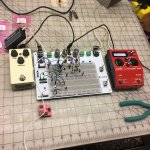
I got this protoboard put together and needed something to play with, so I took another run at the Waffle.

I tried the purple cat mod. The LEDs weren’t super noticeable, and the 220p cap in the feedback loop darkened it up more than I cared for, but I did end up liking a 30p cap there to just barely take the edge off the crackly-ness.

I also tried some new opamps I didn’t have when I put the first one together. op27, LF441, and Lm301a. The 301 ended up being my favorite from that set.

61428FF7-F330-4D70-A107-315AF3E5AE07.jpeg

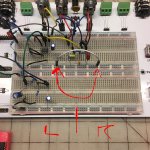
I made a breadboard noob mistake and didn’t realize/ remember that the rails on these board are split and need to be grounded/ powered seperately.

I did a bunch of testing with a couple caps un-grounded, so the presence control wasn’t working right.

Once I straightened that out and A/B tested the protoboard against my finished build the difference was small, and to be honest I slightly preferred the boxed one with the op07.

It was a fun experiment at least. I also played with some different cap values in the presence circuit, and moved vref around a bit, but the values in the stock circuit seem pretty well chosen.

I also spent some more time actually playing through the waffle, and when I’m not trying my hardest to make it crackle and fixating on it, it actually sounds pretty good.

F5057485-B2BB-47CD-A736-719226016D39.jpeg
 
Back
Top