Battery power supply

pi.cast

Active member
While testing my recently built fuzz and overdrive pedals, I've noticed they sound way better with 9V batteries (even compared to a switching power supply).
For this reason, I've started researching a way to build a reliable battery power supply that could power multiple pedal, be hosted on a pedalboard, and be controlled by its main power.

There are some commercially available solutions, like:

but here in Europe, they are almost impossible to find or can only be obtained at outrageous prices.
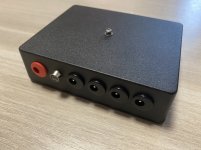
I, therefore, decided to build my own. It is powered by four 9V zinc-carbon batteries, that are switched by an external power supplier (red jack) through a couple of solid-state relays.
This way the batteries remain isolated but do not run out of juice If you don't disconnect the cables.

For a more eco-friendly solution I can also swap out the 9V zinc-carbon batteries, for rechargeable lithium units, although unfortunately, they do not sound as good.

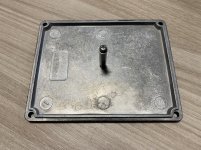
The wiring could have been neater, I admit that. I've threaded and screwed a post in the base plate of the enclosure, so that the batteries can be changed by just unscrewing one fastener at the center, instead of four at the base.
The fastener is also temporary, I've already sourced some thumb screws, to allow a battery swap without screwdriver.

2631F38C-85CC-47C3-B16E-F77F5FC6E5A9.jpeg

07155811-7990-4DEF-AD70-316EEDA04BA6.jpeg
E755C143-D5CA-490A-BE46-08A94B351CC8.jpeg
 
Last edited:
Nice work. I love this! How does the red switching jack work? I didn't follow that part

The red jack gets 9v from the standard pedalboard power supplier (the one powering the rest of the pedals), and triggers two solid-state relays connecting the batteries' positive leads to the pedals. Each relay drives two batteries.

This way when the pedalboard's main power is on, the batteries are connected, and when you unplugged the pedalboard, the batteries are automatically disconnected and not being drained.

First of all, great build!

Not to sidebar, but when people say "they sounded better with batteries...", do they mean noise? Overall tone?

I've been building fuzzes for some time and started out adding battery connections to all that I built so that I could test both. I've never noticed a difference using batteries. Maybe it's just me?

I was also very skeptical, but in the case of pedals using germanium transistors, it does make a tangible difference in tone. You have to use zinc-carbon batteries though. Alkaline batteries unfortunately do not provide the same results in my experience.


IMO batteries are the 'cleanest' power source, but can get costly. That's why I suggested rechargeable batteries

These are Chinese special zinc-carbon batteries that cost next to nothing and should last a very long time with my rate of playing.
However, I'll be sourcing and testing rechargeable 9v batteries as a more environmentally friendly alternative.
 
Last edited:
The red jack gets 9v from the standard pedalboard power supplier (the one powering the rest of the pedals), and triggers two solid-state relays connecting the batteries' positive leads to the pedals. Each relay drives two batteries.

This way when the pedalboard's main power is on, the batteries are connected, and when you unplugged the pedalboard, the batteries are automatically disconnected and not being drained.


Genius.
 

Well, I'm just a hack who can barely use a soldering iron :LOL: ... I've just copied what other people have done commercially.

Parts list or it didn't happen....;)

There aren't many parts at all:

-1x 1590BB Enclosure
-2x Omron G5V-2-H1-DC9 relays (but many others will work)
-2x 2N3904 diodes (to avoid wrong polarities on the relays)
-4x Keystone 1290 battery holders (they are quite pricey, you can use way cheaper plastic ones)
-5x 2.1mm dc jacks
-1x 5mm red led
-1x 4.7k resistor (for the led)
-4x Chinesium (zinc-carbon) batteries :)
 
Brilliant job!! :love: I will enjoy using this build as an excuse to hold on to 18650 cells that I really ought to just recycle. I personally have no opinion on battery vs power supply but a great project's a great project anyway you cut it.
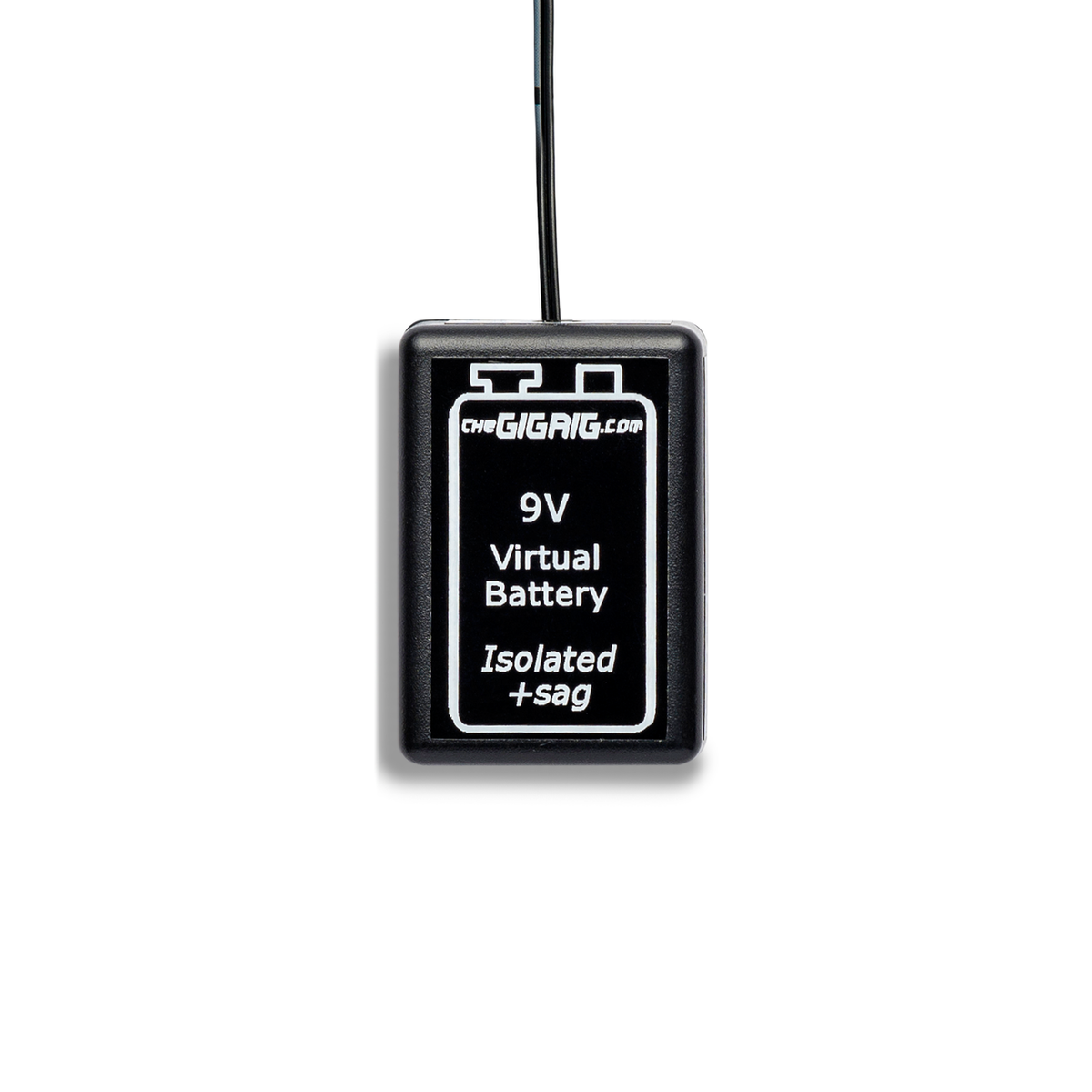
 
Just throwing this out there:

 
Just throwing this out there:


101 level question here but would DIYing this require a transformer that's already like $20?
 
I would argue you don't need an isolated out for a Fuzz pedal, ergo no transformer required. I'm wondering if a Virtual Battery/Sag Circuit thread is required here.

I don't want to hijack @pi.cast and his thread. Unless you're ok with this topic within the thread?

(sorry for adding to the tangent - please feel free to ask me to delete my replies) I was just asking about the isolator part in general, not necessarily for the same applications
 
Not how I read ya at all @Big Monk! Just wanted to clarify what I was asking :) Bummer that DIYing wouldn't save enough money to make it seem worthwhile (at least for my wallet / desire to have one)
 
I think the discussion is very interesting, so I'm eager to see how it develops.
Before building this contraption, I've also investigated virtual batteries, then eventually decided it would have been much simpler to use real batteries rather than trying to simulate their effects. This is, however, something that I'd like to research further in the future.
 
Neodymium magnets epoxied into key locations of the lid and base would allow tool-free battery swaps for the project, yet still be plenty secure with the appropriate magnets...

PS: Hammond also has flanged mountings that might make things easier to change batteries depending on how you set it up...
1590-f-closed.jpg
Spot Welded bottom flanges


1590fl-black-closed.jpg
Lid-integrated wall-mount flanges
 
Last edited:
That is really cool! I just bought of the Vertex ones recently.

Apparently, there might be a PCB of one of these on the way.
 
So, inspired by this thread, I used a 9v snap that I soldered to an old barrel plug years ago that I accidentally wired reverse polarity, then stuck it on an ACTUAL reverse polarity cable that came with my power supply, and tested my 2 Germanium fuzzes with a carbon zinc battery I had in my 9V stash.

There was definitely a small difference between power supply and battery. There was a quality to the fuzz that was a little grungier and messier, which sounded cool. Not a mind-blowing experience, mind you, but it is also a fairly new battery.

I think when i design my Tonebender MK I/Zonk! and Tonebender MK III/Buzzaround/Dizzy Tone boards, i'll also design a compact voltage sag/series resistance board as well to test.

I like the idea of "cloning" a carbon zinc battery and it's qualities without having to use batteries.
I'm curious what kind of power supplies people are using and if this is having an effect. I have a nice Cioks DC7 and I notice marginal, if any, difference in tone with my DIY or manufactured pedals. Wondering if cheap MXR and old Voodoo power supplies are the cause for all the noise and difference in tone. As mentioned before, battery sag really changes the sound. But if we can emulate that, why not save and not waste?
 
First of all, great build!

Not to sidebar, but when people say "they sounded better with batteries...", do they mean noise? Overall tone?

I've been building fuzzes for some time and started out adding battery connections to all that I built so that I could test both. I've never noticed a difference using batteries. Maybe it's just me?
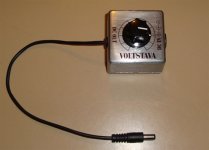
Reminded me of this, Build from around 2012.
Boss style 9v In power jack & does what is says '' 9 Volts all the way down to 1.8v ''
What they now call a Bias knob on Fuzz pedals!


VOLTSTAVA  Alumina Converter ( 9v down to 1.8v - Tip)  .jpg
 
I still don’t quite understand why batteries affect the sound of a fuzz, @Big Monk you said you found an article on the topic? This is fascinating!
 
  • Like
Reactions: fig
Back
Top