
BuddytheReow
Moderator
No problem at all as long as it's uniquely yours from a circuit standpoint. Again, it doesn't have to be boxed up to be a submission.


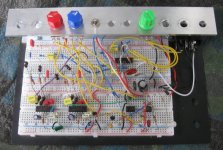

I don’t even…Stereo Chorus
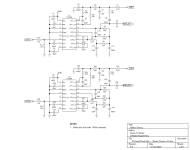
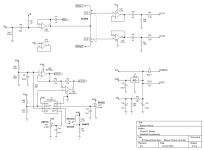
Schematic coming soon...
Uses a pair of PT2399s for delay, STOMPLFO for LFO, TL074 for buffers & mixers.
Controls (L-R): SPEED - DEPTH - SHAPE (smooth / Random) - BLEND
View attachment 40312

Looking forward to seeing more about this! I’m a sucker for stereo stuff, and I have a decent number of 2399s on handStereo Chorus
Schematic coming soon…
Ooooh Tap Tempo!STOMPLFO for LFO,
This is what my brain feels like on a Monday morning.Stereo Chorus
Schematic coming soon...
Uses a pair of PT2399s for delay, STOMPLFO for LFO, TL074 for buffers & mixers.
Controls (L-R): SPEED - DEPTH - SHAPE (smooth / Random) - BLEND
View attachment 40312
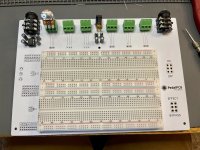
I’m building the ProtoBoard as we speak. Now I just have to learn how to use itOne week down. Get those breadboards going!

I tried separate BLEND controls with mono-in, stereo-out and it does allow for some additional tailoring of the stereo image.What do you think of separating the dual gang blend control for more control over the stereo image? I’ll definitely do that when I try it in true stereo, but I wonder if it would give interesting results on the mono in as well— could allow for pseudo-Eventide style chorusing.

One week down. Get those breadboards going!
-No large vacuum tubes that require high voltages (we want to keep people alive here).
-It must have a max current draw of 100mA.

That’s awesome. Very clever too!Yeah, me too!
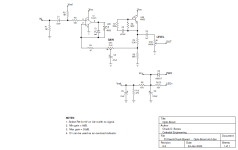
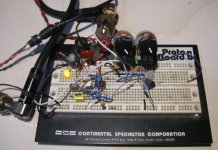
My latest entry: A Slightly Dirty Boost. All components are available from the usual sources. Mouser sells the 4N35 opto-couplers. At low GAIN settings it plays clean. As you turn up the GAIN, the lower harmonics come on very gradually until you overdrive the opto-coupler. Clipping is fairly symmetric and the note decay is very smooth. With GAIN at noon or below, the freq response is flat. At higher GAIN settings, the low bass rolls off a bit. The circuit is not complicated, but the operation is a little out of the ordinary. This circuit exploits the non-linear relationship between LED current (U2A) and phototransistor current (U2B). I've been trying to get a circuit like this to work the way I wanted for quite some time. That fact is reflected in the rev number. D1 can be any color LED you like. It lights up when the optocoupler saturates and can bse used as an overdrive indicator. In the pic below, D1 is a 3mm red superbright and it's lit because I'm driving the opto to saturation. NB: I have changed a few resistor values since I shot that breadboard photo.
View attachment 40944
View attachment 40945

