I also posted this to DIYStompBoxes, but it's not getting much attention over there, so I thought I'd see if it piqued anyone's interest here.
In my pedal builds, for bypass switching, I generally prefer a buffered electrical bypass scheme (similar to typical Boss pedals). I've been doing this with a CD40106 for footswitch response and state management, and a CD4053 for the actual audio signal switching. I've used this circuit as a standalone module as well as directly integrated into the PCB of the effect itself.
Integrating it directly with the PCB is frustrating with through-hole components, because it uses up so much precious PCB space. The standalone module works fine, but I don't like all the added board-to-board wiring.
I got to thinking, the ideal would be if all this functionality was contained in a single integrated circuit. I don't think such an IC exists. Having custom ICs fabricated is unlikely to be accessible to hobbyist budgets any time soon. So I figured the next-best thing is a "quasi-IC", basically a small (i.e. using SMD components), standalone PCB that can be directly-soldered to the actual effect PCB. My other observation is that all the new and improved ICs are generally only available in SMD format.
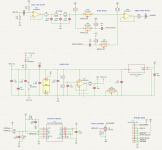
Attached is the design of this "quasi-IC" circuit so far. An overview of the design:
In the schematic, the "offboard wiring" will be castellated PCB edges, so the actual effect PCB ("motherboard") would have corresponding solder pads (turning this bypass mini-PCB into a "daughterboard").
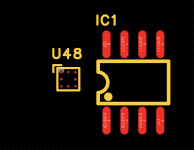
The current draft PCB layout is about 38mm X 23mm. Not quite IC sized, but dramatically smaller than the through-hole equivalent.
Any thoughts/comments/criticisms? Notice any errors or gotchas I likely overlooked?
Edits from the original DSB post:
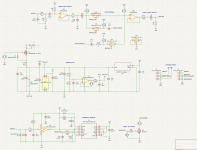
Edit #2: I finally had this fabricated, see post #21 below. I changed the design somewhat, mainly in that it's built around a microcontroller. But the concept is the same. It works!
In my pedal builds, for bypass switching, I generally prefer a buffered electrical bypass scheme (similar to typical Boss pedals). I've been doing this with a CD40106 for footswitch response and state management, and a CD4053 for the actual audio signal switching. I've used this circuit as a standalone module as well as directly integrated into the PCB of the effect itself.
Integrating it directly with the PCB is frustrating with through-hole components, because it uses up so much precious PCB space. The standalone module works fine, but I don't like all the added board-to-board wiring.
I got to thinking, the ideal would be if all this functionality was contained in a single integrated circuit. I don't think such an IC exists. Having custom ICs fabricated is unlikely to be accessible to hobbyist budgets any time soon. So I figured the next-best thing is a "quasi-IC", basically a small (i.e. using SMD components), standalone PCB that can be directly-soldered to the actual effect PCB. My other observation is that all the new and improved ICs are generally only available in SMD format.
Attached is the design of this "quasi-IC" circuit so far. An overview of the design:
- TLV9301 for virtual ground buffer: available in ultra-small SC70 package, 150uA quiescent current, can drive capacitive loads
- AP7375-50 5v LDO: tiny sot-23 package, 3uA quiescent current, up to 45v input voltage
- DG413 for audio switching: replaces the CD4053 I previously used; quad SPST switches, two normally open, two normally closed; one is unused in this design, the remaining three exactly mimic Boss-style JFET audio switching; 35R on-resistance
- SN74HCS74 for state-management; this is a dual D (data) flip-flop with Schmitt trigger inputs (think CD4013 with Schmitt inputs); one flip-flop is unused, the other is wired as a T (toggle) flip-flop (/Q tied to D); replaces the CD40106 in my previous design; available in ultra-small SOT-23-THIN package
- OPA1652 input and output buffers: hifi-grade opamp with super-high impedance JFET inputs, tiny bias current, rail-to-rail capable, overkill specs
In the schematic, the "offboard wiring" will be castellated PCB edges, so the actual effect PCB ("motherboard") would have corresponding solder pads (turning this bypass mini-PCB into a "daughterboard").
The current draft PCB layout is about 38mm X 23mm. Not quite IC sized, but dramatically smaller than the through-hole equivalent.
Any thoughts/comments/criticisms? Notice any errors or gotchas I likely overlooked?
Edits from the original DSB post:
- I just noticed I have R22 as 22k, that's a typo, should be 22R. (Only off by 1000!)
- I also realized the input cap C18 plus the R4 Vbias pullup resistor will have a time constant around 10 seconds. I'll think on this a bit, but 1uF or maybe even 470nF is probably fine here.
Edit #2: I finally had this fabricated, see post #21 below. I changed the design somewhat, mainly in that it's built around a microcontroller. But the concept is the same. It works!
Attachments
Last edited:
 But it looks like all the board-mount DC jacks are rectangular, and I don't know how to cleanly make a rectangular hole. So I feel like I'd need some kind of robot-based drilling service to make these precision holes for me to realize such a module.

 Even though I know it doesn't really matter, big round hole vs rectangular jack... I'm getting anxious just writing about it!

 Mine is top-mount in 125B.