I agree with what everyone else has said, and looks like I'm in good company as part of the "hate offboard wiring" crowd. Depending on how much wiring there is, that part of the build might take as much time as the rest of the build combined!
On one of my most recent builds, the
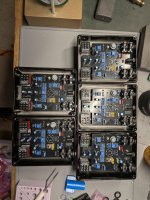
Old Fashioned, I only used manually-soldered wires for the I/O jacks. Power and footswitch were via pre-made wires-with-JST-connectors. So technically those still required manual soldering on one end, but it cuts the number of wire-ends-to-be-soldered-manually in half.
@StompBoxParts currently has their Pro SPST momentary switches with
pre-soldered JST leads for the same price as the bare switches.
I personally think minimizing offboard wiring - besides being a quality of life improvement - just makes the build look neater. I think that's important if you're selling these. I suspect even non-technical users can have an opinion on "that looks neat and professional" versus "that looks like a messy hack job".
Using some kind of SPST-based switching scheme (e.g. Boss-style buffered electrical bypass or relay bypass) helps too, since you only need two wires from the switch to the PCB. The mechanical SPST switches have nine solder points. As has been mentioned, ribbons and pin-headers help, but... I'm biased, I just don't like 'em!
I've recently started working on this
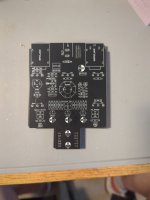
Buffer + Bypass "Quasi-IC" Module. The motivation for this was largely for build quality of life (and PCB design quality of life). The idea is you get a lot of the pedal "boilerplate" in a tiny pre-assembled PCB that you can direct-solder to your actual effect PCB. In other words, treat it like an IC that does: footswitch handling, effect/bypass state management, status LED switching, provides buffered VREF, input and output signal buffers, RF filtering, and actual engage/bypass switching. I'm going to make another version of the Old Fashioned PCB with basically all the entire lower half of the existing board removed, and replaced by solder pads for this "quasi-IC". An additional benefit here is that practically all the newer/better parts are SMD-only: so all the boring-but-essential parts of an effect get better components versus what's available in through-hole.
If buffered electrical bypass isn't your thing, the concept could be applied to relay bypass (pretty sure the nice Panasonic TQ2 relays have SMD variants).
I think the next evolution of this idea - and I've seen other people here do exactly this - is to make this quasi-IC into an I/O and power module, where you solder the power and I/O sockets directly to it. Then use a ribbon (or JST) connector to go between the I/O and power module and the actual effect PCB. The only reason I haven't done this myself is that I hand-drill my enclosures - wired I/O and power jacks makes for very forgiving enclosure drill holes.

But it looks like all the board-mount DC jacks are rectangular, and I don't know how to cleanly make a rectangular hole. So I feel like I'd need some kind of robot-based drilling service to make these precision holes for me to realize such a module.