Capacitor Voltages

None of those are inherent to a higher voltage rating; they are due to other characteristics totally separate to that.

The question was is there any sound difference with higher voltage rated caps, and the answer is unequivocally no.
I'd have to go back and review data sheets, etc. but I seem to remember the same line of caps having specifications like internal resistance and delta change with different voltage ratings—and in some applications, this can create a change in sound. For what we do here, guitar frequencies and oodles of noise in the signals anyway, I agree with you—but I believe from a technical point of view, the voltage rating can change the way a capacitor can sound.

This would be similar to saying that there is no physical or sonic difference (beyond size and power handling capability) between resistors of different sizes.
 
I can never get the "mp3 or wav" tests right either, the only way I can notice a difference between resistor sizes is if you stick it in my ear.

And I'm only in my thirties, I believe most members here have... let's say more advanced presbycusis than me.
 
Care to provide proof of such a claim?
Look up self noise. When you’re designing (or at least building) very high gain stages (say, 65 db for a low output phono cartridge), you start to look at a lot of specs. Typically, higher power resistors exhibit lower self noise. This is audible. And caps end up having the same types of issues.

I’m not trying to start a pissing match. I also don’t like it when people write such blanket statements. Your “LMAO” at someone’s question is really out of place on this forum.
 
Look up self noise. When you’re designing (or at least building) very high gain stages (say, 65 db for a low output phono cartridge), you start to look at a lot of specs. Typically, higher power resistors exhibit lower self noise. This is audible. And caps end up having the same types of issues.

I’m not trying to start a pissing match. I also don’t like it when people write such blanket statements. Your “LMAO” at someone’s question is really out of place on this forum.
I'm dubious of any blanket statements made that X or Y is definite, especially when person making the original claims has made similar ones before that he's said aren't measurable, but he can definitely hear them - I've read enough audiofoolery to know what going down this path leads to.

Re: resistor noise - I've read a lot, but always happy to read more. The only person I can see making the claim that higher wattage resistors are quieter is Aiken - specifically talking about carbon comp resistors (and noting this only applies to resistors using carbon-based resistive materials, but then also saying that it's the major source of noise for all resistors except wirewound; who knows).

I've looked for the studies he is making these claims from but haven't found them - I have found stacks of discussion with people pointing out the confusing nature of his contradictory statements, and interpretations of the noise source that support that it only applies to carbon comp resistors (as the noise reportedly comes from grain contact). I did also find some papers from somebody who attempted to measure this noise and quantify it in more detail - who said they found it almost impossible to measure across any modern constructed resistor and it was orders of magnitude smaller than any other noise source.

So we've got:
  • Johnson noise - dependent on temperature (and we're not dealing with power where smaller resistors are going to heat up noticeably more than larger ones).
  • Contact noise - reportedly higher wattage is quieter for carbon comp only (without any supportive evidence I can find).
  • Shot noise - dependent on DC current, resistor wattage plays no role.
If you have any information contrary to the above I'd be happy to see it.
 
This may be a round about way, but I can approach it from a few directions. I'm attaching a link to the first online resistor noise calculator that I clicked on. Note what they say, in terms of how you lower the noise that a resistor makes—there's two ways; one is to keep the temperature lower. Larger resistors do this.


This link gives you some equations. The T factor is quite important in the overall noise level.


In the mid-aughts I built a DAC where the I-V section called for matched quads of very low noise resistors in 6 places. I got the lowest noise Vishay trimmed naked foil (~$30 a pop!!) for just the 2 most upstream locations, and went with Caddocks (something like $8 each) for the rest. This was probably the only solid state project I've built where the power supply wasn't the bulk of the cost...

 
Last edited:
The general pecking order for noise is : carbon comp << thick metal Film << thin metal film <<wirewound << naked foil . Wirewounds have another issue, but I don't remember it off the top of my head.

I made that confusing, carbon is the loudest, etc.
 
Last edited:
This may be a round about way, but I can approach it from a few directions. I'm attaching a link to the first online resistor noise calculator that I clicked on. Note what they say, in terms of how you lower the noise that a resistor makes—there's two ways; one is to keep the temperature lower. Larger resistors do this.


This link gives you some equations. The T factor is quite important in the overall noise level.


In the mid-aughts I built a DAC where the I-V section called for matched quads of very low noise resistors in 6 places. I got the lowest noise Vishay trimmed naked foil (~$30 a pop!!) for just the 2 most upstream locations, and went with Caddocks (something like $8 each) for the rest. This was probably the only solid state project I've built where the power supply wasn't the bulk of the cost...

Both of these examples are referring to Johnson noise. This is totally separate from the noise that reportedly is decreased by using physically larger/higher dissipation resistors - contact noise. The only supportive evidence of the contact noise claim is Aiken, and even he says that this only happens with carbon comp resistors.

Carbon comp resistors are very, very rare in anything we're dealing with AND I can't even find the studies that this claim is made off of, so from everything I can see the claim that larger resistors are inherently quieter has no basis.

We're also not in situations where currents or dissipation is going to make much of a difference with Johnson or even shot noise.

To play my own devil's advocate, assessing the impact of doubling the power dissipation if we were dealing with temperature differences between resistor sizes that would be measurable are hard to make as that info isn't available, but even with an absolute insane assumption that something like a basic 100k 1w resistor would run at a 25 degree ambient and a 1/2w would run twice as hot - the difference in Johnson noise purely from heating is <5%.

This is an insane situation that's never going to happen in practice.

Again, I'm not arguing that different materials and construction types have different noise levels. They do, and they're measurable. They can make a bunch of difference, as can a bunch of design decisions that don't avoid generating these kinds of noise.

These are all entirely separate from the claim you're making.
 
Last edited:

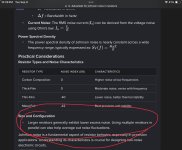
Attempted to find what this screenshot is from with no luck - source? Love to look into where they're making this claim from as again, I've found zero evidence that it's true except for a single claim made by somebody specifically talking about contact noise in carbon composition resistors - and plenty of people repeating these original claims as being a blanket rule for every resistor.

This has, again, absolutely nothing whatsoever to do with Johnson noise which is a factor of temperature and resistive media - given you've searched for "datasheet for Johnson noise in resistors", I'm rather uhhh...skeptical that we're even talking about the same thing.

I've also pulled up a bunch of papers talking about excess noise - but again, this isn't contact noise! This is noise due to current flow through specific resistive materials and is linear with the voltage drop across the resistor. There is zero correlation with the physical size of the resistor, and in the data I could find comparing specific models of resistors in the same series from the same manufacturer, the quieter resistor was equally as likely to be lower power handling than higher. There was mention of studies that had shown the relationship you've mentioned, but they're going all the way back to the 1960s-1980s, and specifically mention this noise is totally non-existent in metal film or wirewound resistors - backing up what I had found in the original place your claim had probably come from, and making it not true.

I've also spoken to two electrical engineers who deal with extremely small signals where Johnson noise is absolutely a major consideration in their day to day jobs, and they've both said that it's an old wives tale they've heard without any evidence to back it up - and one was specifically told it was a common misconception from a lecturer.
 
Last edited:
Back
Top