@Passinwind so I’ve been thinking……. I think I do want to replace the stock preamp in this Stagg bass and just have buffers for each piezo and then to the out jack. According some info on talkbass, after the buffer circuits, the two piezo signals are mixed together with 2 fixed resistors. Would there be any benefit to adding a “pan” knob so that the output between the two could be tweaked to taste, instead of a tone (sub) knob? Not sure if it would make a ton of difference in tone since the piezo’s are fairly close together. Any thoughts?

You are using an out of date browser. It may not display this or other websites correctly.
You should upgrade or use an alternative browser.
You should upgrade or use an alternative browser.
Dear Low End Friends, EUB pre?
- Thread starter Diynot
- Start date

Passinwind
Well-known member
@Passinwind so I’ve been thinking……. I think I do want to replace the stock preamp in this Stagg bass and just have buffers for each piezo and then to the out jack. According some info on talkbass, after the buffer circuits, the two piezo signals are mixed together with 2 fixed resistors. Would there be any benefit to adding a “pan” knob so that the output between the two could be tweaked to taste, instead of a tone (sub) knob? Not sure if it would make a ton of difference in tone since the piezo’s are fairly close together. Any thoughts?
I'm just about ready to dive into this pool, a friend sent me some nice NOS J201s recently. He has all my existing buffer boards but I'll order a new set this week after doing some layout revisions I've had in mind for a while. I also have a bunch of cute little 2-4 channel mixer PCBs which might actually work just fine as-is for buffering and blending, I'll give that a shot ASAP. Might be a week or two, I have a new tube bass amp that really needs to get bolted together this week while my wife is out of town.

@Passinwind ok, so since I like to think things through as much as the next guy, I went ahead and grabbed 2 of the simple Jfet buffer boards and some SMD j201s from PPCB, so here is my next round of inquiries (going to try and pull in the electrical wizard himself @Chuck D. Bones and the man behind the madness @PedalPCB for their thoughts as well). According to interwebs and talkbass, piezo pickups like to see around a 10M ohm input impedance so to accomplish this with the jfet buffer boards do I simply need to change R2 to 10M or do both R2+3 need to be 10M. I was also imagining that C1 would need to be upped to at least 10uf. That said, does the jfet buffer circuit put out a lower z, or does it need to be followed by an output buffer to achieve the lower z? Also I had mentioned using a blend/pan between the pickups and have a board for this schem:

I presume to make that work, I can eliminate C1, R1, and R12 since the impedance and input cap would be handled by the buffer boards (R1 and R12 may simply be pull down resistors, but would presumably still contribute to impedance). All caps in the audio path would be upped to 10uf. Or would it be better just to do a passive blend knob with a dual pot? Lastly, thinking of dropping a bass modded lpb-1 last in the chain for more oomph if needed. So is this a pipe dream, is my thought process going to upset the bass/electrical circuit gods? What have I overlooked or misunderstood?
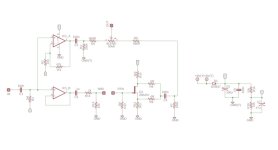
I presume to make that work, I can eliminate C1, R1, and R12 since the impedance and input cap would be handled by the buffer boards (R1 and R12 may simply be pull down resistors, but would presumably still contribute to impedance). All caps in the audio path would be upped to 10uf. Or would it be better just to do a passive blend knob with a dual pot? Lastly, thinking of dropping a bass modded lpb-1 last in the chain for more oomph if needed. So is this a pipe dream, is my thought process going to upset the bass/electrical circuit gods? What have I overlooked or misunderstood?

Feral Feline
Well-known member
Why 10µ? Have you calculated the bandwith to require 10µ? Maybe not all the audio-path caps need to be that large.
Depending on the circuit design, it may not need 10µ. The AMZ Mosfet Booster, for instance, Jack Orman says:
"The frequency response of the AMZ Mosfet Booster is flat and extends down low enough for both bass and guitar use. There is no need to mod the design to add more bass; it will not make any audible change." (bold emphasis mine).
The Mosfet Booster's input cap is a paltry 1n (yes, 0.001µF)!
Mind that didn't stop Catalinbread from bumping the Mosfet Booster's input cap to a whopping bass-friendly 10n (as well as some other cap changes such as output going from 100n to 220n) and renaming it all as the Sogrado Poblano Picoso.
Anyway, I'm still learning the mysteries as to why a seemingly treble-some looking cap value can still let all the bass through.
For something like your build I've got some 2µ2 caps and I know you can get WIma film caps in 4µ7 from Tayda, not sure about larger Film cap sizes, but then there's always 10µF tantalums for sticking in the audio path.
Depending on the circuit design, it may not need 10µ. The AMZ Mosfet Booster, for instance, Jack Orman says:
"The frequency response of the AMZ Mosfet Booster is flat and extends down low enough for both bass and guitar use. There is no need to mod the design to add more bass; it will not make any audible change." (bold emphasis mine).
The Mosfet Booster's input cap is a paltry 1n (yes, 0.001µF)!
Mind that didn't stop Catalinbread from bumping the Mosfet Booster's input cap to a whopping bass-friendly 10n (as well as some other cap changes such as output going from 100n to 220n) and renaming it all as the Sogrado Poblano Picoso.
Anyway, I'm still learning the mysteries as to why a seemingly treble-some looking cap value can still let all the bass through.
For something like your build I've got some 2µ2 caps and I know you can get WIma film caps in 4µ7 from Tayda, not sure about larger Film cap sizes, but then there's always 10µF tantalums for sticking in the audio path.
Admittedly it was a guess based on little more than I have seen that large an input cap used in other circuits, but also upon the half understanding that a larger input cap usually means more bass. Just read an R.G. Keen post elsewhere and now (sort of) understand that it is both the input cap and R1 (impedance determining/pull down) that determines the overall frequency cut off. Essentially, you can either increase the capacitor or if using a larger resistor, you can get away with a smaller input cap while achieving the same frequency response. Looking at the mosfet booster, it has a 10M input impedance from that 10M resistor to ground so that’s probably why you can get away with the 1Nf input cap. According to the little cap/res/freq calculator I just used, a 10M input impedance with a 1nF input cap would have a frequency response of 15hz. Take that with a grain of salt since I could totally be misinterpreting the results.Why 10µ? Have you calculated the bandwith to require 10µ? Maybe not all the audio-path caps need to be that large.
Depending on the circuit design, it may not need 10µ. The AMZ Mosfet Booster, for instance, Jack Orman says:
"The frequency response of the AMZ Mosfet Booster is flat and extends down low enough for both bass and guitar use. There is no need to mod the design to add more bass; it will not make any audible change." (bold emphasis mine).
The Mosfet Booster's input cap is a paltry 1n (yes, 0.001µF)!
Mind that didn't stop Catalinbread from bumping the Mosfet Booster's input cap to a whopping bass-friendly 10n (as well as some other cap changes such as output going from 100n to 220n) and renaming it all as the Sogrado Poblano Picoso.
Anyway, I'm still learning the mysteries as to why a seemingly treble-some looking cap value can still let all the bass through.
For something like your build I've got some 2µ2 caps and I know you can get WIma film caps in 4µ7 from Tayda, not sure about larger Film cap sizes, but then there's always 10µF tantalums for sticking in the audio path.
Last edited:
Feral Feline
Well-known member
Yeah, you have a better handle on it than I do. Over on Kit Rae there are Muffs with 10µ caps that aren't as good on bass as the Green/Black Russian Muffs with much smaller couplers, but that's a whole other conversation.