expensive clipping diodes? diode talk

~nick~

Active member

20 bucks for a diode.. hmmm... claiming to be another tube like replacement. hmmmm.

I'm half tempted to buy one of each and try them out. Anyone ever try these?

While on the topic of expensive diode options, what are some crazy options y'all have run across?
 
Only thing I've seen online about them said that they're similar to using LEDs for clipping, which makes sense given the curve of N3. Can't find any audio demos or anything much more useful than that. Google really does not like the term "nanalog" and just thinks I misspelled analog. They're about $15 too expensive for me to buy just for the hell of it.
 

20 bucks for a diode.. hmmm... claiming to be another tube like replacement. hmmmm.

I'm half tempted to buy one of each and try them out. Anyone ever try these?

While on the topic of expensive diode options, what are some crazy options y'all have run across?
Only thing I've seen online about them said that they're similar to using LEDs for clipping, which makes sense given the curve of N3. Can't find any audio demos or anything much more useful than that. Google really does not like the term "nanalog" and just thinks I misspelled analog. They're about $15 too expensive for me to buy just for the hell of it.
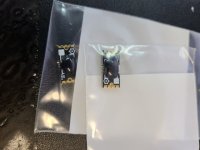
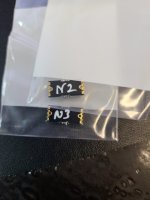
I purchased one of each on my last round of manic spending. They are sitting in with my other diodes. What should I build with them? Not much to see.... hopefully something to hear. I just need to find a circuit.

20210526_075047 (Small).jpg 20210526_075111 (Small).jpg
 
I purchased one of each on my last round of manic spending. They are sitting in with my other diodes. What should I build with them? Not much to see.... hopefully something to hear. I just need to find a circuit.

Build a Sandspur or a Simulcast circuit with them? Make that circuit even more epic?
 
Neither of those circuits use diode clipping though?
Can confirm, currently building a simulcast, definitely has no clipping diodes
Oops! I haven't actually built a pedal yet, just buy them from reverb builders but now I really want to after seeing PedalPCB upload the 125B sized Duocast pedal.

Are there any jfet or mosfet circuits y'all'd(ain't ain't a word, but this should be) recommend to try this circuit out? I feel like using an OPamp wouldn't be as open and wide frequency to take advantage of these expensive nanalog diodes.

Idea: take a non-opamp circuit with very open high end and replace the diodes to get the very open bottom end. No? Thoughts? I'm just spit ballin' here. 🤔

What about the Benson preamp pedalpcb?
 
What about the Benson preamp pedalpcb?
Again, there are no clipping diodes in that circuit. You'll want to look for a circuit that has clipping diodes to use that device. A general rule of thumb is that overdrive circuits will have soft clipping (i.e., anti-parallel diodes within a gain stage feedback network) and distortion will have hard clipping (i.e., anti-parallel diodes to ground after a gain stage. Fuzzes usually have transistors (or op amps) driven to saturation; pre-amp emulation pedals usually use JFETs as replacements for tubes.

The tommy you mentioned does have diode clipping. That circuit is a bit complicated compared to a straightforward implementation of diode soft clipping (due to the symmetrical / asymmetrical switch). It's certainly possible, but you may need to do a little bit of planning.

If these terms are new to you, check out the the Distortion+ or Rat circuits for examples of hard clipping or the Tube Screamer for an example of soft clipping.
 
Thanks to watching Wampler, JHS and TPS etc videos, I'm somewhat familiar with hard and soft clipping as well as symmetrical. I'll have to look closer to pcbs.

One thing I've wanted to try is using yellow and orange LEDs in parallel or to create somewhat symmetrical clipping. Wampler did a test with different colored LEDs and the orange one sounded really sweet and smooth compared to the red.
 
Another crazy idea: you know how people cryogenic freeze vacuum tubes to make them more dynamic and such? What if you cryo treated every type of diode and A B'd then against non treated diodes?
Heck, why not cryo treat an entire complete PCB?
 
Another crazy idea: you know how people cryogenic freeze vacuum tubes to make them more dynamic and such? What if you cryo treated every type of diode and A B'd then against non treated diodes?
Heck, why not cryo treat an entire complete PCB?
Tube freezing is quackery.

Diode forward voltage is inversely related to temperature. That is, as temperature decreases, forward voltage increases. You may recall that the forward voltage largely determines how a diode clips. However, the diode will return to around the same temperature after freezing.

Cryogenic temperatures are way below freezing. Somewhere around -200C I think.
Parts are rated to work within a certain temperature range, and many have a separate storage temperature range. For example, the 1N4148 diode that is common for clipping can only be stored down to -65C. Anything less and it is not guaranteed to work.

Freezing a whole PCB with components down to cryogenic levels would destroy parts, most likely things like electrolytic capacitors. Even if it worked after, I’d bet it wouldn’t sound better.

I like where your head’s at tho lol
 
Dr Scientist's Heisenberg was the first pedal to use nanalog clipping, developed with mad Profs at the UofA in Edmonchuk.

drscientist_heisenberg-preview_004.jpg
 
I'm guessing those SD slot looking things are a prototype nanalog chip?

There's a Heisenberg pedal on reverb rn but it's super duper expensive. But I have thought before about how a circuit with jfet, mosfet, germanium and OPamp drive blending would make a very versatile pedal. Basically only have a volume and drive on each and use an 10 band eq pedal before and after.
 
Last edited:
Back
Top