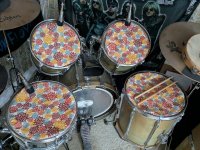
Hey drummers


Once you get a head in tune with itself, you can experiment with intervals between the drum heads. I like to have my resonant head a major second above my batter for bass drum. I do a major or minor third up for toms and a perfect fifth for snare drums. That's a method you can do by ear without buying anything. It's not as instantly repeatable as a tunebot, but it will help you become better and faster at tuning while developing your ear for drum sounds. I actually play with tunings when I'm in a rut to keep from buying more gear. You can get a lot of sounds out of just one drum.
 
The tune bot is helpful when tuning toms to learn what to listen for, but you don't need anything to tune a bass drum. Google "bass drum tuning just over wrinkle" and you'll learn all you need to know about bass drum tuning without buying anything.

I tried all the drum tuning mechanisms, and what worked for me is a Tune Bot to train my ear, but now I go by the "Rob Brown" method (google his youtube vid) to get the tom in tune with itself and then move the head up or down from there. When tuning toms, turn the key 1/8-1/4 turns at most and then check. But again, you don't need that for the kick drum.

Tuning is a thing not enough people talk about, but it's really crucial to getting a good drum sound. It's also why so many people go for the "dead" sound - they can't get the hang of it.
 
I'm no drummer but learning how to tune a kit is incredibly valuable. In my last band we had a great drummer - an older guy who could play an excellent shuffle. When we went into the studio to record the producer ended up completely replacing all the heads and tuning it - took best part of a day. Our drummer reckons his kit had never sounded so good and i have to agree.

Drummers aren't alone in this. I don't know many drummers who are good at tuning their kits, but then I don't know many guitarists who know how to set up their amps!
 
Drummers aren't alone in this. I don't know many drummers who are good at tuning their kits, but then I don't know many guitarists who know how to set up their amps!
Or set up their guitars - I know a lot of people on this forum know how to do it, but I bet that it's a small minority of the greater guitar population.
 
I’m no drummer, but I wish I could play. Really I just wish I was Jamie Muir or Pat Mastelotto. On YouTube I usually geek out more over drum videos than guitar content. RDavidR has some awesome videos on DIY drum hacks and weird diy percussion stuff.
 
When I'm out'n'bout taking in live music, more often than not the best solos are from the drummer.

I had a nice pearl-white drum-kit when I was a kid, but I was never meant to be a drummer.
So I sold the kit to a friend who's a pretty good drummer still. Wish I had that kit back though, for others to jam on it when they come over.

I confess, I like watching drum technique vids... JoJo Mayer, Bernard Perdie, Steve Gadd, Gene Krupa, Tito Puente...
 
Our drummer reckons his kit had never sounded so good and i have to agree.
Yup, it makes a huge difference. I try to tune my kit at least every couple months (which is probably more than typical drummers do), and having a sound guy tell me my kit is tuned really well feels like a better compliment than a stranger commenting on my playing.
 
A while back I bought a Tunebot and it helped me out considerably. It takes a while to tune drums with some guess work plus back and forth between the heads and the tunebot cut so much of the time and guesswork out. It's funny to see some drummers trash it as if they're so above using a tuner. Even if you tune by ear you could use it to record the frequencies and be able to precisely duplicate that tuning again later. Or it could show you that maybe you're not tuning your drums as well as you thought you were.
 
20 is pretty middle of the road. You'd think more wires means more snare response, but that's not necessarily true. Wire tension, resonant head tuning, shell material and depth, will all have an effect on the snare response as well.
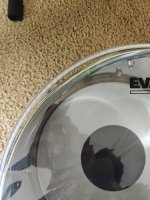
Thanks. I really don't want to go too far down the rabbit hole here. Just do some light duty replacement
 
Uh i guess my snare isn't round?
View attachment 104142
I've seen this a couple times, most commonly on steel snares. My best bet is that the snares were left on for a long time putting pressure on the shell. On a wood snare (or even acrylic, as I found out a couple weeks ago) this will start to wear into the shell, resulting in grooves underneath the straps for the snare wires and eventually a gap between the shell and the head. A steel shell is much less likely to be worn down like this, so it's more common that the strain will cause it to start to bend, resulting in a non-circular shell.

I picked up a used acrylic snare that has grooves worn in, I'm going to have to sand down the shell so the head sits flush again then re-shape the bearing edge. With a steel snare you can just figure out which direction it's starting to bow and stand on it to bend it back. Or honestly you can just use it as-is and it won't cause any problems.
 
Back
Top