Looking for simple compressor or limiter schematic

Are you writing about this version?

Or the one you presented the schematic for is a different version?
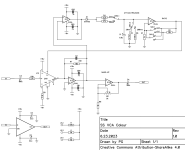
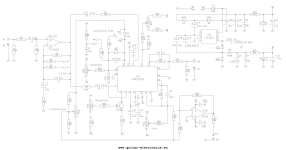
Of the two I presented, the first is simply a marked up version (with a coupla mod suggestions) of the one from Muzique. The 2nd schematic is Jack Orman's yet-to-be released version 3 which doesn't have the amount of control the 1st one has. Version 3, while using the same chip, seems to be more of a sustainer/boost.

2166_Comp_V3_A_Done.jpg

By the way, I was looking for resuorces to get the SSM2166 chip earlier, and found it has different versions: SSM2166A, SSM2166P, SSM2166SZ, etc. Does it matter which one you buy? At Smallbear electronics they are selling the A, but on Aliexpress and many other shop sites they sell the other versions. For example the local shop here is selling the P. Does it matter what letter is at the end of the identifier, or you can just use all for building this compressor?
It doesn't really matter.
The main differences between the SSM2166 variants (A, P, SZ) relate to packaging, temperature range, and RoHS compliance, rather than functional audio performance The SSM2166 is a low-noise, mono microphone preamplifier with variable compression and noise gating. [1, 2, 3]
  • SSM2166SZ (Standard/Current): This is the modern, Lead-Free (RoHS compliant) version. The "Z" suffix specifically indicates RoHS compliance. It usually comes in a 14-lead SOIC (narrow body) package.
  • SSM2166S (Obsolete/Original): The original standard SOIC version, likely non-RoHS or an older packaging revision compared to the SZ.
  • SSM2166P (PDIP): This indicates the 14-lead Plastic Dual-In-Line Package (PDIP), which is intended for through-hole mounting rather than surface-mount (SOIC).
  • SSM2166A: Often used in vendor part numbers to denote high-grade or specific automotive temperature ranges, but generally adheres to the same functionality as the base model in a similar SOIC package.
Another thing: to keep it on the empirical path, do you have this compressor? If yes, in case I send you a sample over, can you run it through the compressor to see if it can compress the signal in the way I want? I can send you a screenshot from the editor where the threshold should be.
Unfortunately, I've sold the ones I built. In my personal journey for empirical experience, I would often invest in evaluation board for some devices to better understand it/them. Mouser has an eval board for the SSM2166 if you're interested in pursuing it that way.
 
It doesn't really matter.
The main differences between the SSM2166 variants (A, P, SZ) relate to packaging, temperature range, and RoHS compliance, rather than functional audio performance The SSM2166 is a low-noise, mono microphone preamplifier with variable compression and noise gating. [1, 2, 3]
  • SSM2166SZ (Standard/Current): This is the modern, Lead-Free (RoHS compliant) version. The "Z" suffix specifically indicates RoHS compliance. It usually comes in a 14-lead SOIC (narrow body) package.
  • SSM2166S (Obsolete/Original): The original standard SOIC version, likely non-RoHS or an older packaging revision compared to the SZ.
  • SSM2166P (PDIP): This indicates the 14-lead Plastic Dual-In-Line Package (PDIP), which is intended for through-hole mounting rather than surface-mount (SOIC).
  • SSM2166A: Often used in vendor part numbers to denote high-grade or specific automotive temperature ranges, but generally adheres to the same functionality as the base model in a similar SOIC package.
Thanks for the clarification on the version, it helps a lot.

Another thing that still confuses me is that the version that is uploaded to Muzique seems to lack attack and Release setting. Those would be essential to delicate limiting or compression. To act fast on peaks and release fast when they are gone. How can you achieve this if there are no separate attack release knobs? Another thing: in this topic I am searching for the solutions to cut outstanding peaks occuring at the highest sounding frets (23-24). The highest note: E6 is 1318Hz as I remember. So those transients need a faster acting compressor than the ones that are usuable without issues when someone plays at frets 1,2,3,4. Can the attack on the AMZ act that fast?
 
Thanks for the clarification on the version, it helps a lot.

Another thing that still confuses me is that the version that is uploaded to Muzique seems to lack attack and Release setting. Those would be essential to delicate limiting or compression. To act fast on peaks and release fast when they are gone. How can you achieve this if there are no separate attack release knobs? Another thing: in this topic I am searching for the solutions to cut outstanding peaks occuring at the highest sounding frets (23-24). The highest note: E6 is 1318Hz as I remember. So those transients need a faster acting compressor than the ones that are usuable without issues when someone plays at frets 1,2,3,4. Can the attack on the AMZ act that fast?
I'm unsure about your question about faster transient response for higher frequencies. What I can make out from the datasheet, I refer to TCP8a on page 5 of the datasheet. The SSM2166 uses a VCA to manage the gain bandwidth, which is virtually flat out to ~10K Hz. The SSM2166 is not extremely fluent in controlling all aspects of compression. It is simply a versatile, low-parts-count compression chip with which to build a decent compression circuit. IMO, to get the type of fine control of compression you're on about is not gonna happen in a low-parts-count DIY pedal.
 
'm unsure about your question about faster transient response for higher frequencies.
What I referred to: some may consider a compressor fast, but it must be clarified about which part of the neck we are talking about. At the stem of the neck where the highest notes are, you need to make sure the attack can be set fast enough to catch the fast transients there in time. If you know the exact smallest value where you can set the attack on the AMZ, and it is faster than the transients at fret 23-24 to reach their peak, it will work, else not.

About what you can reach with DIY: don't judge too early. I have the Carl Martin Compressor/Limiter, and the Carl Martin Opto Comp, they are all free of distortions, and with at least the Compressor/Limiter, you can reach extra fast attack. I tried it, that part works for me. I have disassembled the Opto Comp already, it is not a complicated circuit, and maybe the Attack could be set faster than it is. Have never disassembled the the Comp/Limiter, but I assume it won't look like a Strymon inside. Those two pedals could be the starting point to create very good custom pedals that can address the problems I mentioned in this thread, but... the schematics are not available. So there are examples to the contrary, you see.

Nevertheless, the AMZ is on my list. If I get proper info about that it can do the delicate limiting, I will build it faster than I planned. But I have been planning to build it anyway, because of the way it is doing the compression, I want to listen to how it sounds. I wish I had so few problems with pedals so that building the AMZ was my biggest problem :D

Edit: holy molly I have just noticed the Carl Martin Opto Comp has visible PCB routes :DDD
 
Then you'll likely want to go with the THAT4301 chip which doesn't suffer HF transient laziness. The SSM2166 lets them slip by.

Ask most any AI engine this question: "How does the THAT4301 cope with the fast transients at higher frequencies compared to lower frequencies on the guitar compared to the SSM2166?"
 
Last edited:
Then you'll likely want to go with the THAT4301 chip which doesn't suffer HF transient laziness. The SSM2166 lets them slip by.
Maybe. That is one possible way. But having realized that the Carl Martin has normal, old fashioned PCB and normal sized parts with values written on all, maybe the best approach would be to clone them and correct the weakness about their controls. The Opto Comp is such a simple circuit that even I could trace it easily. I have not disassembled the Comp/Limiter yet, but I have a suspicion that won't be too different either. IF that is the case, problem is solved because both pedals are distortion free and their problem is only the lack of a meter and the Attack/Release knobs. I guess it won't be a complicated mod to lead them to separate knobs and add a meter to see when the compression kicks in.

It makes me think about however how the hell they are distortion-free? I have the Gurus Optivalve that is a much more expensive pedal, and it has way more components inside, even a tube is part of the circuit. It would sound good, but that suffers from serious intermodulation too. The Carl M. Opto Comp is ridiculously simple compared to that, yet it is super clean, no intermodulation at all, and can take higher input signal gain as well. Moreover the Demeter Compulator (also opto) praised by many also suffers from distortion problems in spite of being much more expensive. That one however has a simple circuit too, but something is not okay with it's design it seems. I can see there are 2 chips in the Carl Martin Opto Comp. I guess the magic why that pedal is distortion free can be found in those chips, right?

However, even until I trace them I will need to do something for that the schematic is ready. Tonight I got some advice what to do if the Fast Audio Limiter tends to distort. So maybe I will still build it.

An option for using the THAT has came up as well: THAT Jam Compressor. Have never heard about it.
 
Remember what the comment was in connection with the Fast Audio Peak limiter? That the technology is obsolete prone to distortions, and the THAT chip is a much more advanced technology with better noisefloor and distortion specs. Remember I mentioned the Carl Martin Compressor/Limiter is unlike other compressors because it does not have the intermodulation and can receive higher gain signal? Look:

carl.jpg


I think I found the reason why the Carl Martin is like that :)
 
Just to reiterate some points,
  • Opto compression will never be as fast as you are looking for, the opto cell simply cannot react, or recover fast enough.
  • Regardless of the rest of the circuit, or the method by which compression is occurring, fast compression produces distortion, always. It's just an intrinsic property of altering a waveform.
  • The faster compression occurs, the closer the process resembles / is clipping.
  • I still think a proper neck adjustment, fret leveling, and pickup height adjustment is the real solution to this problem
  • failing that I don't think the compressor with the features you want, exists in a ready to go PCB
  • I still think if you do want an active device what you want is a clipper, one where it only shaves off a dB or two and is very clean before that.

Anyway, this is probably the closest circuit to what you're looking for. https://www.freestompboxes.org/viewtopic.php?t=31550&sid=f0ba995efcc1e2427667b01bdcbc603c
 
Just to reiterate some points,
  • Opto compression will never be as fast as you are looking for, the opto cell simply cannot react, or recover fast enough.
  • Regardless of the rest of the circuit, or the method by which compression is occurring, fast compression produces distortion, always. It's just an intrinsic property of altering a waveform.
  • The faster compression occurs, the closer the process resembles / is clipping.
  • I still think a proper neck adjustment, fret leveling, and pickup height adjustment is the real solution to this problem
  • failing that I don't think the compressor with the features you want, exists in a ready to go PCB
  • I still think if you do want an active device what you want is a clipper, one where it only shaves off a dB or two and is very clean before that.

Anyway, this is probably the closest circuit to what you're looking for. https://www.freestompboxes.org/viewtopic.php?t=31550&sid=f0ba995efcc1e2427667b01bdcbc603c

The Carl Martin Compressor offers the solution that you refer to is not possible (the photo of the chip is from that, not the Opto Comp). It does have a fast attack and is distortionfree, but the fact that the Attack and Release has 1 common knob on that compressor makes it unable to do delicate and prompt compression. You can either set fast attack/slow release, or slow attack/fast release. But no option to set fast attack and a release time based on the song tempo. So that should be modified, to have Attack and Release knobs separately.

Considering the Carl Martin does not have the intermodulation, I know because I have it, and it has the THAT chip that was recommended by others anyway, I would go to that direction instead. Because it has already proved it works as I expect and no intermodulation like in many other pedals.

Searching the web a device came up called Foote Pico Compressor, that used that chip, but I can find absolutely nothing about it. I can see the device listed on some sites but no info or homepage of the device at all, or schematics.
 
Last edited:
THAT4301:
  • End of Life
  • Obsolete
  • No longer made

There is still hope though.


Three things I've found empirically:
"AI" is often emphatically wrong. I've posted elsewhere on the forum regarding how AI messed up on the type of phaser/compressor/whatever.​
I would trust AI less than the distance I can throw a living breathing fully grown pachyderm, whether south-bound or otherwise.​

It is good to learn the language that everyone speaks, so that communication is clear and concise. The neophyte card loses its validity fast.​

I know of no compressor nor limiter nor noise-gate that can detect what part of the neck I'm playing on my bass, say for example:​
the G-string 2nd-fret, vs​
D-string 7th-fret, vs​
A-string 12th-fret, vs​
E-string 17th fret.​
 
THAT4301:
  • End of Life
  • Obsolete
  • No longer made
You didn't get the point: the chip is in my original Carl Martin pedal. So available!!! If the updated fully controllable board is ready, I will not hesitate placing that chip onto that board. The original Carl Martin Compressor is functionally very useless. Will not be missing that. They ruined it with the common Attack/Release knob design.


I know of no compressor nor limiter nor noise-gate that can detect what part of the neck I'm playing on my bass, say for example:the G-string 2nd-fret, vsD-string 7th-fret, vsA-string 12th-fret, vsE-string 17th fret.

Well, I can only talk about myself, about my experiences. I have never tried compression on bass extensively. But what I tried whether the Carl Martin can act promptly: it can. So that part is sorted out. What it can't do is to do the Release according to the song tempo while the Attack is on the minimum. Because of the knob design I referred to. So the board is capable of what I need it for, only the Attack/Release have to be separated on two knobs. And done. Problem solved. No distortion, fast precise limiting is available.

By the way, I tried my Keeley compressor with my bass guitar a few times, and it sounded to do a decent job. If you have sombody in your circles who owns one, try it. The Keeley is a pretty good, rock solid compressor, unfortunately the intermodulation affects it seriously, but not in the bass range. So you will notice nothing from that problem.
 
Do you have the desoldering skills to safely remove the THAT4301 chip from your Carl Martin pedal without damaging the chip with excessive heat during the desoldering process?

Perhaps it's better to sell the pedal and use the money to buy the latest-greatest THATCorp IC, and/or get the Retrofit module I mentioned in my previous post. The Retrofit module will enable you to build a 4301 circuit without THAT specific chip.

Nonetheless, I'm a firm believer in doing whatever you want with something that belongs to you: Paint it, sell it, rehouse it, mod it, smash it with a 10lb sledge — it's yours to do with what you will.

The original Carl Martin Compressor is functionally very useless.

Maybe for you; I know others feel differently about the Carl Martin Compressor and find it useful for their needs. It's a highly coveted pedal in some circles that could be sold for profit.

They ruined it with the common Attack/Release knob design.

Carl Martin simplified the control interface to work with a broad spectrum of users.
CM didn't ruin anything, just because the controls don't meet your niche-needs.

The original Dan Armstrong Orange Squeezer had zero knobs, none. It was a successful design, but nonetheless it didn't meet everyone's needs with such limited control (on/off). So people started modding the circuit, to vary the amount of compression, attack, and other common functions found on compressors. There are one-knob variants, two- three- and as many as six-knob variants of the Orange-Squeezer.

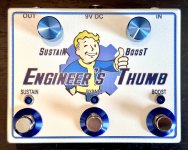
Another example: Merlin Blencowe's The Engineer's Thumb was originally designed to be a 2-knob compressor: LEVEL & COMPRESSION.
It has been modded since, and is a popular DIY compressor with as many as 5 controls:
  • Attack
  • Release
  • Level
  • Ratio
  • Threshold
  • Optional Bright Control (Toggle switch)
I'm not suggesting you build either the Orange Squeezer or Thumb Sucker for your particular needs, in case you've missed my point;
I'm suggesting that you perhaps MOD your Carl Martin by separating the ATTACK and RELEASE functions. Then you'll have the speed you want, the control you want, and won't have ruined a perfectly good IC (and pedal for that matter).

You said it yourself:

So the board is capable of what I need it for, only the Attack/Release have to be separated on two knobs. And done. Problem solved. No distortion, fast precise limiting is available.

Mod the Carl Martin.


The Keeley Compressor might be fine for guitar. If I wanted to try it, I'd just breadboard it, but it does not meet my needs for bass.
It seems you were not able to extrapolate my example of playing the same note all over the neck and apply it to your own situation. A limiter doesn't care where on the neck you play (or what note for that matter), be it a Guitar, Upright Bass, Mandolin, Dutar, Guembri or other.
So let's stay focused, don't worry about my bass-compression, we're all here trying to help you solve your problem.

Empirically, were it me, I'd start with Rossbalch's suggestion of fixing the problem at the source, the Guitar.
THEN if that doesn't do it, I'd start looking into modding the Carl Martin Compressor.
 
Carl Martin simplified the control interface to work with a broad spectrum of users.
CM didn't ruin anything, just because the controls don't meet your niche-needs.
Well, we won't agree about it but these are our personal opinions indeed.

Do you have the desoldering skills to safely remove the THAT4301 chip from your Carl Martin pedal without damaging the chip with excessive heat during the desoldering process?
I am planning to desolder the stuff with a so called tinsucker, the metal one that can be heated, placed over the pad and remove the tin with a push of a button. But now as you mentioned it, maybe I will have a professional desolder the transistor.

Mod the Carl Martin.
That would be the ideal thing to do. I am still considering the options because THAT has very good compressor schematics on their site, too. I amy trying to figure out which one would be the best for me.
 
Well, we won't agree about it but these are our personal opinions indeed.


I am planning to desolder the stuff with a so called tinsucker, the metal one that can be heated, placed over the pad and remove the tin with a push of a button. But now as you mentioned it, maybe I will have a professional desolder the transistor.


That would be the ideal thing to do. I am still considering the options because THAT has very good compressor schematics on their site, too. I amy trying to figure out which one would be the best for me.

Maybe post the schematic of the Carl Martin comp, usually variable attack and release isn't too hard to implement depending on the design.

Let's look at this fairly simple compressor from DIY Recording Equipment, you can kinda work out pretty well how the various parts of it work.
1777581017647.png
 
Here's what is purportedly the schematic for the Carl Martin comp:

THAT4301 COMPRESSOR SCHEMATIC (CARL MARTIN).png

I extracted it from a PDF that included a layout, and the layout closely matches the gutshot geso posted earlier.
Get the full PDF from the url on the schematic.
 
I cannot confirm this is the correct schematic, because I haven't disassembled that pedal yet. I had the photos from another user. But I will definately create the schematic for the Carl Martin Compressor and the Opto Comp, too. I want to see why those two pedals lack intermodulation and why all others suffer from it. I'll just need some time because I need to get a tin remover tool.

On the other hand, you were partly right about the Attack speed problem. I have just noticed it tonight. I wrote the Carl Martin tackles the outstanding peaks problem, because it does seem to do that indeed. But actually I maybe wrong. Not even maybe, I am sure now. So on the Carl Martin even if you turn the Threshold to min it is not on 0, and the Attack/Release follows a preset scheme. So you can not be sure about exact values. Me, I couldn't set it not to affect the notes that might not be cut. This way it does the job, but it is affecting notes it shouldn't, because the release in the fast attack position of the Response knob is not going back to 0. No wonder there are no peak problems.

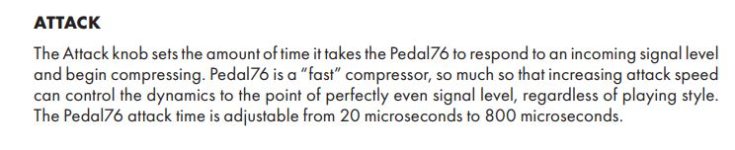
However I dug deeper in the Attack topic. and I realized the THAT won't solve this issue. I recorded a sample picking the notes on the guitar as loud as possible, between about frets 18-24. I marked at what amplitude the peak cut should happen. The outstanding peaks are on the highest notes (D#6, E6). If you want the peak limiting in time on those notes, I calculated that you need the attack to be set to 20-50 microseconds at least. Else the transients will reach their peaks earlier than the compressor would act.

Here is the sample:

Here is the photo about the limiting level (red arrow)
v-g-s.jpg


The AI says because of the RMS the THAT chip is not capable to do such a fast limiting. It suggests kits like the Hairball Audio FET/RACK. But that is about 600€. At that price it is just a future plan for me.

The AI says it is possible to set nearly that fast Attack on the Fast Audio Limiter, but it might be doing pops or clicks when cutting, because it was not designed for that fast Attack. This limiting approach seems to be a dead end now. This might not be a route for me to fix headroom problems in problematic pedals.

But at least it revealed you can build distortion free circuits with the THAT.
 
Back
Top