
You are using an out of date browser. It may not display this or other websites correctly.
You should upgrade or use an alternative browser.
You should upgrade or use an alternative browser.
Problems with Caesar chorus
- Thread starter Jkhicks
- Start date
benny_profane
Well-known member
The LFO should function without the LEDs by the switch installed. All those LEDs do is alter the shape of the wave. When power is applied to the pedal, you should see the LFO indicator LED (i.e., the Rate LED) cycle.
TL022 pin one=7.23v,pin two=7.17v,pin three=6.9v,pin four=7.42v,pin five=7.1v,pin six=6.79v,pin seven=7.1v,pin eight 0v.Have you double checked all component values? It's tedious, but going through resistor-by-resistor and cap-by-cap could lead you to something that is incorrectly placed.
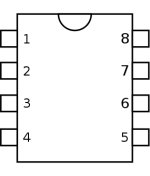
Another step that could help us diagnose what's happening here: take your voltage to ground across all IC pins. They're numbered like so:
1. 8
2. 7
3. 6
4. 5
Post those measurements for all 4 ICs. That may help us pinpoint the problem
Another question: does your LFO LED light up and pulse when you plug the pedal in? If not, that's an indication that your LFO is not operational, in which case no signal will pass through your MN3207. This should light up regardless of if the pedal is "on" or "off".
MN3707 pin one=0v,pin two=3.4v,pin three=6.3v,pin four=6.7v,pin five=7.26v,pin six=2.5v,pin seven=0v,pin eight=3.41v
MN3102 pin one=7.2v,pin two=3.3v,pin three=6.4v,pin four=6.4v,pin five=0v,pin six=3.4v,pin seven=6.2v,pin eight=6.7v
45580 pin one=3.6v,pin two=2v,pin three=2.5v,pin four=7.2v,pin five fluctuating 0-6v,pin six=3.5v,pin seven fluctuating 2-5v,pin eight 0v……..9v depleted battery supplying 7.7v to the pcb. I don’t remember the power fluctuations the first time I checked it earlier.
This is how the 4558, TL022 pinout is. PIn 8 is power in = 9v & Pin 4 is GND!TL022 pin one=7.23v,pin two=7.17v,pin three=6.9v,pin four=7.42v,pin five=7.1v,pin six=6.79v,pin seven=7.1v,pin eight 0v.
MN3707 pin one=0v,pin two=3.4v,pin three=6.3v,pin four=6.7v,pin five=7.26v,pin six=2.5v,pin seven=0v,pin eight=3.41v
MN3102 pin one=7.2v,pin two=3.3v,pin three=6.4v,pin four=6.4v,pin five=0v,pin six=3.4v,pin seven=6.2v,pin eight=6.7v
45580 pin one=3.6v,pin two=2v,pin three=2.5v,pin four=7.2v,pin five fluctuating 0-6v,pin six=3.5v,pin seven fluctuating 2-5v,pin eight 0v……..9v depleted battery supplying 7.7v to the pcb. I don’t remember the power fluctuations the first time I checked it earlier.

Stickman393
Well-known member
Looks like your voltages are all over the place. It also looks like you may have swapped the readings for the TL022 and the JRC4558.
Can you confirm that your voltages match the pattern in the photo that music6000 posted?
A few points from reading your posts:
1) Reading different voltages across a capacitor is normal, a fundamental part of the capacitor design is a dielectric - that is, an insulator. Something which does not allow for the passage of electrons.
They're often used in circuits to block DC voltage from one part of the circuit from influencing another part of the circuit. Fun thing about caps - they don't allow DC to pass (DC will cause a capacitor to build a charge, but that charge won't release until the voltage acting on it is released). It is this property that allows AC...E.G. audio signals...to pass across a capacitor...a trick of electromagnetism that I spent a good 30 minutes explaining to my apprentice earlier this week.
2) A lack of voltage as compared to ground simply means that there is no potential between that point and ground - that is, there is no difference in electrical pressure between the point that you are measuring and ground. If you were to attach a wire between those two points, no electrons would flow. This does not mean that there is a problem at this point unless you're measuring a point that is supposed to have some sort of potential to ground.
3) You should not read much, if any, DC voltage on the left or right side of the footswitch - these are your input and output poles, and depending on the switch position they're either grounded or there is a capacitor between these points and any DC voltage source. The center pole may show potential to ground on the top terminal only but that will depend on the position of the switch as well. If the switch is currently completing the ON/OFF indicator LED circuit to ground, you will not read DC voltage ANYWHERE on the switch. If the switch is not completing that circuit, then you will see something in the range of your power supply voltage on the top center position ONLY.
If you do not see voltage on the center top terminal of your switch, it is either currently in the "effect on" position, or there is a problem upstream of that point. That is, unless you have a bridge or a whisker or something shorting out the connections on your bypass switch.
-----
A lesson that stuck with me from my apprenticeship: In a troubleshooting mindset, you need to know what measurement you expect to see *before* you take a reading. Otherwise it's just meaningless data.
That's where this board comes in. We can help to interpret the data that you provide, but remember that none of us is sitting at your bench with a meter or an audio probe. We can only see what is in focus and unobscured in your photos, and we can only interpret voltages if we know for certain where that measurement was taken.
Truthfully, I get it. I know where you're at, because I was right where you are a little less than a year ago when I was first getting back into the whole DIY pedal thing. I built a Klon that never got finished because I got too hasty with condemning components and eventually ended up ripping out a bunch of traces while de-soldering. I posted a thread on another forum where I even questioned if my PCB was defective...which is a little less common than, say, getting a bad resistor. Which is to say; buy a lottery ticket if you get a defective PCB.
Confirm those voltage readings for us, and it would probably be a good idea to build yourself an audio probe as well.
Can you confirm that your voltages match the pattern in the photo that music6000 posted?
A few points from reading your posts:
1) Reading different voltages across a capacitor is normal, a fundamental part of the capacitor design is a dielectric - that is, an insulator. Something which does not allow for the passage of electrons.
They're often used in circuits to block DC voltage from one part of the circuit from influencing another part of the circuit. Fun thing about caps - they don't allow DC to pass (DC will cause a capacitor to build a charge, but that charge won't release until the voltage acting on it is released). It is this property that allows AC...E.G. audio signals...to pass across a capacitor...a trick of electromagnetism that I spent a good 30 minutes explaining to my apprentice earlier this week.
2) A lack of voltage as compared to ground simply means that there is no potential between that point and ground - that is, there is no difference in electrical pressure between the point that you are measuring and ground. If you were to attach a wire between those two points, no electrons would flow. This does not mean that there is a problem at this point unless you're measuring a point that is supposed to have some sort of potential to ground.
3) You should not read much, if any, DC voltage on the left or right side of the footswitch - these are your input and output poles, and depending on the switch position they're either grounded or there is a capacitor between these points and any DC voltage source. The center pole may show potential to ground on the top terminal only but that will depend on the position of the switch as well. If the switch is currently completing the ON/OFF indicator LED circuit to ground, you will not read DC voltage ANYWHERE on the switch. If the switch is not completing that circuit, then you will see something in the range of your power supply voltage on the top center position ONLY.
If you do not see voltage on the center top terminal of your switch, it is either currently in the "effect on" position, or there is a problem upstream of that point. That is, unless you have a bridge or a whisker or something shorting out the connections on your bypass switch.
-----
A lesson that stuck with me from my apprenticeship: In a troubleshooting mindset, you need to know what measurement you expect to see *before* you take a reading. Otherwise it's just meaningless data.
That's where this board comes in. We can help to interpret the data that you provide, but remember that none of us is sitting at your bench with a meter or an audio probe. We can only see what is in focus and unobscured in your photos, and we can only interpret voltages if we know for certain where that measurement was taken.
Truthfully, I get it. I know where you're at, because I was right where you are a little less than a year ago when I was first getting back into the whole DIY pedal thing. I built a Klon that never got finished because I got too hasty with condemning components and eventually ended up ripping out a bunch of traces while de-soldering. I posted a thread on another forum where I even questioned if my PCB was defective...which is a little less common than, say, getting a bad resistor. Which is to say; buy a lottery ticket if you get a defective PCB.
Confirm those voltage readings for us, and it would probably be a good idea to build yourself an audio probe as well.
Stickman393
Well-known member
Sometimes that's all you can do, de-soldering can lead to board damage. I've scrapped boards in the past; I built an unpleasant surprise that lived up to it's namesake.
Solid core wire is a good way to go: no whiskers. I personally tend to use 26awg. Just be careful not to put any strain on those wire to board connections and you should be fine.
Solid core wire is a good way to go: no whiskers. I personally tend to use 26awg. Just be careful not to put any strain on those wire to board connections and you should be fine.