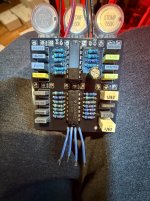
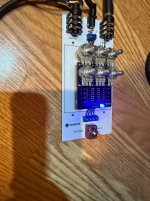
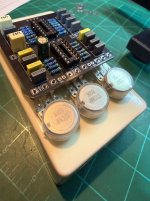
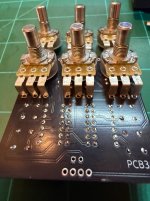
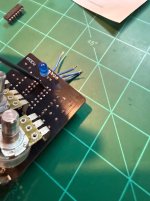
Six band equalizer potentiometer style

OD is Glorious

Active member
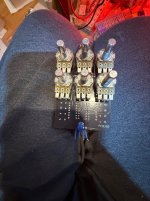
So the pedal gets bypass on the auditorium platform but when you engage the switch, you just get a loud pop. Maybe someone can see something I’m missing here I tested every resistor and cap and potentiometer. I’m hoping it’s something simple but right now it gets nothing on the auditorium platform except that loud pop and the light of course comes on.
 

Attachments

  • IMG_9692.jpeg
    IMG_9692.jpeg
    1.1 MB · Views: 19
  • IMG_9691.jpeg
    IMG_9691.jpeg
    1 MB · Views: 21
  • IMG_9688.jpeg
    IMG_9688.jpeg
    838.5 KB · Views: 22
  • IMG_9680.jpeg
    IMG_9680.jpeg
    787.1 KB · Views: 19
  • IMG_9679.jpeg
    IMG_9679.jpeg
    789.4 KB · Views: 16
What you want to confirm is that each pin of the IC is making proper contact with the underside of the board. Tricky without a multimeter with that option. So failing that, check that each pin of the socket has sufficient solder and that you haven’t missed any altogether. Feel free to ask me how I know… 😉
Thanks, I do have a DMM. I check resistors and capacitors. Mostly paint by numbers over here.
 
You're looking for a low ohm reading. Near zero, but anything below 100 ohms or so would be suspect in this case.

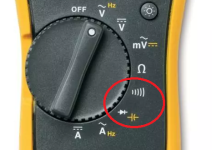
Does your DMM have a setting where it beeps when the leads are touched together? Usually represented by a diode or speaker/sound symbol.
1771777886874.png
 
So I will write down my readings because I’m not sure exactly what I’m looking for; from looking on the Internet it looks like when there’s no continuity there will be an OL.
If your DMM has a continuity option, you’d be able to check that there are no breaks between the socket tops to bottoms (IOW, you’d be seeing that each pin of the IC connects to the other side of the board). If not, there’s another solution with the auditorium. Working on it as we speak.
 
If your DMM has a continuity option, you’d be able to check that there are no breaks between the socket tops to bottoms (IOW, you’d be seeing that each pin of the IC connects to the other side of the board). If not, there’s another solution with the auditorium. Working on it as we speak.
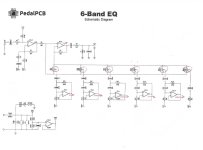
This is a suggested pathway for tracing the audio.

six band audio trace.jpg
The right-facing triangles (marked with arrows) are the outputs of each IC. If you have a way of separating the auditorium's output connector, you could use that to track the audio as it goes through the circuit. The circled bits are the pot wipers which send the EQ'd band to the output (second IC at the top). If you have a way of looping the audio, you have two free hands to check this (or you could use an iPhone output, whatever gives you continuous audio). You should get audio at least at IC1.2's output unless the problem is before this.

This message might be a bit cryptic as it stands but I'm happy to assist if you get stuck.
 
Just to make sure I’m doing this right I’m on pin one. Taking the lead from pin one and touching each of the others. These are my readings socket one pin one.
1-2 .1
1-3 6.9
1-4 6.7
1-5 23.8
1-6 25
1-7 25
1-8 25
1-9 25.9
1-10 19.9
1-11 6.7
1-12 21.8
1-13 25
1-14 25
 

Attachments

  • IMG_9702.jpeg
    IMG_9702.jpeg
    863.4 KB · Views: 2
This is a suggested pathway for tracing the audio.

View attachment 111960
The right-facing triangles (marked with arrows) are the outputs of each IC. If you have a way of separating the auditorium's output connector, you could use that to track the audio as it goes through the circuit. The circled bits are the pot wipers which send the EQ'd band to the output (second IC at the top). If you have a way of looping the audio, you have two free hands to check this (or you could use an iPhone output, whatever gives you continuous audio). You should get audio at least at IC1.2's output unless the problem is before this.

This message might be a bit cryptic as it stands but I'm happy to assist if you get stuck.
Thanks right now. I’m trying to figure out how to read the meter. My friend who I gave pedals to actually thinks I know what I’m doing.
 
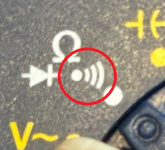
This is the mode you want to use right here:
1771778985535.png

Figure out which button selects that particular sub-mode. My guess is Select or Range, but the manual might help.

You want the meter to beep when you touch the leads together.
 
Just to make sure I’m doing this right I’m on pin one. Taking the lead from pin one and touching each of the others. These are my readings socket one pin one.
1-2 .1
1-3 6.9
1-4 6.7
1-5 23.8
1-6 25
1-7 25
1-8 25
1-9 25.9
1-10 19.9
1-11 6.7
1-12 21.8
1-13 25
1-14 25
Thanks right now. I’m trying to figure out how to read the meter. My friend who I gave pedals to actually thinks I know what I’m doing.
Yeah, you want to check using the continuity option that each pin on the IC socket connects to the board (underneath). So the readings don't matter so much now. You want a beep from the DMM to prove that the soldering isn't funky, as @Robert says.
 
Yeah, you want to check using the continuity option that each pin on the IC socket connects to the board (underneath). So the readings don't matter so much now. You want a beep from the DMM to prove that the soldering isn't funky, as @Robert says.
Sorry I'm talking at cross purposes to @Robert, so let me sit back and see what develops in the meantime.
 
This is the mode you want to use right here:
View attachment 111962

Figure out which button selects that particular sub-mode. My guess is Select or Range, but the manual might help.

You want the meter to beep when you touch the leads together.
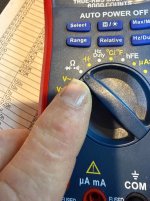
All right, I figured out how to make it beep by pushing the select button. I didn’t test every pin, but I went to your settings where you said the upper IC should have continuity and all of those had continuity but when I got to the lower, I see there was no continuity between pins 13 and 14 no beep.
The lower IC did have continuity between pins eight and nine
 
OK, now pull the IC out of the socket and measure on the socket itself.

Make sure none of the pins of the IC got bent when installing it.

And make sure you soldered those pins. I've definitely skipped a pin when I was working in a hurry.
 
All right, I figured out how to make it beep by pushing the select button. I didn’t test every pin, but I went to your settings where you said the upper IC should have continuity and all of those had continuity but when I got to the lower, I see there was no continuity between pins 13 and 14 no beep.

OK, now pull the IC out of the socket and measure on the socket itself.

Make sure none of the pins of the IC got bent when installing it.

And make sure you soldered those pins. I've definitely skipped a pin when I was working in a hurry.
All right, I removed the IC and tested the socket. There is no continuity between pins 13 and 14 in the socket. Here is a picture of the solder on the back.
 

Attachments

  • IMG_9703.jpeg
    IMG_9703.jpeg
    664.1 KB · Views: 4
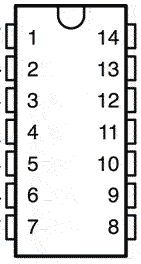
Make sure you're counting your pins correctly.

View attachment 111964
Oh boy, I’m such a spaz my numbering was off. Thanks. So the lower socket has continuity between 1 and 2 and 13 and 14. The upper has continuity between 1 and 2, 6 and 7, 8 and 9, 13 and 14.

Edit: I put it back on the platform. Still a loud pop every time I flip the switch. Nothing going on with the EQ though.
 
Last edited:
I share this hot take. As long as you straighten the legs of the IC enough, leaf sockets are quite easy to use.
I'm more inclined to just solder ics at this point
Me three, i used to use the machined dip sockets. But then, i think it was @Betty Wont who mentioned something about a square peg in a round hole and it was like a total “duhhh” moment for me. I’ve been using the leaf spring sockets ever since. As long as your careful about not folding a leg under the socket when installing there much cheaper and I’ve had no issues.
 
As long as your careful about not folding a leg under the socket when installing there much cheaper and I’ve had no issues.
This is exactly why I don’t use them. The gentle affirmative tiny snap sound as the IC seats correctly in the precision socket gives me mild jollification, I have to admit.

Discovering that I’ve bent a leg under the board and the prospect of desoldering the remaining pins of a leaf socket gives me no such joy 🤣
 
Yeah, you want to check using the continuity option that each pin on the IC socket connects to the board (underneath). So the readings don't matter so much now. You want a beep from the DMM to prove that the soldering isn't funky, as @Robert says.
Thanks much. It looks like the sockets and chips are OK. I just used my meter to check everything else on the board and everything seems to be where it should and all seems to have the correct readings. I’ve actually checked every resistor to make sure I didn’t put one in the wrong spot. It’s a mystery, but I’m still getting this loud pop and no control or sound when the pedal is engaged on the platform.
 
Back
Top