You are using an out of date browser. It may not display this or other websites correctly.
You should upgrade or use an alternative browser.
You should upgrade or use an alternative browser.
So, any other bakers in the group?
- Thread starter RetiredUnit1
- Start date


Brett
Well-known member
My wife only eats gluten free as well, we've found comparable substitutes for a lot of things but they come at a cost. In an attempt to avoid spending $6-7 a loaf for GF bread at the grocery store, we've tried to make our own. We used King Arthur GF flour and active yeast, but it ends up being as hard as a brick.This look delicious. I bake but my wife had to go gf like 4 years ago so I'm out of the SD game.
I know this is a long shot, but have any of you baking experts had any luck making gluten-free bread?

KR Sound
Well-known member
Definitely centennial and Galaxy for me. Citra and Amarillo- those two are actually aCentennial was always one of my favorites back when I was brewing, and of course Cascade is hugely popular here in the Pacific Northwet. But whatever grows best kind of is best.

Mentaltossflycoon
Well-known member
Similarly I've tried some gf bread recipes but none that my wife or I like nearly as much as the big money grocery loaves. I find the bobs red mill gf ap to work for simple baking needs like banana bread or waffles but gave up on diy gf sammich loaf. I would also be interested if someone had a recipe they like.My wife only eats gluten free as well, we've found comparable substitutes for a lot of things but they come at a cost. In an attempt to avoid spending $6-7 a loaf for GF bread at the grocery store, we've tried to make our own. We used King Arthur GF flour and active yeast, but it ends up being as hard as a brick.
I know this is a long shot, but have any of you baking experts had any luck making gluten-free bread?

Passinwind
Well-known member
My wife uses our Le Creuset "French oven" for her no-knead bakes, it works great.I’m definitely going to start making some bread now. Anyone have luck in a cast iron pot or pan?

RetiredUnit1
Well-known member
I was planning on vacuum packing the majority of it and putting in the freezer. I was doing some reading on it and it has a lot of interesting uses, planning on using it in soups as a thickener, perhaps after making a roux out of it. Amazon/eBay had CRAZY INSANE high prices on it and my local stores don't carry it.....25 pounds! That ought to last you quite a while.
Mentaltossflycoon
Well-known member
Yeah, my lodge Dutch oven makes a nice loaf.I’m definitely going to start making some bread now. Anyone have luck in a cast iron pot or pan?


peccary
Well-known member
You can also use it to make seitan as well, if you're into meat substitutes.I was planning on vacuum packing the majority of it and putting in the freezer. I was doing some reading on it and it has a lot of interesting uses, planning on using it in soups as a thickener, perhaps after making a roux out of it. Amazon/eBay had CRAZY INSANE high prices on it and my local stores don't carry it.....

RetiredUnit1
Well-known member
Yeast makes co2, which makes bubbles in the bread and makes it soft. However, without gluten, which is an elastic protein, the bubbles burst and you end up with hard bread. The whole reason I bought the mixer is so that it can create more gluten through 'kneading' action. My bread is VERY elastic and holds together without breaking, which is one of the problems I've always had with home made bread, even with a kitchenaid mixer. The Hobart *definitely* made all the difference in the world, but I digress...My wife only eats gluten free as well, we've found comparable substitutes for a lot of things but they come at a cost. In an attempt to avoid spending $6-7 a loaf for GF bread at the grocery store, we've tried to make our own. We used King Arthur GF flour and active yeast, but it ends up being as hard as a brick.
I know this is a long shot, but have any of you baking experts had any luck making gluten-free bread?
Cake is a very low protein flour mix, and uses a chemical reaction between acid and alkali to make bubbles, which are very fine compared to yeast bubbles. Perhaps if you used a 'from scratch' cake recipe, and omit the sugar, you might have more luck. Baking power is the key ingredient, uses cream of tartar for the acid and baking soda for the alkali. Drop biscuits also use baking powder, so you might try that.
I know people use guar gum and other substances with GF flour and yeast to make the bubbles that form last longer, but I have never used guar gum and have no idea how to work with it.
I have heard that making gluten free bread can be a real challenge. I'm trying to make more gluten because as long as you're not allergic it's very good for you. The Roman army built the empire using high gluten bread, some have said it was their baker's that allowed their army to win!
Mentaltossflycoon
Well-known member
I have messed with xantham gum a bit which supposedly can improve the texture of things but I never did any side by side tasting though. Not sure if any perceived benefit is a placebo or not.

BuddytheReow
Moderator
I prefer bread over other baking (cakes/cookies/pastries). It's one of the easiest flipping things to make, especially when I wfh certain days of the week. I don't have a mixer, so I work everything by hand. The positive of that is you can't really overwork the dough. I mean, it's only 4 ingredients (flour, salt, yeast, water)! Put it all in a bowl, mess around with it for 10 minutes (kneading), let it sit for an hour or two, shape it, let it sit for another hour or two, then bake it. Fresh bread beats store bought any day of the week!
RetiredUnit1
Well-known member
Sourdough is NOT easy!!! Yeast bread is. But sourdough gets 16 hours to turn carbohydrates into protein, where yeast bread gets 30-40 minutes, resulting in very little protein and a lot of carbs. I do use yeast when I make cinnamon buns, which is only when I know I'm going to have people to help me eat them, lol. Fat pills they are!!!I prefer bread over other baking (cakes/cookies/pastries). It's one of the easiest flipping things to make, especially when I wfh certain days of the week. I don't have a mixer, so I work everything by hand. The positive of that is you can't really overwork the dough. I mean, it's only 4 ingredients (flour, salt, yeast, water)! Put it all in a bowl, mess around with it for 10 minutes (kneading), let it sit for an hour or two, shape it, let it sit for another hour or two, then bake it. Fresh bread beats store bought any day of the week!
BuddytheReow
Moderator
I was given a sourdough starter for my birthday last year from my dad. I like to mix regular yeast with a few heaping scoops of the starter into many recipes I have and add some extra time on the proofs. I've noticed that it doesn't rise as much as just straight yeast, but once in the oven? POW! Springs right up.
RetiredUnit1
Well-known member
That's how a lot of commercial sourdough makers do it, but as a cork sniffing sourdough puristI was given a sourdough starter for my birthday last year from my dad. I like to mix regular yeast with a few heaping scoops of the starter into many recipes I have and add some extra time on the proofs. I've noticed that it doesn't rise as much as just straight yeast, but once in the oven? POW! Springs right up.
 I have to say it's not like dough proofed for 16 hours. The fruity overtones, the sour bite, you just don't get that from the hybrid method. You can still taste it tho, I seldomly buy bread but when I do that's what I get.
Today's yeast is a real frankenstein, the second it comes in contact with sourdough yeast, it kills it. Here's an interesting experiment. Put some yeast and sugar into a ball jar half full of water, the next day put some more sugar in and watch how the yeast eats and converts that suger into CO2 in about 3 seconds. They are like piranhas of the microbe world.....!
Last edited:


Harry Klippton
Not Interested
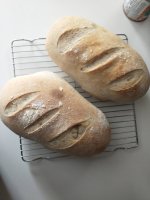
Just pulled this sourdough out of the oven