Some issues with the FreakZEQ pedal build

jeffwhitfield

Well-known member
Ok, just completed a FreakZEQ build and...well...there are some issues with this one.

First, the drill template is off. Specifically, the middle EQ switch is lower on the template than what the PCB allows. Has to be dead center of the four pots. Ended up with a bad hole in my enclosure. Not the worst thing to happen given that this is just a personal build. :P

Second, the 60pF capacitor is hard to come by at the moment. Only version that Mouser had available was a surface mount version...which can be used, but not easy to deal with. I socketed the thing and tried using a 56pF instead. I did try a 60pF surface mount...but wasn't sure if it really was doing anything. More on that in the next part...

Lastly, it just doesn't seem like the effect is doing what it's supposed to. A sweep of the Frequency knob doesn't seem to effect the frequencies in the same way as the Son of Kong pedal, which is what this one is based on. In fact, turning up the Gain and Q all the way and sweeping the Frequency knob results in some really funky sounds. Doesn't sound normal for sure. Just not sure how to go about debugging this thing given the weird nature of the build.

Can provide photos of my build and whatnot. Just throwing this up for reference purposes to start the conversion with. Anyone else build this one with success?
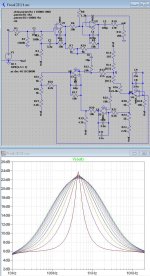
 
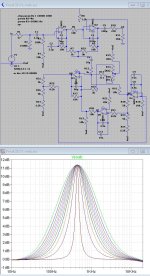
Hi, this is one of the only mentions I've seen concerning the FreakZEQ so even though it's a bit old I'm going to see if I get any response. I'm about to build the PCB and I simulated the schematic in LTspice and I get some pretty strange results. It seems to me that something is off in a few places in the schematic. I believe that this is essentially a state variable filter based parametric similar to most others and based on the original Urei schematic for the most part. The schematic as provided does 'work' in LTspice but it has a very wide Q, gain is too high and the sweep of Q doesn't return the expected frequency response. If I make a few changes to the schematic then it starts to behave as I think it should. First I removed C3 (now unity gain instead of boosted) and then I removed R7. Then I re-arranged the resistance for Q to match all the other PEQ schematics that are based around this topology. Now things look 'normal' in terms of what a typical Urei parametric clone response might be. I'm going to try and build the modified version and see if the simulation matches the measured frequency response if I can mod the existing PCB correctly. If anyone has any warnings or sees errors please let me know. Below I've included the frequency response and schematic from LTspice for the as-published schematic (top) and my modified one (bottom):
FreakZEQ-orig.JPG

Modified:
FreakZEQ-redo.JPG
 
I just got the board, it’s next on my build list. But now I’m thinking I’ll bread board it first.

At the rate I get things done, I’ll have an update for you before Halloween.
 
Jeff, did you mess with this anymore?

I got my breadboard working.
It's functioning and I should get some more time to play it tonight. I did use a 56pF instead of the 60.

As I was building it, I noticed some things:
1. R16, 17, and 18 are strange values: 215, 287, and 24300. I stacked resistors on the breadboard to make these exact values, but I wouldn't be able to do that on the pcb. Does it matter? I don't know.
2. Do the components around the frequency function need to be matched tightly? Again, I don't know. For example, do C8 and C10 need to be deadnuts equal? What about R14=R20. And R15=R19. And C9=C11.

I'm curious to run it before and after fuzz/overdrive and see what it does.
 
Jeff, did you mess with this anymore?

I got my breadboard working.
It's functioning and I should get some more time to play it tonight. I did use a 56pF instead of the 60.

As I was building it, I noticed some things:
1. R16, 17, and 18 are strange values: 215, 287, and 24300. I stacked resistors on the breadboard to make these exact values, but I wouldn't be able to do that on the pcb. Does it matter? I don't know.
2. Do the components around the frequency function need to be matched tightly? Again, I don't know. For example, do C8 and C10 need to be deadnuts equal? What about R14=R20. And R15=R19. And C9=C11.

I'm curious to run it before and after fuzz/overdrive and see what it does.
Honestly, I haven't. I'll pull out the board and play with it when I get the chance (it's currently in my "graveyard" box).

Ironically enough, I have a Triskelion, which is a pedal that does a similar thing. Might be interesting to get this one working and see how it stacks up against the Triskelion.
 
Ok, here is what I learned today: This pedal (breadboard) is very cool and I’m going to build it with no modifications.

I get very noticeable changes for each of the knobs.
1. At first, I wasn’t sure how to use it.
2. Then I maxed the Q and set the gain pretty high. I played a couple of open chords. Then I played the chord arpeggio and BANG! One or two of the strings would jump out, sometimes at ice pick-to-the-brain levels.
3. Then I moved the FREQ around and could change which note was causing brain damage.
4. Then I backed off the Q and kept moving the FREQ around.
5. The Gain, Q, and Freq all play off of each other. But it’s easy to dial in once I figured it out.

I think it’s useful at subtle settings and can also do some wild stuff.

This probably all sounds obvious, essentially Q and FREQ are doing what they are supposed to do. But this is the first time I’ve played with this type of effect so I stumbled my way through it.

Finally, I put a muff in front and a rat behind it. I fiddled with variations for a few minutes and then stumbled onto: Muff into FreakZEQ with the gain low and the Q and FREQ somewhere in the middle and played Sleep’s Dopesmoker riff for 20 minutes.
 
Last edited:
Back
Top