
Chuck D. Bones
Circuit Wizard
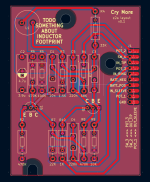
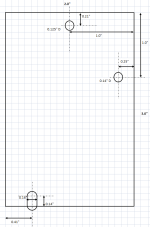
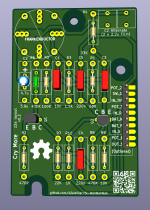
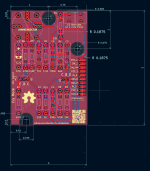
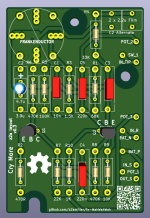
I'll wager that Robert would be willing to share the inductor footprint he uses on his Wah boards.
As for why I prefer tantalum in this application, I have stated in numerous threads that tantalum & film caps are highly transparent. They don't color the sound in any discernible way. Aluminum electros exhibit dielectric absorption that muddies the tone by smearing the transients. Their ESR varies with time & temperature. In the CryBaby circuit, that cap couples one end of the inductor to ground. The inductor and the 10nF cap that connects to the emitter of Q2 form the basis of the tuned circuit. They are the heart of the CryBaby. Any resistance, non-linearity, microphonics or time-domain artifacts (the afore-mentioned dielectric absorption) that sneak into that part of the circuit will alter the tone in a less than desirable way.
As for why I prefer tantalum in this application, I have stated in numerous threads that tantalum & film caps are highly transparent. They don't color the sound in any discernible way. Aluminum electros exhibit dielectric absorption that muddies the tone by smearing the transients. Their ESR varies with time & temperature. In the CryBaby circuit, that cap couples one end of the inductor to ground. The inductor and the 10nF cap that connects to the emitter of Q2 form the basis of the tuned circuit. They are the heart of the CryBaby. Any resistance, non-linearity, microphonics or time-domain artifacts (the afore-mentioned dielectric absorption) that sneak into that part of the circuit will alter the tone in a less than desirable way.
Last edited: