What’s on *YOUR* workbench?

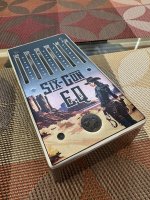
I’m not sure if this is a “what’s on your workbench” post because I’m actually working with an enclosure for one of these, or a “what’s on the drawing board” because the other is a graphic that hasn’t actually been applied yet. Anyway:

1. My finalized design for my six band EQ (six band equals “six gun”, geddit?). This will be a film free decal applied to polished aluminum enclosure so everything in gray will actually be printed “empty” so that bare metal shows through. Just waiting on my bare enclosure and slide potentiometers to arrive from Tayda - it took them over a week to ship this time, which I assume has something to do with some holiday or other.

Screenshot 2024-02-19 at 8.47.22 AM.jpeg

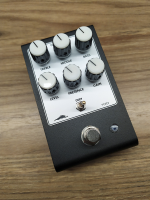
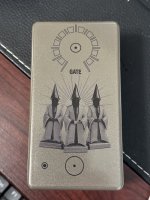
2. The other is a bit lame because, let’s face it, noise gates are not the most inspiring of pedals. But here is my enclosure for the Muffler. I will use a film free decal for the final, but this is my “test run” using a regular waterslide decal just to see how the colors looked on the enclosure.

Though the enclosure looks champagne in this picture, it’s actually the glimmer brown sugar from Tayda so it’s much darker than it appears in the picture. I thought that was kind of fitting since this is a pedal that really should just sort of “disappear“ – so I didn’t even bother with a title and instead went with a sort of a “monastery/vow of silence“ theme and left it very simple.

IMG_0839.jpeg
 

Attachments

  • IMG_0839.jpeg
    IMG_0839.jpeg
    463.7 KB · Views: 1
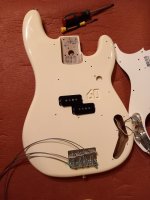
From yesterday. This bass needed shielding. Unfortunately the copper tape didn't want to stick to the cavity very much. So I did an ugly job. Then the usual problems soldering to the back of the volume pot. I shielded the back of the pickguard as well but there's still soem static when I touch it. I often have this issue.

I also gouged the neck at the nut edge while rolling the edges. :(

I'm a hack.

20240220_205523.jpg
 
1000005879.jpg
Someone here may recognize this 👀

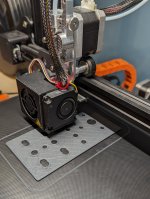
Finally got the printer working again after adding automatic bed leveling and changing the firmware over to Klipper. I don't think the first level is quite calibrated yet and there are some other parameters to tweak, but I have a bunch of pedal building tools in the print queue and I'm impatient.
 
View attachment 69080
Someone here may recognize this 👀

Finally got the printer working again after adding automatic bed leveling and changing the firmware over to Klipper. I don't think the first level is quite calibrated yet and there are some other parameters to tweak, but I have a bunch of pedal building tools in the print queue and I'm impatient.
I have printed that one too! It is helpful. What other tools are you printing?
 
I have printed that one too! It is helpful. What other tools are you printing?
Nothing too crazy: lead bender, rocket sockets, a spacer/flange thing to center my half lb solder spool on the one lb dispenser.

I want to come up with a printable knob alignment tool, but if I post the design I want it to be something that isn't just a ripoff of the better setter.

Also @DailyDovetails thanks for the build platform design!
 
View attachment 69080
Someone here may recognize this 👀

Finally got the printer working again after adding automatic bed leveling and changing the firmware over to Klipper. I don't think the first level is quite calibrated yet and there are some other parameters to tweak, but I have a bunch of pedal building tools in the print queue and I'm impatient.
Hey I do recognize that!

Changing things on the printer can be hard and Klipper is a little hard to dial in but once you get there it works really well. For me on the first layer I preheat the bed to whatever the print temp will be, do the bed level screw routine, the z offset routine until a piece of thin paper barely has resistance when you slide it past the nozzle then do the auto bed level. I store mine in the garage so with weather changes I have to do that process pretty regularly.

Let me know if you have any feedback on the build platform.
 
I want to come up with a printable knob alignment tool, but if I post the design I want it to be something that isn't just a ripoff of the better setter.
That better setter tool is pretty neat. It reminds me of a marking gauge for woodworking. I think this would be called a French style marking gauge but it replaces the thumbscrew with a cam mechanism something like that would be cool as it could be entirely 3d printed.

1708575053690.jpeg
1708575073315.jpeg
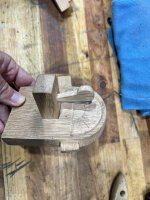
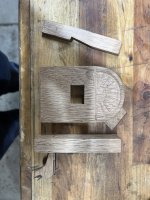
Try to look past the amateur carving on in. Oak is hard to carve and I’m still learning.
 
Looks awesome -- love the knobs
I’m not sure if this is a “what’s on your workbench” post because I’m actually working with an enclosure for one of these, or a “what’s on the drawing board” because the other is a graphic that hasn’t actually been applied yet. Anyway:

1. My finalized design for my six band EQ (six band equals “six gun”, geddit?). This will be a film free decal applied to polished aluminum enclosure so everything in gray will actually be printed “empty” so that bare metal shows through. Just waiting on my bare enclosure and slide potentiometers to arrive from Tayda - it took them over a week to ship this time, which I assume has something to do with some holiday or other.

View attachment 68981

2. The other is a bit lame because, let’s face it, noise gates are not the most inspiring of pedals. But here is my enclosure for the Muffler. I will use a film free decal for the final, but this is my “test run” using a regular waterslide decal just to see how the colors looked on the enclosure.

Though the enclosure looks champagne in this picture, it’s actually the glimmer brown sugar from Tayda so it’s much darker than it appears in the picture. I thought that was kind of fitting since this is a pedal that really should just sort of “disappear“ – so I didn’t even bother with a title and instead went with a sort of a “monastery/vow of silence“ theme and left it very simple.
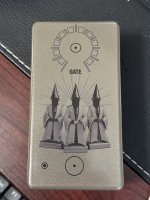
View attachment 68983
Love these!
 
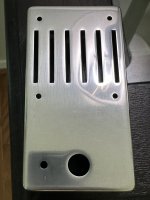
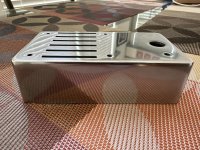
Just finishing polishing up this enclosure for my band EQ. It was just a raw aluminum enclosure that I had Tayda drill using a template kindly provided by a member on this forum.

On a 100% related note – I’ve decided that this sanding and polishing is a complete pain in the ass (especially since a good portion of the face will be covered by a graphic) so my current plan is that if I ever get the urge to do this again, I’m coming to you all asking for an intervention.

Mike

IMG_0846.jpeg IMG_0847.jpeg
 
Just finishing polishing up this enclosure for my band EQ. It was just a raw aluminum enclosure that I had Tayda drill using a template kindly provided by a member on this forum.

On a 100% related note – I’ve decided that this sanding and polishing is a complete pain in the ass (especially since a good portion of the face will be covered by a graphic) so my current plan is that if I ever get the urge to do this again, I’m coming to you all asking for an intervention.

Mike

View attachment 69147View attachment 69148
Wow, that’s dead sexy.
 
Finally managed to squeak in some pedal-build related time, yesterday.

I absolutely LOVE the look of engine-turned alumin(i)um.
I've mentioned it before.

Before I work my way up to hand-scraping ala Bugatti, as mentioned in this post, I thought I'd take a turn on machining an enclosure.

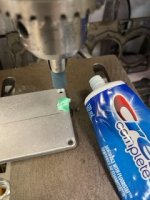
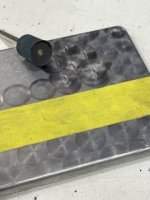
So I searched online "how-to" and a few results popped up, one of which was this Hackaday post. I like Hackaday, so I didn't even bother to look at others. Hackaday's suggestion? Toothpaste and a pencil eraser. I've got proper polishing compounds and wheels, but...

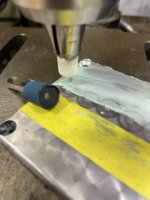
Well I cheated a little and went with a mildly abrasive Dremel bit, though I did go with an old stale tube of Crest;
Using a cheap 1590N1 clone's lid as a test bed, I began the experimintations...

2F52B38F-A088-41E8-819C-768AB5E60DA7.jpeg E7B53C5E-F0F0-4C8C-8FA1-C47CCECD098B.jpeg

Friend's garage is heated or I would've used my own drill-press/garage, I started off working "free-hand" ( though not as free as if I'd used my own Dremel instead of a friends drill-press), and it was quickly obvious some form of a line was needed more than just a 2B-pencil's:

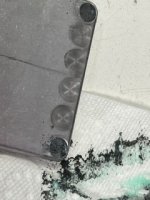
EC37F725-6DE0-41F6-AC3B-DEC0E62748D4.jpeg AE698459-0CB0-4C29-B9FB-9645FAB18697.jpeg

See the Gap(s) above, especially at 8 o'clock relative the screwhole? Too much goo on the bit to see where to start the next circle.
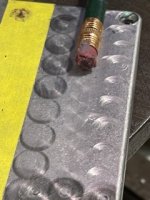
Then some more experimentation with varying degrees of pressure, led to the material being worn down to the shaft of the bit.
This was expected, but it came about much sooner than hoped for. It left some damaging grooves in the centre of these circles:

4656EA3F-16BA-4ABB-A5D8-A55CDC4564B5.jpeg


So I had to swap out the blue bit for a smaller white bit, of a different compound.
Tried it dry, without toothpaste and with toothpaste, the latter was only marginally better but in both cases the white bit wanted to grab the alloy, too much so.

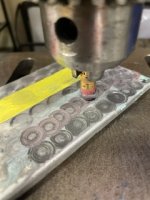
So I broke out the 2B-pencil's eraser, as per the Hackaday article, the smallest circles yet...

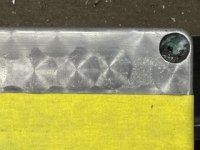
84E09A86-1E2E-445F-8670-DFD3F5AADC27.jpeg 9418568F-CA78-4371-9337-5BBBCB820131.jpeg


Well, as you can see, between the crescents on the left by the yellow tape and the scratchings on the right by the edge of the enclosure lid...
The eraser barely gets the job done. It would take forever with pencil erasers.
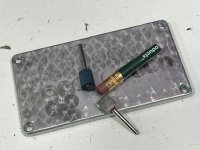
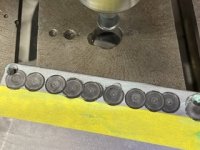
C8C92912-9E27-4241-9A3D-012DF359706C.jpeg


Here's the entire lid. I started at the top and worked my way down. It looks like it should be the other way 'round, starting off poorly at the bottom and figuring it out by the time I got to the top. Alas, this was NOT the case:

29FA6416-3A4D-4355-9441-20FBBEB74A53.jpeg


Here's what I learned:

1 — A gate/rail will be mandatory to get evenly spaced circles — eyeballing it isn't going to achieve the desired result.
2 — When working with toothpaste, keep a small tub of water and PLENTY of paper-towels/shop-towels handy. That stuff WILL get everywhere.
3 — With the right bit, only light pressure is needed and let the machine do the work.
4 — Have plenty of the right bit on hand; this test run KO'd the first bit in no time. I'll have to experiment further to find the right bit material.
5 — It's easy, but time consuming, and I still love the look; I'm very satisfied with my first ever proper machine-turning results.
6 — A method to get even spacing between swirls and rows/columns is needed (see 1 above).


Suggestions on how to label it once it's turned are welcomed. Sort of leaning to a Fairfield Circuitry stamped letters with ink backfill. Maybe laser-etching. Will test those both on the lid in future.

Looking forward to finishing turning the pedal.
 
Back
Top