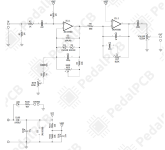
What is in the signal path?

genXslacker

Well-known member
Ignoring the questions of whether mojo parts are worth the money or whether I'd actually discern a difference without an oscilloscope, one of the hundred projects simmering on my back burner is making a top-notch Red Snapper in terms of sound quality. I normally throw 1% metal-film resistors in just about every pedal, but I'm contemplating carbon-film or even tootsie rolls for the signal path.

That said, I'm not 100 percent certain of what qualifies as "the signal path".

RH Schematic.png

I think that I can rule out R100–R102. Metal films there, I'm thinking.

R2, R4, and R6, clearly in (to me, anyway). R5? I'd guess "yes", but with less confidence.

But what about R1? Is a pulldown resistor "in the signal path"? R3? My instinct is "no" on those two, but I'm very much in the part of the Dunning-Kruger curve where I know I don't know what I don't know.

Please and thanks...
 
The signal path is the top part. The non-signal path is the bottom part, where the + and - interact.

Carbon composite (not film) resistors are suppose to have a certain mellowness to the sound but only in old vintage tube amps where they have like 400 volts running thru them. They don't have the same mojo in our pitiful 9v pedals. You are better off playing with different op amps, or different value capacitors in the tone circuit.
 
The signal path is the top part. The non-signal path is the bottom part, where the + and - interact.

Ah, thanks. I didn't realize it was so simple.


Carbon composite (not film) resistors are suppose to have a certain mellowness to the sound but only in old vintage tube amps where they have like 400 volts running thru them. They don't have the same mojo in our pitiful 9v pedals. You are better off playing with different op amps, or different value capacitors in the tone circuit.

Yeah, I've heard some very smart people make that point, including the Psionic guy, and it does stand to reason. My chief concern in regard to resistor composition is raising the noise floor with carbon comp or carbon film. Maybe I'd be better off sticking ½-watt metal films in the signal path than mucking about with the others.

Anyway, thanks again, I appreciate the input.
 
I mean this in the least offensive way possible, but you're basically saying "Ignoring that it doesn't really make any difference in the sound, should I use X or Y?"

Just go with what feels best for you IMO, if you want carbon comp resistors because it makes the pedal feel cooler, use carbon comp resistors. It's not really about sound quality (at least as long as you use standard quality parts - knockoff Aliexpress caps or very bad tolerances might make it worse).

And I don't think it's necessarily a bad idea either, after all the end point is to make art, and it helps if you like your tools or if they make you feel cool. That's why mojo part pedals and relic'd guitars are so popular.

I don't really care that much myself, and I know a lot of others don't either, but if you do, go for it.

(like Falco said, if you want the best sounding Red Snapper instead, you should probably breadboard it and fine tune any values to your liking, and maybe try out different op amps too - probably not going to make a huge difference between similar op amps, but a small difference might be there)
 
Ignoring the questions of whether mojo parts are worth the money or whether I'd actually discern a difference without an oscilloscope, one of the hundred projects simmering on my back burner is making a top-notch Red Snapper in terms of sound quality. I normally throw 1% metal-film resistors in just about every pedal, but I'm contemplating carbon-film or even tootsie rolls for the signal path.
The simplified answer is the signal path travels from the input to the output. The real answer is a little more convoluted 😂. Truth is, it depends on the circuit. Some things are universal like the power section. When I was learning this stuff I wanted to really understand, and as someone who learns by doing and as a visual person, I used an audio probe to see where the signal path was as I followed the schematic.

As for mojo parts, that doesn't mean much in most pedals. I stick with metal film and basic caps. I want right tolerance and low noise, unless I don't. Opamps I may decide to use lower fidelity in a circuit for various reasons, but it's dependent on what it's doing in the circuit. I do generally follow the film caps in the audio path if I can logic, but there are no hard and fast rules most of the time. And having a scope is a visual representation of what the circuit is doing electrically, not necessarily what it sounds like. Don't overthink it, now amps...that's a different story 😂
 
One downside of using three different kinds of resistors is there's no way I'm checking those values for you if you post a troubleshooting thread. :ROFLMAO:

I don't buy that you could tell the difference with carbon resistors, but I do think they look cool, and I'm all for making your gut shots look cool.

Just pick a flavor of resistors and do the same thing for the whole board would be my vote.
 
I mean this in the least offensive way possible, but you're basically saying "Ignoring that it doesn't really make any difference in the sound, should I use X or Y?"

Heh. No, I'm basically saying I want to understand the electronics and not get bogged down in a discussion that we've all seen hashed out on the Gear Page until we're thoroughly and permanently nauseated.

I was trying to head that off. Such is the Internet.
 
The simplified answer is the signal path travels from the input to the output. The real answer is a little more convoluted 😂. Truth is, it depends on the circuit. Some things are universal like the power section. When I was learning this stuff I wanted to really understand, and as someone who learns by doing and as a visual person, I used an audio probe to see where the signal path was as I followed the schematic.

Thanks for responding. My intuition was not that pulldown resistors would be considered to be in the signal path, so I have learned something. When I saw values like 1MΩ and higher, I just assumed that there wouldn't be a lot of AC current going through them at 9.1V. I still have a lot to learn.
 
Thanks for responding. My intuition was not that pulldown resistors would be considered to be in the signal path, so I have learned something. When I saw values like 1MΩ and higher, I just assumed that there wouldn't be a lot of AC current going through them at 9.1V. I still have a lot to learn.
Pulldown resistor isn't gonna add mojo regardless what it's made of😂
 
What you've got is a non-inverting opamp configuration (IC1.1) and an inverting opamp configuration (IC1.2). Google and here will help you with more in depth analyses and specific calculations. The non-inverting opamp is a bit more complicated so I'll give my 2 cents about it here.

R3 biases the opamp and effectively "turns it on". D1, D2, and D3 in this configuration provide asymmetric soft clipping (think OD, not distortion). C2 tames the super high frequencies and helps prevent squealing/oscillation. R4 and GAIN when compared to R5 and BITE sets the voltage gain in this opamp. C3, R5, and BITE set the corner frequency of the gain (in other words, the gain will be boosted more above the calculated frequency).
 
What you've got is a non-inverting opamp configuration (IC1.1) and an inverting opamp configuration (IC1.2). Google and here will help you with more in depth analyses and specific calculations. The non-inverting opamp is a bit more complicated so I'll give my 2 cents about it here.

R3 biases the opamp and effectively "turns it on". D1, D2, and D3 in this configuration provide asymmetric soft clipping (think OD, not distortion). C2 tames the super high frequencies and helps prevent squealing/oscillation. R4 and GAIN when compared to R5 and BITE sets the voltage gain in this opamp. C3, R5, and BITE set the corner frequency of the gain (in other words, the gain will be boosted more above the calculated frequency).

Thank you!
 
Anybody who claims they can hear a difference between carbon and metal film resistors (of the same value) is, at worst, a liar. Most of the mystique around vintage parts is most have massive tolerances, so an amp that sounds particularly good is likely caused by values being different from what the builder expected that's coincidentally worked out for the best.

The only reason to use vintage parts is because they look cool.

That's it.

Outside of that, there are no benefits (and usually plenty of downsides like terrible tolerances).
 
So if I'm understanding what y'all are saying, I should go all carbon-comp resistors and pretty much any caps other than tropical fish are going to make it sound horrible?
 
In pedals I use metal film resistors because they're not expensive and they're accurate. In amps I use carbon film for most of them and metal film for the higher wattage resistors. I never use carbon comp in amps unless I'm fixing an old amp with CC in there. Carbon comp can be as quiet as anything but they don't always age as well. They can drift in value with use and I've found 100K CC resistors used as dropping resistors in a '60s Super Reverb which measured around 1M from heavy use and age. They can also become noisy.
 
In pedals I use metal film resistors because they're not expensive and they're accurate. In amps I use carbon film for most of them and metal film for the higher wattage resistors. I never use carbon comp in amps unless I'm fixing an old amp with CC in there. Carbon comp can be as quiet as anything but they don't always age as well. They can drift in value with use and I've found 100K CC resistors used as dropping resistors in a '60s Super Reverb which measured around 1M from heavy use and age. They can also become noisy.

I'm slowly filling the BOM for a Princeton Reverb build on turrets. I keep procrastinating on resistors because I can't decide what I'm willing to compromise on. I love the way 1/2-watt tootsie rolls look on turret board. At the same time, I'm painfully aware of the drawbacks.

I've yanked a few over the years that had drifted substantially out of spec, but I don't think any that were out by an order of magnitude. I think I would have framed those and hung them on the wall. The soldiers gave all that they had and then some.
 
I'm slowly filling the BOM for a Princeton Reverb build on turrets. I keep procrastinating on resistors because I can't decide what I'm willing to compromise on. I love the way 1/2-watt tootsie rolls look on turret board. At the same time, I'm painfully aware of the drawbacks.
I built a 5f2a, and like you am assembling the parts for a PR. I was debating with myself if I should use carbon comp for at least the plate resistors. In the end I decided my ears and playing aren't good enough to justify the cost.
 
Based on that I would never use CC in a pedal. The signal level is way too low to get the “sweetening” resistor distortion so you get no benefit and all the downsides (temperature drift, short life etc). And of course if the pedal is not an overdrive or a fuzz you don’t even want that resistor distortion in the first place.
You definitely have to trade off some desirable attributes to use carbon comps, but there a lot of builds they just look the best on. If they fail, I replace them. Since I don't sell many pedals, warranty returns aren't really a concern for me.

Speaking of fuzz, I've had a Skreddy P-19 for close to a decade that is all carbon comp, and it still sounds great. I'd be surprised if there hadn't been a little drift over that time, but it's not introducing any noticeable noise and is still doing that Wall thing very well.

I was debating with myself if I should use carbon comp for at least the plate resistors. In the end I decided my ears and playing aren't good enough to justify the cost.
I'm in the same boat, but still haven't made up my mind. I absolutely don't kid myself into thinking I could pass an ABX listening test with resistors, and I doubt many others could either. On a turret build, that's actually a point for CC on my scorecard. If I were building to record with it, I'd go metal film throughout. I don't buy the metal-film-sounding-sterile thing.

It may come down to tootsie rolls on the turret board to make it pleasing for me to look at, and metal films on jacks and pots.
 
Back
Top