What would I need to know before rehabbing a Ceriatone Lightning?

G.G.

Well-known member
I bought a Ceriatone Lightning used about 15 years ago. It started having problems a few years ago and I switched to a Blues Jr. I'm not sure what's wrong with the Lightning, there could be a number of things and I don't think I could sell it in its current condition. I've never worked on amps so potentially lethal voltages would be totally new, as would tubes, transformers, and what-not. I'm thinking maybe I could rebuild the board and wiring, hopefully that's where the problem is. Is that a pipe dream? Would I be facing an extensive debug not matter what?
 
I haven't played it in a while, so I'll need to get it back out and make a list of issues. IIRC, there was an overall lack of volume that seemed to have become more significant over time. When I would try to compensate by turning up volume and master volume it wouldn't get overdriven like I would expect from a tube amp, it got kind of a nasty fuzz. Thought it could be a blown speaker, or maybe something else. I've replaced all the tubes a couple times so it's possibly a tube issue but in my experience tubes usually last longer than I've had these. Whoever built the amp put a push-pull pot on the volume that I discovered by accident one day, not quite sure what it does but it seems to increase the volume and gain when I pull the switch out. I looked at a Lightning schematic and didn't see a switch like that in there so I'm not sure what's going on with that. But most recently there was a really loud popping noise when I touched that pot so clearly a significant problem there. 😅
 
I haven't played it in a while, so I'll need to get it back out and make a list of issues. IIRC, there was an overall lack of volume that seemed to have become more significant over time. When I would try to compensate by turning up volume and master volume it wouldn't get overdriven like I would expect from a tube amp, it got kind of a nasty fuzz. Thought it could be a blown speaker, or maybe something else. I've replaced all the tubes a couple times so it's possibly a tube issue but in my experience tubes usually last longer than I've had these. Whoever built the amp put a push-pull pot on the volume that I discovered by accident one day, not quite sure what it does but it seems to increase the volume and gain when I pull the switch out. I looked at a Lightning schematic and didn't see a switch like that in there so I'm not sure what's going on with that. But most recently there was a really loud popping noise when I touched that pot so clearly a significant problem there. 😅
The push-pull switch on those is usually there to take the master volume completely out of the circuit, so that makes sense.

First step would be to remove the tubes, open it up and look for any resistors that look burnt up.
 
I have a Robertson driver set now with hopefully the right size for this. Time to take some pics! Thanks guys!
 
Don’t automatically assume that an entire overhaul is needed with this amp. Low output volume and fuzzy like distortion can easily be chalked up to a bad output tube or even dirty pins or tube sockets, and the symptoms you described are indicative of that. The push pull pot is more than likely a master volume cut in/cut out. The newer lightning Ceriatone builds actually has a toggle switch for that so, Nik probably used a pot back in the day.
 
that would be great if all it takes is some contact cleaner and maybe replace some tubes. The venue I regularly play had really really bad electrical noise back when I was using this amp (which they have since fixed), maybe it's possible there was more tube wear than I realized.
 
I've never worked on a Ceriatone, but Lyle from Psionic Audio was talking about them in his live chat last week. He said they're generally really solid, but skimp on quality of electrolytic caps. At that age, it wouldn't be a bad idea at all to swap in some new F&Ts.
 
Just be more careful—as has been mentioned, make sure the caps are all discharged. And sit on one hand, or keep it in your pocket, until you’re positive there’s no juice anywhere.

I have a ~25 year old Top Hat I need to pull apart too, am thinking it’s time to change out the large caps which are all still original.
 
here are a few pics, let me know if you need a close-up on something. Thanks again for the help guys! The chassis was bent around the speaker jacks when I bought it, looks like a previous owner tried unsuccessfully to lean it back against a wall.
qQgFpJV.jpg
NzDQvlv.jpg
h68ra05.jpg
 
I see some solder joints that look dubious. And the mismatched filter caps don't inspire confidence.

Here's what I'd do:
1. Replace all the electro caps with F&T.
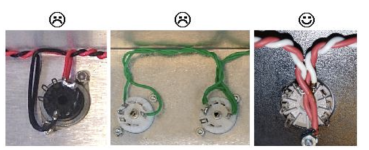
2. Redo the heater wiring. It's about as sloppy and noisy as it could be done.
3. Replace the 10W, 120R ceramic resistor with one that's 180R to make life a LOT easier for the EL84s.
4. Replace those gray, 100R screen resistors on the power tubes with 1K, 3W metal oxide resistors, again to extend the life of your EL84s.
5. Reflow all the solder joints.
 
I will say that Matchless runs their tubes HARD so I would start there ... if you can, Sovtek EL84M or the equivalent 6p14p ... which is a tall order in the middle of the war but those are the kinds of power tubes you'll be needing

if you do end up needing to crack it open then electrolytic caps along with whatever repairs may be necessary. Jubal's changes are correct if you want your tubes to last longer but again, running the piss out of them was the Matchless way of doing things
 
I would start by checking tubes. 9 times out of 10, that’s the problem when something goes wrong.

After that, I’d check voltages and compare to the schematic. Alligator clip ground probe to the chassis, carefully check each test point with the other probe. Keep your unused hand out of the chassis!

The parts and wiring may be ugly or mismatched, but it’s best to start with the easiest stuff and fix it before messing with any of that.
 
FWIW when I built a Lightning recently for a friend I used the Ceriation chassis and board. It all seemed to be good stuff. But as far as the circuit is concerned I agree with ICTRock - the biasing of these amps is really important. I think it's nuts that so many guys just use whatever bias resistor is specced in the schematic. It depends on the tubes, and modern tubes can't take the punishment that the tubes that these amps were designed with.

I also found the Lightning, like most Matchless designs, is way over-filtered. When I compared it with the Vox amps it is based on the Vox amps seem to hardly be filtered at all! I found that by reducing the amount of filtering fairly drastically sounded a lot better. As did biasing the amp to 100%. I would never bias a fixed bias amp to 100% but 100% seems to be the sweet spot for cathode biased amps and still they don't run too hot.

I also discarded the bright switch. I found that I would never use it! Way too bright. I can't remember exactly what I did with the bright switch - I think I used it to switch cathode bypass cap values to add or cut low end. I wish I could remember.

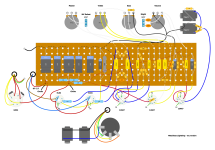
Here is a layout I drew to document most of the changes I made. As you can see the filtering is simplified and reduced a bit. The amp sounded a lot more lively after I did this. It was pretty nasty beforehand.

Lightning my version.png
 
Ceriatone Lightning was my main amp for years until I finally got a DZ-30, and I'll echo what everyone else says, the most likely culprit is bad tubes, so start by testing those. I agree that at that age it's a good idea to look around and possibly start swapping electros.

I will also say that looking at the guts it looks like it was more likely a kit build as the wiring doesn't look as tidy as Ceriatone's factory wiring, so definitely a good idea to inspect solder joints and such.
 
Back
Top