DEMO Rock Star Distortion (Colombo Rocker 83)

This post contains an audio or video demo

MichaelW

Well-known member
Build Rating
5.00 star(s)
I have to admit that I did not know what this pedal was about when I ordered it.
I just saw "Colombo" and figured I'd probably like it.

It wasn't until I went to go build it that I realized it was a "Rockman" style pedal. Now, I like Boston but I would not consider myself a "fan" by any means.
And Tom Scholz's sound is not something that I gravitate towards. Still it was an interesting and easy build for a Thursday afternoon:)

Compared to the other Rockman pedal in the shop, this one is MUCH simpler and has a lot less parts. Yet it definitely gets you into that "Rockman" super compressed sound. Only thing missing is the chorus that I had in my X100 back in the day.

The Rock Star has a 2 way toggle for a more aggressive sound and a more laid back sound. As expected, lots of gain on tap and the tone control can get into ear piercing trebles. The tone control also adds volume and gain and you turn it up.

It reminds me of a Rat in some sense. But it's also not a Rat.
I didn't really explore the lower gain settings too much. Is it a one trick pony? Maybe, but it's a pretty cool pony:)

I used the Tayda Candy Metallic enclosure. Man, this is really a pretty wild color.

Everything was built stock to the BOM except for the C22k pot hack. I added a parallel resistor to a C50k.

I recorded a short demo clip showing how it sounds (with some lame Boston licks that I could remember).
I also added my MBP TouchStone chorus to get the "full experience" hahah.

IMG_4333.JPG

IMG_4332.JPG


Woah holy saturated distortion! This thing sounds great! I find it fun buying a random circuit you know nothing of and it rocks your socks off. Even if it is a 1 trick pony that’s one cool trick! Awesome build as always!
 
I have to admit that I did not know what this pedal was about when I ordered it.
I just saw "Colombo" and figured I'd probably like it.

It wasn't until I went to go build it that I realized it was a "Rockman" style pedal. Now, I like Boston but I would not consider myself a "fan" by any means.
And Tom Scholz's sound is not something that I gravitate towards. Still it was an interesting and easy build for a Thursday afternoon:)

Compared to the other Rockman pedal in the shop, this one is MUCH simpler and has a lot less parts. Yet it definitely gets you into that "Rockman" super compressed sound. Only thing missing is the chorus that I had in my X100 back in the day.

The Rock Star has a 2 way toggle for a more aggressive sound and a more laid back sound. As expected, lots of gain on tap and the tone control can get into ear piercing trebles. The tone control also adds volume and gain and you turn it up.

It reminds me of a Rat in some sense. But it's also not a Rat.
I didn't really explore the lower gain settings too much. Is it a one trick pony? Maybe, but it's a pretty cool pony:)

I used the Tayda Candy Metallic enclosure. Man, this is really a pretty wild color.

Everything was built stock to the BOM except for the C22k pot hack. I added a parallel resistor to a C50k.

I recorded a short demo clip showing how it sounds (with some lame Boston licks that I could remember).
I also added my MBP TouchStone chorus to get the "full experience" hahah.

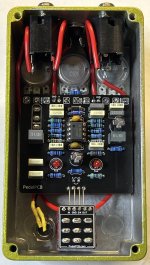
View attachment 43203

View attachment 43204


Killer tone! What guitar is that? I don’t recognize the cutaway.
 
Man that sounds great.. what are you playing the pedal through?
I'm using an amp-less rig in the video.
My pedal chain:
Polytune3 Tuner w/buffer
General Tso Compressor (always on setting)
Rock Star + TouchStone Chorus
Buffered side chain w/two delays and reverb
Then into a UAD Apollo Twin X using a Friedman Buxom Betty amp model on a very clean setting so the pedal does all the heavy lifting.

All the effects you hear are from pedals in front of the digital interface.
In software it's just the clean amp and a 1x12 cab IR.
 
New builder here. I've had the Rock Star on my wishlist but have been waiting for the build docs. How do you know what component values to use without the docs when they're not printed on the board? Thx
 
I have to admit that I did not know what this pedal was about when I ordered it.
I just saw "Colombo" and figured I'd probably like it.

It wasn't until I went to go build it that I realized it was a "Rockman" style pedal. Now, I like Boston but I would not consider myself a "fan" by any means.
And Tom Scholz's sound is not something that I gravitate towards. Still it was an interesting and easy build for a Thursday afternoon:)

Compared to the other Rockman pedal in the shop, this one is MUCH simpler and has a lot less parts. Yet it definitely gets you into that "Rockman" super compressed sound. Only thing missing is the chorus that I had in my X100 back in the day.

The Rock Star has a 2 way toggle for a more aggressive sound and a more laid back sound. As expected, lots of gain on tap and the tone control can get into ear piercing trebles. The tone control also adds volume and gain and you turn it up.

It reminds me of a Rat in some sense. But it's also not a Rat.
I didn't really explore the lower gain settings too much. Is it a one trick pony? Maybe, but it's a pretty cool pony:)

I used the Tayda Candy Metallic enclosure. Man, this is really a pretty wild color.

Everything was built stock to the BOM except for the C22k pot hack. I added a parallel resistor to a C50k.

I recorded a short demo clip showing how it sounds (with some lame Boston licks that I could remember).
I also added my MBP TouchStone chorus to get the "full experience" hahah.

View attachment 43203

View attachment 43204


Your build is beautiful. I am trying it myself, but am probably having a few beginner's issues. You stated you used the "C22k pot hack. I added a parallel resistor to a C50k." I am trying to figure this out, but struggling. I have a C50k pot, but can't find any info on the correct resistor to add in parallel, or to which pins. Additionally, I have not found the two black and grey circular items on your circuit. It looks like there is a peace sign in the middle. Thanks for any help.
 
Your build is beautiful. I am trying it myself, but am probably having a few beginner's issues. You stated you used the "C22k pot hack. I added a parallel resistor to a C50k." I am trying to figure this out, but struggling. I have a C50k pot, but can't find any info on the correct resistor to add in parallel, or to which pins. Additionally, I have not found the two black and grey circular items on your circuit. It looks like there is a peace sign in the middle. Thanks for any help.
Here you go, bookmark this site, I use it a lot:)


You add the resistor to the two outer pins of the pot. There's a couple of different ways to do it. You can solder in the pot and add the resistor to the solder points on the board. Or, the way I do it is just mount it on the bottom side of the post and push the pins of the resistor through the little square holes near the body of the pot.

"Black and gray circular items"? You mean the electrolytic capacitors?
 
Here you go, bookmark this site, I use it a lot:)


You add the resistor to the two outer pins of the pot. There's a couple of different ways to do it. You can solder in the pot and add the resistor to the solder points on the board. Or, the way I do it is just mount it on the bottom side of the post and push the pins of the resistor through the little square holes near the body of the pot.
Forgive my ignorance but what does the pot hack do? Are you just adding 22K on to the 50K?
 
Forgive my ignorance but what does the pot hack do? Are you just adding 22K on to the 50K?
No, the schematic calls for a 22k Pot. No one makes them (that I know of) available in the US. (I dunno maybe there are I didn't look too hard).
The "hack" brings the value of the pot from 50k down to 22k. A potentiometer is just a variable resistor. If you add two resistors together in series, say a 10k+ a 10k you get 20k. If you put two resistors in parallel 10k + 10k you get half the value (or 5k). So let's say I had a 50k resistor and wanted to make a 22k value, I would need to calculate what to add in parallel to make it 22k. You can do the math or be lazy like me and use the calculator I linked to:)

With potentiometers it's a little trickier because one of the resistors is "variable". (As you turn the pot it goes theoretically from 0k to 50k of resistance. There's also the pot taper to take into consideration as adding a parallel resistor can alter the taper as you turn it up and down.

If you really wanted to get say a 50k audio taper pot to function like a 22k audio taper and match the tapers correctly you would want to add TWO parallel resistors, each going from the outer pot leg to the inner pot leg, which is the "output" of the pot. But then the math gets even more complicated. I generally don't care too much about the taper as long as I can get to the sound I want, it doesn't matter too much to me if it's a little fiddly to get there with an altered taper.

Hope all this makes sense! There's a lot more smarter people than me here that could probably explain it better!
 
No, the schematic calls for a 22k Pot. No one makes them (that I know of) available in the US. (I dunno maybe there are I didn't look too hard).
The "hack" brings the value of the pot from 50k down to 22k. A potentiometer is just a variable resistor. If you add two resistors together in series, say a 10k+ a 10k you get 20k. If you put two resistors in parallel 10k + 10k you get half the value (or 5k). So let's say I had a 50k resistor and wanted to make a 22k value, I would need to calculate what to add in parallel to make it 22k. You can do the math or be lazy like me and use the calculator I linked to:)

With potentiometers it's a little trickier because one of the resistors is "variable". (As you turn the pot it goes theoretically from 0k to 50k of resistance. There's also the pot taper to take into consideration as adding a parallel resistor can alter the taper as you turn it up and down.

If you really wanted to get say a 50k audio taper pot to function like a 22k audio taper and match the tapers correctly you would want to add TWO parallel resistors, each going from the outer pot leg to the inner pot leg, which is the "output" of the pot. But then the math gets even more complicated. I generally don't care too much about the taper as long as I can get to the sound I want, it doesn't matter too much to me if it's a little fiddly to get there with an altered taper.

Hope all this makes sense! There's a lot more smarter people than me here that could probably explain it better!
Very very interesting. I certainly learned something! Thanks so much for replying!
 
Back
Top