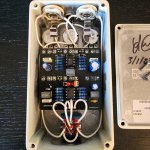
Trembling Loon build w/ question

GettyImages-172788666-scaled-2554x1703.jpg


Now, that's clean.
 
Looks good.


Bright... Try increasing C4 to lose some brightness. I'd start by doubling it and see if that does the trick — adjust up or down from there. Since parallel caps sum, you could either alligator clip on another 330p or whatever value and see if it does the trick. When you find the correct value, tack-solder it on to the existing C4 cap. Minimal muss no fuss.


Mark's Stupidly Wonderful Tone Control is also a candidate, though it's most oft used for taming shrill dirt pedals; Aion's Flare would be a good example of how to implement the SWTC without having to alter your Loon's existing circuitry — basically you could add it between the output of the loon and the 3PDT bypass. If you use a trimmer you won't have to drill another hole in your enclosure either.


I would've thought this circuit is set up for "what goes in comes out" tone-wise; so another non-invasive method — maybe add some EQ before or after the Loon.
 
TY, Feral!! I'll try the C4 replacement first and see if that does the trick! The Loon is very bright for some reason. Also, the gain pot is interesting. Unity gain is like 3k and the pot is 25k... I think the original lune gain pot is 10k so I'm not sure what's going on there. Thank you so much for the help!!!!!
 
TY, Feral!! I'll try the C4 replacement first and see if that does the trick! The Loon is very bright for some reason. Also, the gain pot is interesting. Unity gain is like 3k and the pot is 25k... I think the original lune gain pot is 10k so I'm not sure what's going on there. Thank you so much for the help!!!!!
The C4 increase would be good, could probably get away with 1n - 2.2n in that spot
You could also reduce the value of R3 to something like 470k. This will also reduce the input impedance, but will take some of the edge off of the signal entering the circuit.
 
The C4 increase would be good, could probably get away with 1n - 2.2n in that spot
You could also reduce the value of R3 to something like 470k. This will also reduce the input impedance, but will take some of the edge off of the signal entering the circuit.
OK I'll give these values a try and see what happens :) Would increasing C3 be of any help?
 
OK I'll give these values a try and see what happens :) Would increasing C3 be of any help?
While it  might change the frequency roll off a bit, I doubt it'd be noticeable. But, the 100n is basically already letting all the worthwhile frequencies through

Given the signal path is so simple, there's not a whole of places to really change much, unless you want to tack solder components to the board.

EDIT- increasing R4 would also be beneficial to rolling off some highs. Could try a 100k pot (wired as a variable resistor) in that spot, and find the sound you like most, then solder in the closest value resistor you have on hand. If you go this route, I'd recommend leaving R3 at 2.2M

 
Last edited:
While it  might change the frequency roll off a bit, I doubt it'd be noticeable. But, the 100n is basically already letting all the worthwhile frequencies through

Given the signal path is so simple, there's not a whole of places to really change much, unless you want to tack solder components to the board.

EDIT- increasing R4 would also be beneficial to rolling off some highs. Could try a 100k pot (wired as a variable resistor) in that spot, and find the sound you like most, then solder in the closest value resistor you have on hand. If you go this route, I'd recommend leaving R3 at 2.2M
Sweet!!! Thank you!!!!!!! Gonna try them now!!
 
Back
Top