
You are using an out of date browser. It may not display this or other websites correctly.
You should upgrade or use an alternative browser.
You should upgrade or use an alternative browser.
Ever seen these before?
- Thread starter swelchy
- Start date

Cybercow
Well-known member
Yeah, I've read about them but have never gotten my hands on any. Light/dark changes can alter their operation with regard to current flow. See what changes when measuring them when one is covered with black heatshrink to block any light.
I have several NOS Mullard OP71 black glass which are basically OCP71s that failed the light control quality testing.
Here's a link to some OCP71 Info
I have several NOS Mullard OP71 black glass which are basically OCP71s that failed the light control quality testing.
Here's a link to some OCP71 Info


swelchy
Well-known member
I don’t quite understand what they were developed for but the just was the HFE changes when exposed to light….. I haven’t put them in circuit yet but I assume they do not emit light and only react to it…Basically they were top quality OC71’s… not bad for a 1.50 each for a nice germaniumWow. That looks interesting. Maybe this is a dumb question, but do they light up at all when amplifying a signal or anything?
Cybercow
Well-known member
No, they do not emit light. Rather, they are directionally sensitive to light.Wow. That looks interesting. Maybe this is a dumb question, but do they light up at all when amplifying a signal or anything?
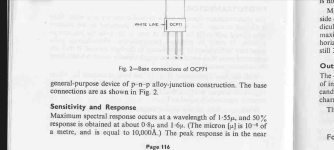
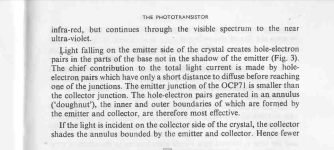
From the linked document: "Maximum current is obtained when the light is allowed to fall on the side of the bulb bearing the type number, in a direction perpendicular to the plane of the leads. The response is about 50% of the maximum, when the light is incident at 90° to this direction int he horizontal plane. If the light falls vertically downwards, the response is still 30% of the maximum."
Cybercow
Well-known member
Intriguing concept there. I imagine with an LFO driven LED up against and pointed at the correct spot on the OCP71, a fuzz could be toyed with.Can you control the fuzz with an LFO? That would be interesting.
EDIT (additional thought): If two OCP71s in a fuzz circuit each had an LFO driven LED next to it, pointed at the right spot, a sort of tremolo-fuzz might be obtainable. Or say three OCP71s in a Burns Buzz Around fuzz circuit, all three having an LFO driven LED next to it pointed at the right spot, an interesting mod to the BBA could be had.
Now I wonder if that OCP71 resource is still available or depleted. (???)
Last edited:
UV/IR clipping diodes bent and sandwiched between the two gain stages is where my head goes.
Could try it with some reds and water clears of course. Idk what spectrum these would react to...
Easy enough to test.
Then you have an "Original Design Reactive and Dynamic Germanium Fuzz" you can sell for $7000 that's a big muf with half the diodes pulled out(ignoring NPN/PNP).
I've thought about this with LDRs on emitters but never gotten around to toying with it.
Could try it with some reds and water clears of course. Idk what spectrum these would react to...
Easy enough to test.
Then you have an "Original Design Reactive and Dynamic Germanium Fuzz" you can sell for $7000 that's a big muf with half the diodes pulled out(ignoring NPN/PNP).
I've thought about this with LDRs on emitters but never gotten around to toying with it.
Cybercow
Well-known member
I'm thinking white light LEDs would be optimal for OCP71s. Back when OCP71s were made, LEDs did not exist and they had only natural and bulb lights to work with. Still, experimenting with different colored LEDs is warranted as an investigatory exercise. I just ordered 10 from what appears to be a reliable UK seller.UV/IR clipping diodes bent and sandwiched between the two gain stages is where my head goes.
Could try it with some reds and water clears of course. Idk what spectrum these would react to...
Easy enough to test.
Then you have an "Original Design Reactive and Dynamic Germanium Fuzz" you can sell for $7000 that's a big muf with half the diodes pulled out(ignoring NPN/PNP).
I've thought about this with LDRs on emitters but never gotten around to toying with it.

KR Sound
Well-known member
Looking forward to see what you come up with. There’s a bunch of new ones out there that would be interesting to experiment with also
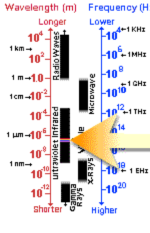
What spectrum were they originally designed to react too?I'm thinking white light LEDs would be optimal for OCP71s. Back when OCP71s were made, LEDs did not exist and they had only natural and bulb lights to work with. Still, experimenting with different colored LEDs is warranted as an investigatory exercise. I just ordered 10 from what appears to be a reliable UK seller.
Im not certain, but I believe tubes emit a ton of IR spectrum. If they were designed to work with tubes, that may be better...
I also suggested IR and UV because of the higher Vf. Let those trannies sing
And, maybe, with the right resistance and current balance, you can ride the Vf of the diodes where the signal sits in the curve
These with the correct circuit, LEDs and maybe LDRs could make something really new. If you really think about it, you could build some very reactive circuits.
And "new" is hard to say in THIS world. I had no idea of their existence. Going to go dig up the data sheet and burn 20 minutes.
Would anyone care to post or PM me a reputable supplier?
Maybe I'll get extra bored this winter.
If nothing else, maybe I'll get lucky enough to get something functional enough to be exciting and stick it in @bean s mailbox.
And "new" is hard to say in THIS world. I had no idea of their existence. Going to go dig up the data sheet and burn 20 minutes.
Would anyone care to post or PM me a reputable supplier?
Maybe I'll get extra bored this winter.
If nothing else, maybe I'll get lucky enough to get something functional enough to be exciting and stick it in @bean s mailbox.


drgonzo1969
Well-known member
kinda like the expandora?
Cybercow
Well-known member
I found this highly rated seller on eBay, ordered 10 of them myself just yesterday and already received a shipping notice. Claims to have more than a few.Would anyone care to post or PM me a reputable supplier?
Cybercow
Well-known member
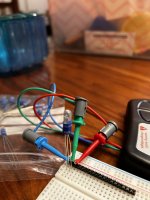
Just received a batch NOS Mullard OCP71 opto-transistors and ran some tests with a Peak Atlas DCA75 and some hand-held water-clear blue LEDs. . . .
They all test between 68 and ~80 HFe and a leakage of about 0.200 mA with a bit of heatshrink covering them. They tend to measure about the same in standard room lighting with no heatshrink over them. (I use daylight bulbs over my bench.)
When I hand hold a lit blue LED directly in front of the tiny plate inside the OCP71s with no heatshrink over them, they fall to a single-digit HFe of about 5 to 7 with an exponential increase in leakage.
With that information, one might assume that a carefully controlled LFO driven LED blue could modulate the gain on them for some interesting effects.
I've yet to breadboard a controllable LFO to test the theory. But there it is.
They all test between 68 and ~80 HFe and a leakage of about 0.200 mA with a bit of heatshrink covering them. They tend to measure about the same in standard room lighting with no heatshrink over them. (I use daylight bulbs over my bench.)
When I hand hold a lit blue LED directly in front of the tiny plate inside the OCP71s with no heatshrink over them, they fall to a single-digit HFe of about 5 to 7 with an exponential increase in leakage.
With that information, one might assume that a carefully controlled LFO driven LED blue could modulate the gain on them for some interesting effects.
I've yet to breadboard a controllable LFO to test the theory. But there it is.
Similar threads

- Replies
- 2
- Views
- 135


