Fortunately my two favourite types of tremolo don't rely on vactrols. The Strymon Flint is (I believe) fully digital and does an excellent bias tremolo simulation, and my all-time fave tremolo is in fact the bias tremolo in my Brown Deluxe, 5F11 Vibrolux, etc. Yeah I know they have their limitations but they way I use 'em they sound fantastic, and I much prefer them over roach trem.
I have to admit that my favorite tremolo is the tremverb setting on the SA Ventris. It's just perfect for moody "southwest desert sound", with a slide, right after a compressor and an ever so slightly cracked valve sound. A reverb after the Delta-Trem needs that additional tweaking that I don't often feel like doing when wanting to play right away. Just three pedals into the amplified desktop speakers and I'm ready to go.
Have to look up that circuit in your Brown. Never heard of it.

Edit: Origin Effects has a pedal modelled after it... "First released in 1961, this modest, little amp is still one of history’s most sought-after guitar tones, thanks largely to its tremolo circuit. Bias tremolo is considered by many to be the most musical of all the tremolo types due to its natural, pulsating character. Because the tremolo acts on the amp’s output valves, overdriven sounds will let you “play through” the tremolo. The effect disappears when you pick hard, slowly fading back in as the note dies away – you can control the tremolo effect with your picking dynamics or your guitar’s volume knob!"
Edit: Oh, my Delta-Trem is actually based on this as well.

"As with all Effectrode pedals, vacuum tubes play an intrinsic role in generating the effect, however another vital component is also involved here, a long forgotten, archaic electronic device known as a ‘Raysistor‘. The Raysistor enables the Delta-Trem to reproduce smooth volume fluctuations, like the ‘bias’ tremolos found in the early Fender® ‘Tweed’ Tremolux guitar amps, and also the deeper throb of the ‘optical’ (neon/photocell) tremolo of their later ‘Blackface’ Deluxe Reverb and Twin Reverb amplifier models. But the Raysistor can do much more than merely replicate bias and optical tremolo… with the right kind of LFO."
"Unfortunately
Raytheon are no longer in the business of manufacturing Raysistors (or
sub-miniature tubes for that matter) and NOS Raysistors are rarer than hen’s teeth. The closest matching device available today is the ‘opto-coupler’, which consists of an LED (Light Emitting Diode) and an photocell housed together in a single epoxy case. However, an LED is an extremely efficient light emitter, too efficient in fact, making that fine control for super-smooth tremolo impossible. The filament bulb really was the only device suitable for achieving the smooth tremolo effects we were looking for. So we set to work developing our own custom Raysistor based on a 3mm ‘grain of wheat’ bulb and
cadmium sulphide photocell. These two electronic components were specially chosen to give the
Delta-Trem range and versatility. The tiny filament light bulb has very low thermal mass, meaning the light can be switched on and off rapidly to mimic the neon lamp in optical tremolo;
and it can also be turned on and off slowly too, where its brightness transitions more gradually, replicating the smoothness of bias tremolo circuitry." (
https://www.effectrode.com/knowledge-base/delta-trem-in-depth/)



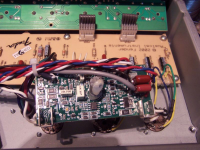


 , but google is not revealing anything to that effect.