You are using an out of date browser. It may not display this or other websites correctly.
You should upgrade or use an alternative browser.
You should upgrade or use an alternative browser.
What’s on *YOUR* workbench?
- Thread starter Bricksnbeatles
- Start date

steviejr92
Authorized Vendor
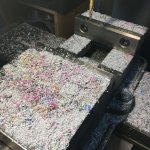
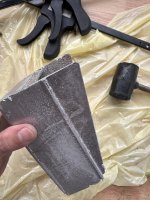
I was soooo close 
These little green Russian enclosures are proving to be a challenge!!

These little green Russian enclosures are proving to be a challenge!!

Robert
Reverse Engineer
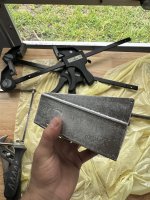
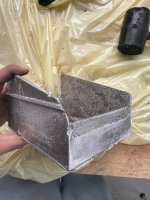
I was soooo close
These little green Russian enclosures are proving to be a challenge!!
But maaaan when you get those last little wrinkles ironed out.....

steviejr92
Authorized Vendor
I know i can get better! Im already making another core to try again!But maaaan when you get those last little wrinkles ironed out.....

drew.spriggs
Well-known member
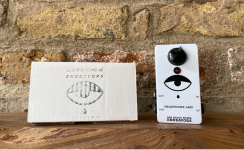
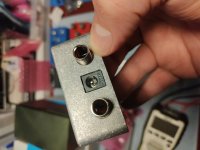
...it's literally just a Ruby clone with some very, very bad design decisions. Rather unsurprisingly the owner said he's had it repaired twice over the last few years and it keeps on breaking. Noticed both the output jacks are very weird - they don't work with any of my mono or stereo 1/4" cables unless they're only 3/4 inserted, and the entire layout/component choices leave a lot to be desired.
drew.spriggs
Well-known member
View attachment 101847
...it's literally just a Ruby clone with some very, very bad design decisions. Rather unsurprisingly the owner said he's had it repaired twice over the last few years and it keeps on breaking. Noticed both the output jacks are very weird - they don't work with any of my mono or stereo 1/4" cables unless they're only 3/4 inserted, and the entire layout/component choices leave a lot to be desired.
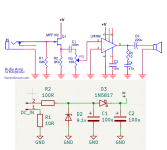
For posterity: it's this with two parallel output jacks instead of a speaker. Yes, that bizarre power layout is what it is from factory.
- removed the resistor to ground from the jack
- replaced the Zener with a 100nf MLCC
- increased the main filter cap to 220uf
- removed the additional 100uf capacitor
- changed the buffer to 2N5457/3k3
- changed the 386N1 to a N4 (I don't know if the N1 was original or not).
- increased C3 to 10uf (so it's actually doing something)
- replaced all the jacks with Neutrik ones so they actually work.

Aleph Null
Well-known member
Time to make this Weeble wobble!

Erik S
Well-known member
Good nameView attachment 101857
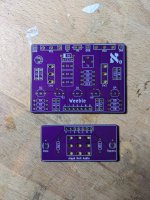
Time to make this Weeble wobble!

jessenator
Well-known member
Exercising my paradoxical relationship with vocational masochism.

Lots going on here:
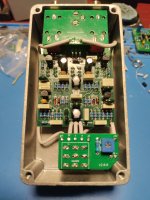
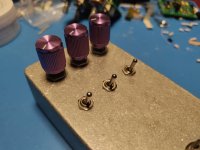
I've been experimenting with I/O and using identical control layouts/patterns. I expected to only have 2, 3, or 4 control points, but this one is pushing the 1590B with 6
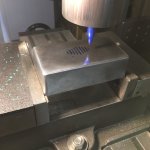
This box is my proto enclosure, so it has jank and no polish, btw, so it's function all the way down. Thankfully my nephew has a mill and we can work relatively quickly to refine things.
I wanted to see if I could fit my new darling circuit into the B sized box; the Kewpie. I've affectionately called this the KewBie.
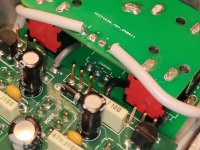
I if course had to resort to 1/8W footprint resistors, submini switches, and 9mm pots (more on that later) and it's density is extra thicc, but still doable. I actually did a unique layout for it at first, but it necessitated the switches traveling on the horizontal, which bugged me, so I ended up modifying Robert's, scaling and shuffling where I needed to.
Having kicke mucked about in 3D helped a lot, but for this round I didn't want to take any chances, so I made up a breakout board for the pots. Unfortunately I measured from what I thought was an Alpha pot, but did not match the actual ones I bought. Still, progress.
The board was also a necessity because the tolerance between the pots and the jacks from the I/O was maybe 2mm in CAD (turned out to be barely that in practice). The milling is required to have the pot sit completely flat, clipping excess pin material.
In the end this doesn't need a breakout board… the height of both the switches and the pots will work out perfectly. Just some wasted board area will be required.
Additionally, I experimented with a tighter fit for component vias, and it makes soldering without additional flux ugly looking, as seen on the PCB pics.
But it all works as intended!
PS, before anyone grumbles, I messaged Robert about this.
Lots going on here:
I've been experimenting with I/O and using identical control layouts/patterns. I expected to only have 2, 3, or 4 control points, but this one is pushing the 1590B with 6
This box is my proto enclosure, so it has jank and no polish, btw, so it's function all the way down. Thankfully my nephew has a mill and we can work relatively quickly to refine things.
I wanted to see if I could fit my new darling circuit into the B sized box; the Kewpie. I've affectionately called this the KewBie.
I if course had to resort to 1/8W footprint resistors, submini switches, and 9mm pots (more on that later) and it's density is extra thicc, but still doable. I actually did a unique layout for it at first, but it necessitated the switches traveling on the horizontal, which bugged me, so I ended up modifying Robert's, scaling and shuffling where I needed to.
Having kicke mucked about in 3D helped a lot, but for this round I didn't want to take any chances, so I made up a breakout board for the pots. Unfortunately I measured from what I thought was an Alpha pot, but did not match the actual ones I bought. Still, progress.
The board was also a necessity because the tolerance between the pots and the jacks from the I/O was maybe 2mm in CAD (turned out to be barely that in practice). The milling is required to have the pot sit completely flat, clipping excess pin material.
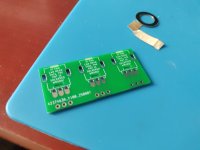
In the end this doesn't need a breakout board… the height of both the switches and the pots will work out perfectly. Just some wasted board area will be required.
Additionally, I experimented with a tighter fit for component vias, and it makes soldering without additional flux ugly looking, as seen on the PCB pics.
But it all works as intended!
PS, before anyone grumbles, I messaged Robert about this.
Aleph Null
Well-known member
Do you hear that?! It's the 1590N1 calling out to you! Come find solace for your circuits in its spacious embrace!I expected to only have 2, 3, or 4 control points, but this one is pushing the 1590B with 6

Feral Feline
Well-known member
This face plate is a single-layer PCB I had fabricated by JLCPCB.


Editor for hire, here, reasonable rates*...
@Band of Dans — would love to hear the story of why "you're" friend wants a grammatically incorrect pedal...
Oh, and a Discount Editing-Rate for your friend... damn. Now I'll have to offer Aleph Null a discount, too.
*Will edit for PCBs...

Aleph Null
Well-known member
@Feral Feline
Holy shit! That's from almost a year ago and I never noticed it. It doesn't help that you have to convert the text to a graphic so that you can make a hole in the solder mask. Guess I'll add corrected face plates to my next PCB order...
Holy shit! That's from almost a year ago and I never noticed it. It doesn't help that you have to convert the text to a graphic so that you can make a hole in the solder mask. Guess I'll add corrected face plates to my next PCB order...
Last edited:
jessenator
Well-known member
You done got SACUEd!never noticed it.

JohnnyCreepy
Well-known member
I tweaked my Drone master/rat pedal with IC change. Before IC1 was ca3140 and IC2 had metal can 741, now it’s NOS lm308n in IC1 and ca3140 moved for IC2. But I noticed I’ve played this circuit for a year enclosure shield lead missing from star gnd. Was a quick fix, but imma dum dum… 
Edit. and I finally fixed a table saw I got as a freebie. Was missing one bolt for locking table flip and handle switch needed cleaning and lube. Now it’s only missing side guide.
Edit. and I finally fixed a table saw I got as a freebie. Was missing one bolt for locking table flip and handle switch needed cleaning and lube. Now it’s only missing side guide.
Last edited:


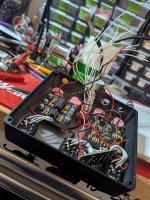
I had a Low tide mini I built a few years back where I stuck a 2.5 centre pin power jack rather than the 2.1 it needed... it also was a bit noisy.
Last night took it to bits, switched the jack, replaced the Jfets (I suspected they were the cause of noise given my dodgy SMD soldering), re-biased (I think) and reset the gate - so much better and so much less noise - it may have been the bias on the BBD was out but it sounds great now - still a bit daft on bass but hey!

Last night took it to bits, switched the jack, replaced the Jfets (I suspected they were the cause of noise given my dodgy SMD soldering), re-biased (I think) and reset the gate - so much better and so much less noise - it may have been the bias on the BBD was out but it sounds great now - still a bit daft on bass but hey!